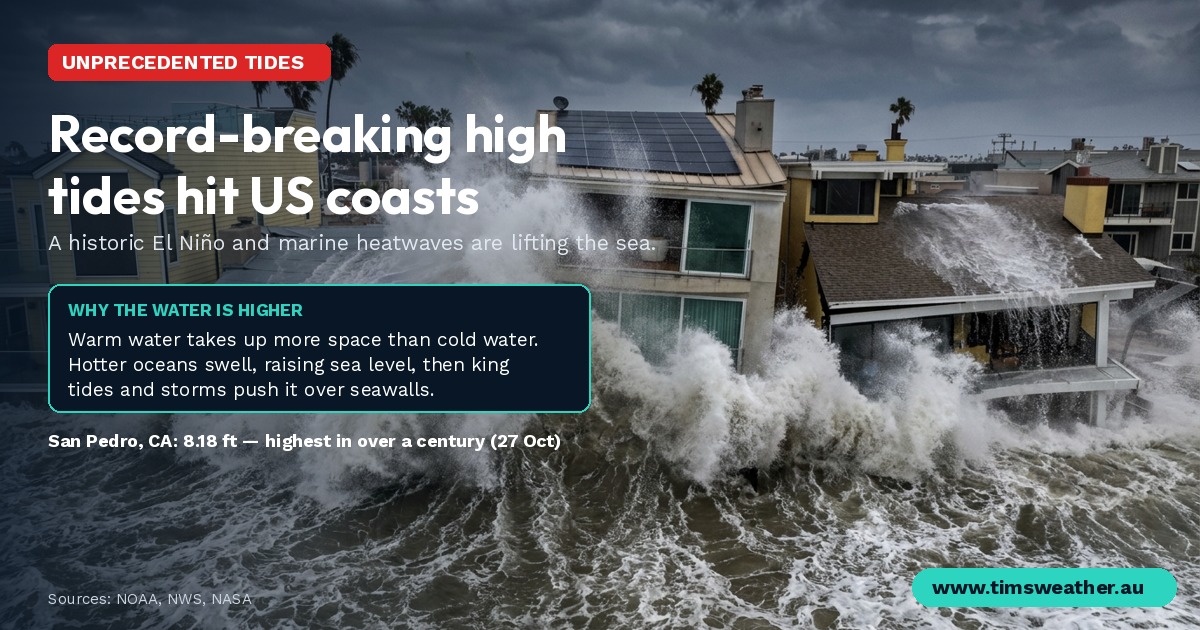
Record high tides flooded coastal communities in Southern California and South Florida on 26 and 27 October 2026, with the San Pedro tide gauge in Los Angeles Harbor reaching about 8.18 ft, its highest reading since records began in 1923. Scientists say a historic El Niño and record-warm ocean water lifted the sea before the king tides arrived, making these floods unprecedented at several gauges.
This article explains what happened, why warm water raises sea levels, and why forecasters expect more coastal flooding this northern winter.
Where did the record high tides hit?
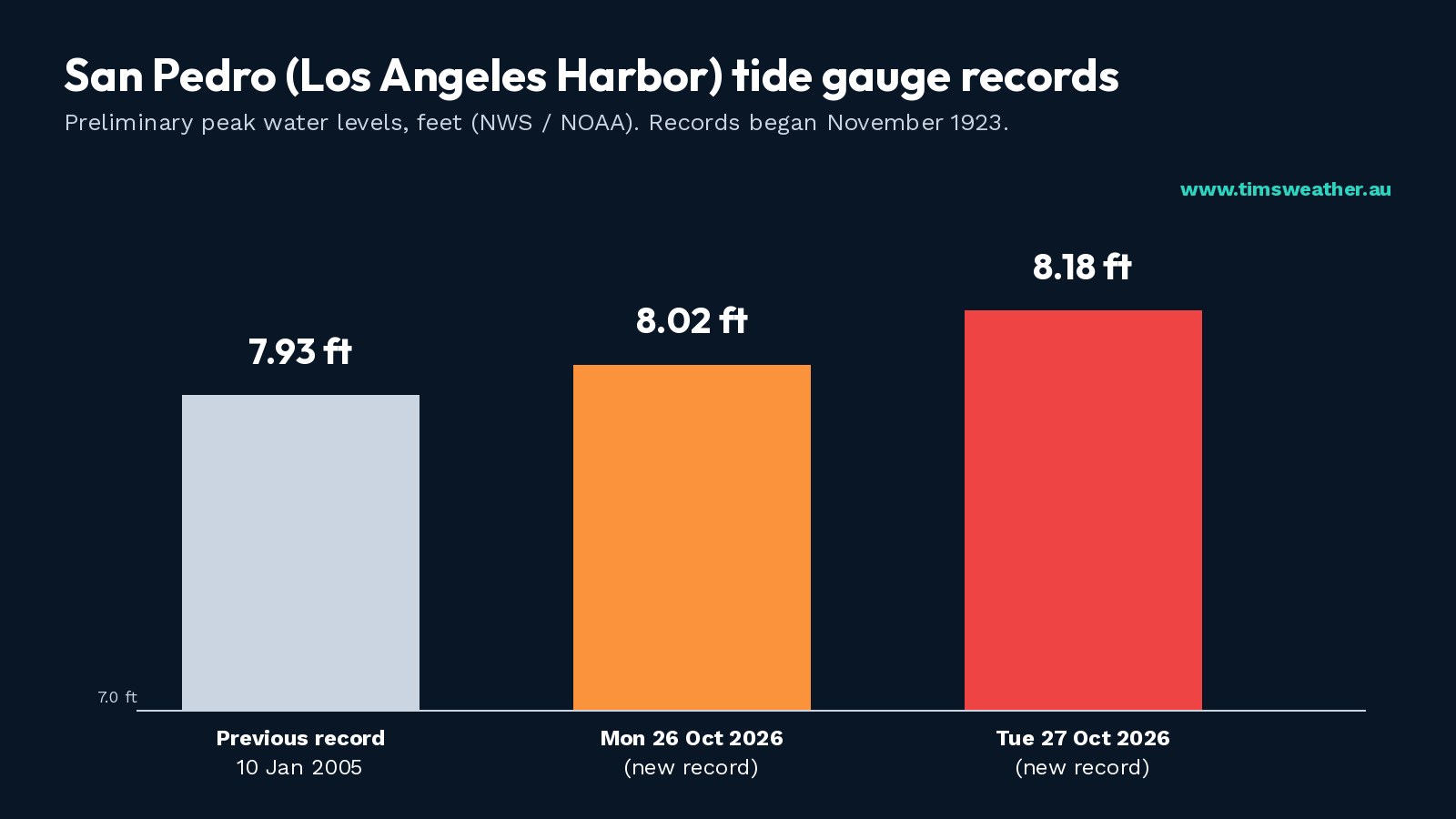
The biggest records fell along the Los Angeles and Orange County coasts. A preliminary 8.02 ft reading at San Pedro on Monday 26 October broke the old record of 7.93 ft from 10 January 2005, and Tuesday's tide went higher again (ABC7).
Key facts at a glance
San Pedro, California: about 8.18 ft on 27 October, a record in more than a century of data (LAist)
Other California records: La Jolla and Santa Barbara gauges also set records
Newport Beach: streets and homes on the Balboa Peninsula flooded; parts of Pacific Coast Highway closed in Huntington Beach
Miami, Florida: new high-water records were reported on four of five days (USA Today)
Warnings: the National Weather Service kept coastal flood warnings and advisories in place until Thursday 29 October
Why are the tides so high? Warm water takes up more room
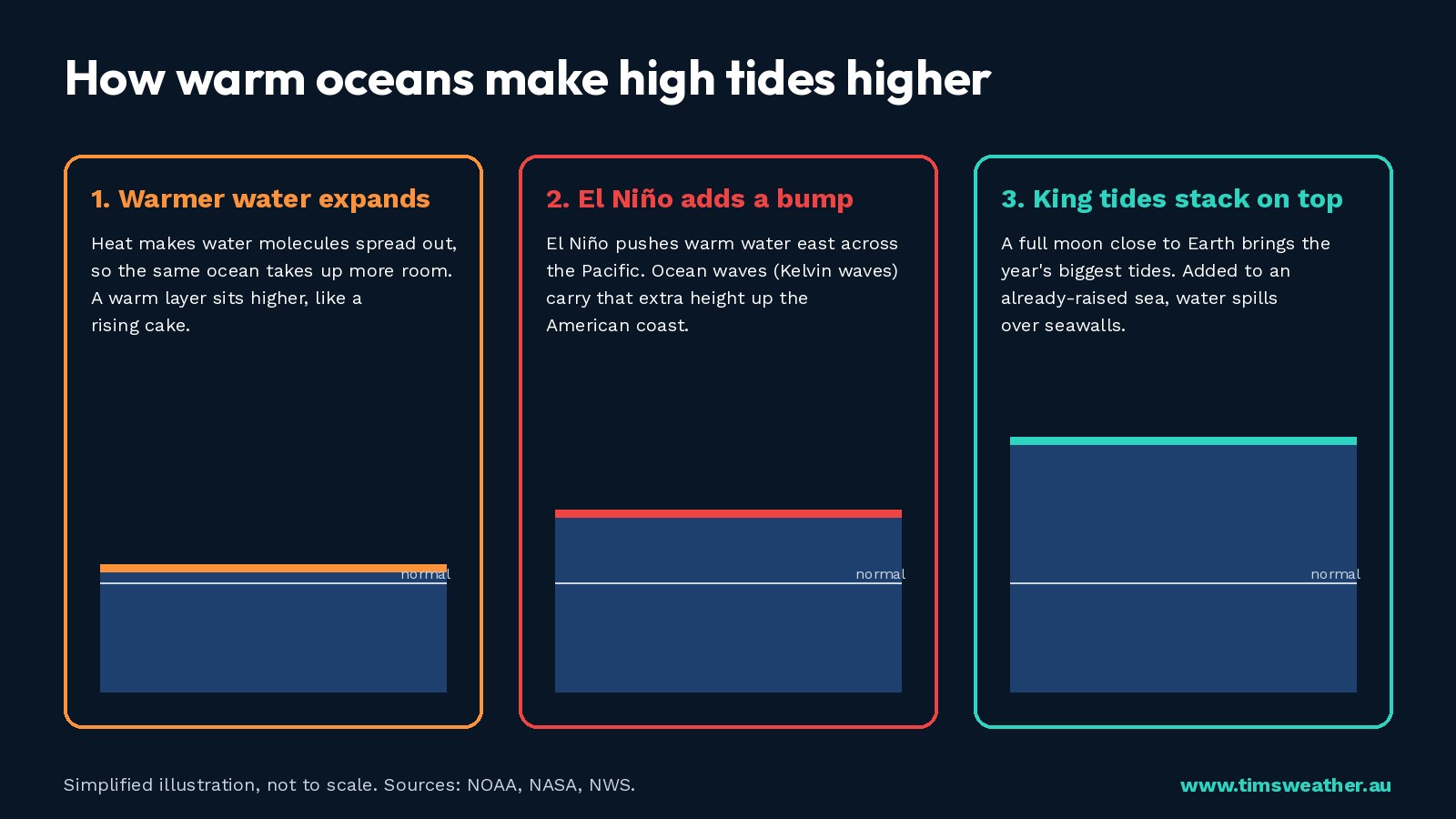
The simplest reason is that warm water expands. When seawater heats up, its molecules move faster and spread apart, so the same amount of water fills more space. Across a deep layer of ocean, that small swelling adds up to a noticeably higher sea surface. Scientists call it thermal expansion.
Ocean temperatures off Southern California have been running at record levels during this El Niño, and the Los Angeles Times reports that this hot water is the key difference from past El Niño years.
How El Niño and king tides stack up
Marine heatwaves: long spells of unusually hot ocean water expand the upper ocean.
El Niño: weakened trade winds let warm water slosh east across the Pacific. Slow ocean waves called Kelvin waves carry that raised water up the American coast.
King tides: the full Hunter's Moon near its closest point to Earth produced some of the year's highest astronomical tides.
Offshore storms and swell: waves and onshore winds pushed water further over seawalls and beaches.
Observed water levels ran roughly 1.5 to 1.8 ft above the tide predictions in parts of Southern California, according to reported gauge comparisons.
Are these high tides unprecedented?
At San Pedro, yes: no higher water level has been measured there since November 1923. The records are preliminary until NOAA checks the gauge data. Long-term sea level rise, which NASA tracks by satellite, also means each big tide now starts from a higher baseline than in past decades.
What happens next?
Scientists quoted by LAist describe this week as a preview. The year's highest astronomical tides are still weeks away, and El Niño typically peaks over the northern winter, so more coastal flooding is likely if storms coincide with king tides.
Does this affect Australia?
El Niño affects Australia very differently. It usually brings warmer water to the eastern Pacific, not to our coast, and often means drier conditions in eastern Australia. Read our 2026/27 Australian cyclone and wet season outlook for what this El Niño may mean here, check local historical rainfall, and see our weather glossary for terms such as El Niño and storm surge.
Staying safe during coastal flooding
Never drive or walk through floodwater; seawater can hide debris and strong currents.
Stay well back from seawalls and rock platforms at high tide.
Follow official warnings: the US National Weather Service in the United States, or the Bureau of Meteorology in Australia.
Tide data: NOAA Tides & Currents. Figures are preliminary and may be revised.
Planning weeks ahead?
Check Australia's long-range seasonal outlook for rainfall, temperature and the climate drivers (ENSO, IOD, SAM, MJO) shaping the next three months.
View Australia's Seasonal Weather Forecast