
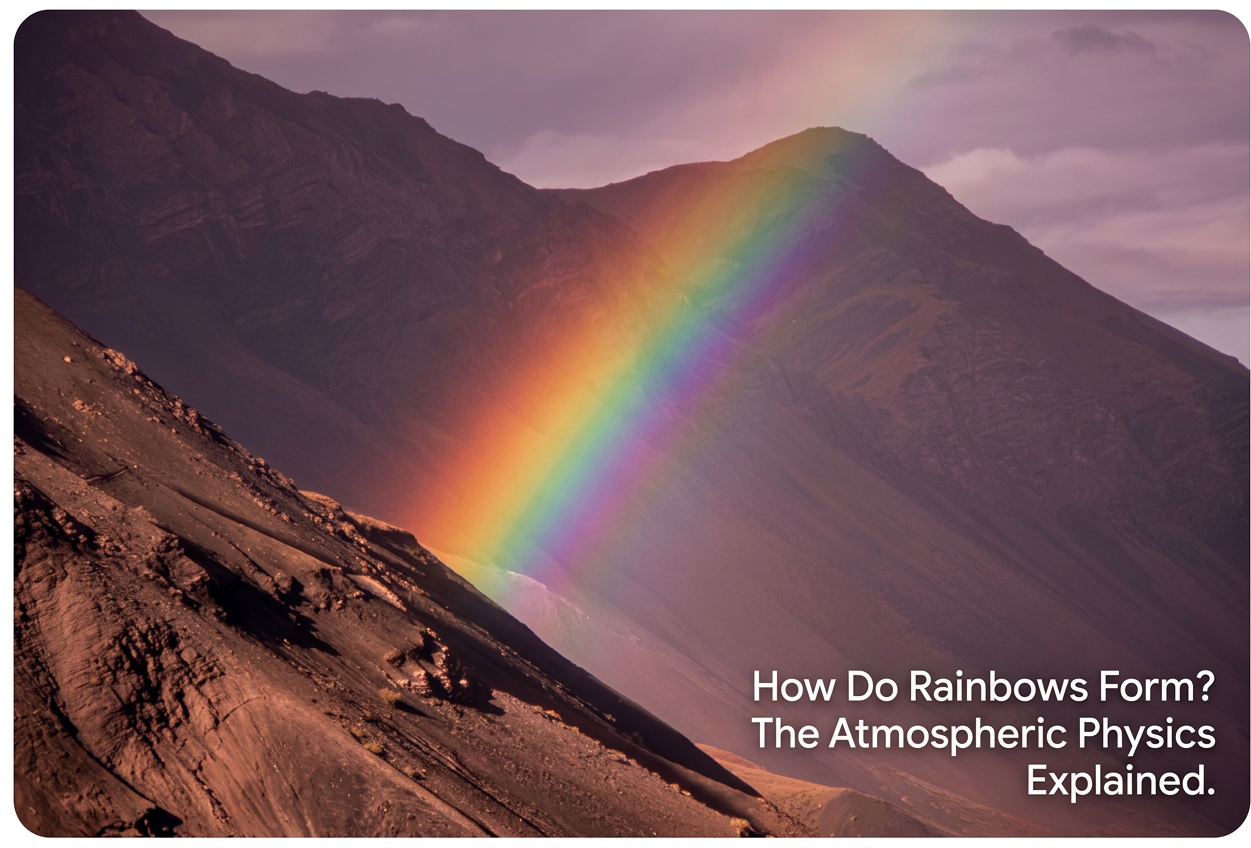
How do rainbows form? A rainbow forms when sunlight enters suspended water droplets, slowing down and bending through refraction. The light reflects off the back interior wall of the droplet, undergoes dispersion into a spectrum of colours, and refracts again as it exits, reaching the observer's eye at a precise 42-degree angle.
Key takeaways
- Rainbows require sunlight and suspended water droplets to align perfectly in the atmosphere simultaneously.
- The visual phenomenon relies entirely on light refraction, total internal reflection, and the dispersion of sunlight into distinct wavelengths.
- The sun must always sit behind the observer, with the rain, mist, or fog located directly in front of them.
- Droplet physical size determines the visual intensity, with larger tropical raindrops producing the brightest and thickest colour bands.
- Double rainbows occur when light reflects twice inside the water droplet, which creates a fainter secondary arc and reverses the colour sequence.
The physics of how do rainbows form
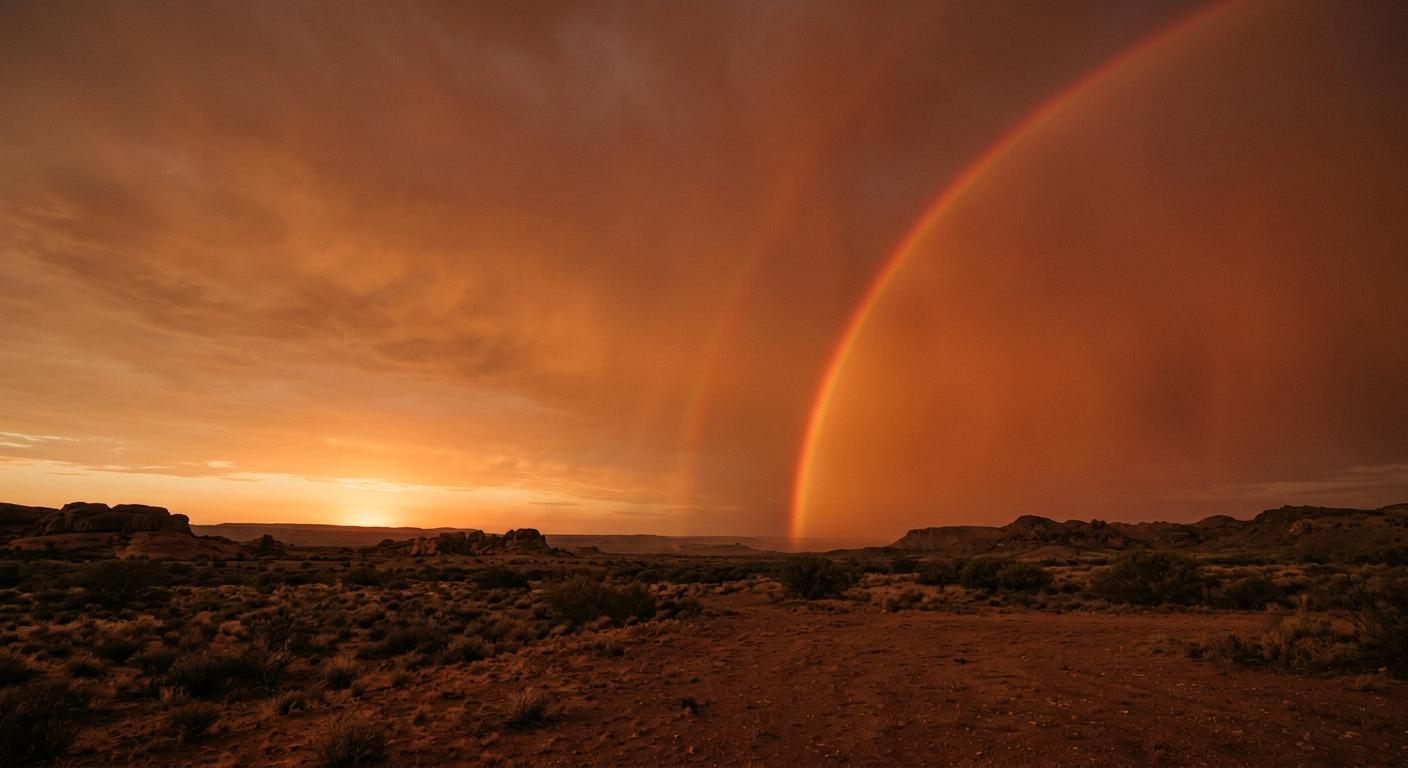
A rainbow is not a physical structure located at a specific set of coordinates in the sky. It is a highly specific optical phenomenon that depends entirely on the geometric relationship between the observer, the light source, and atmospheric moisture. The scientific explanation of rainbow formation begins with understanding the physical nature of visible light. Sunlight appears white to the human eye, but it actually contains every colour in the visible light spectrum. This spectrum is a specific band of electromagnetic radiation that our eyes are equipped to process, ranging from red wavelengths at roughly 700 nanometres down to violet wavelengths at approximately 400 nanometres.
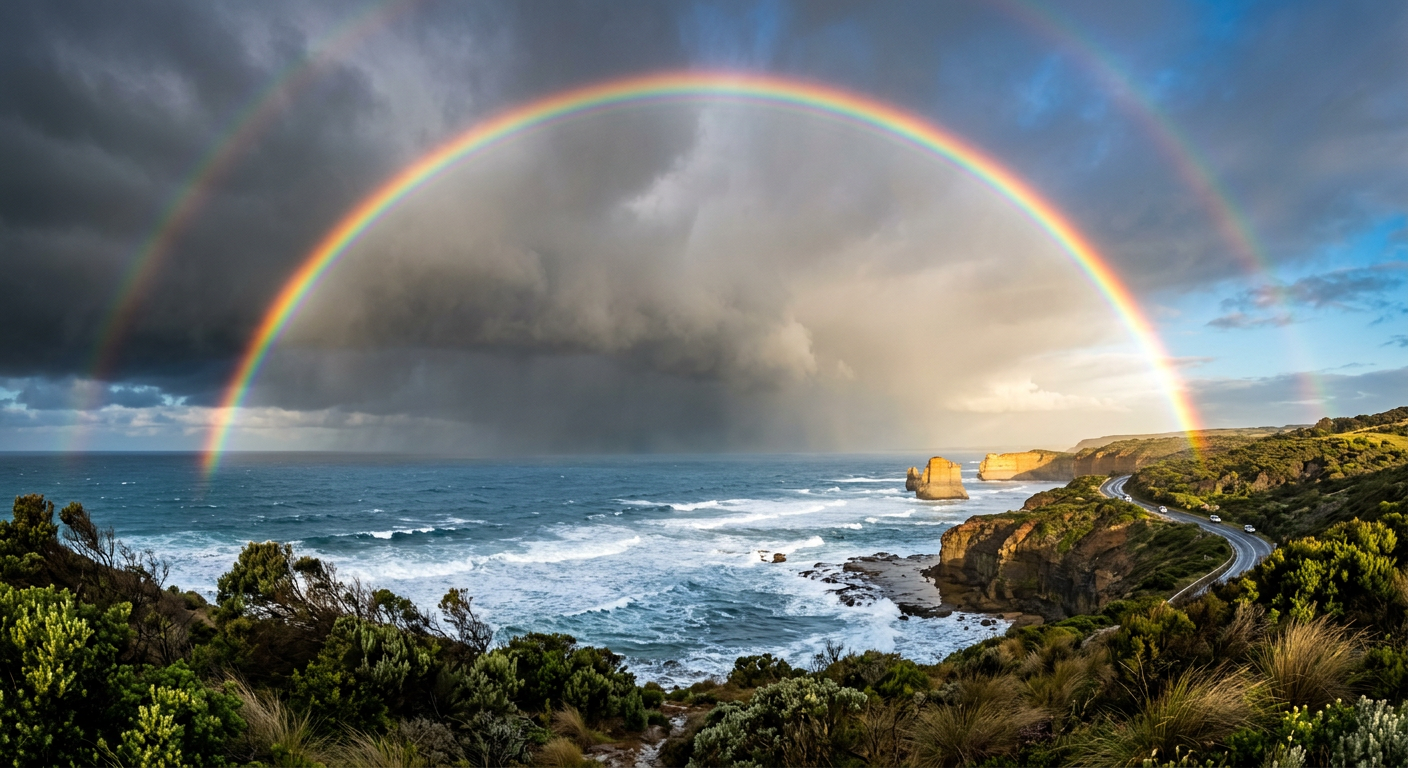
When this white light passes from the thin atmosphere into the denser medium of liquid water, its travelling speed decreases. This sudden change in velocity causes the light waves to bend, a fundamental physics process known as the refraction of light. The concept was heavily studied in the 17th century. In his historical 1704 work 'Opticks', physicist Isaac Newton demonstrated that white light could be split into its component colours using a solid glass prism. A suspended spherical raindrop acts in much the same way as Newton's prism, but with additional internal reflections that redirect the separated light back toward the viewer, as explained by National Geographic Education.
Because different colours possess different wavelengths, they respond to the refractive index of liquid water uniquely. Red light features longer wavelengths and bends the least as it enters and exits the water surface. Violet light features shorter wavelengths and bends the most aggressively. This differential bending is called the dispersion of sunlight. The process effectively separates the white light into the familiar continuous bands of red, orange, yellow, green, blue, indigo, and violet. Meteorological definitions provided by the American Meteorological Society Glossary of Meteorology confirm that these exact physical conditions dictate exactly what we observe during a shower.
What are the three steps to form a rainbow?
The three essential steps required to form a primary rainbow are refraction, total internal reflection, and a second refraction. Initially, direct sunlight strikes a suspended water droplet and refracts upon entry, which begins the critical process of separating the light into distinct wavelengths.
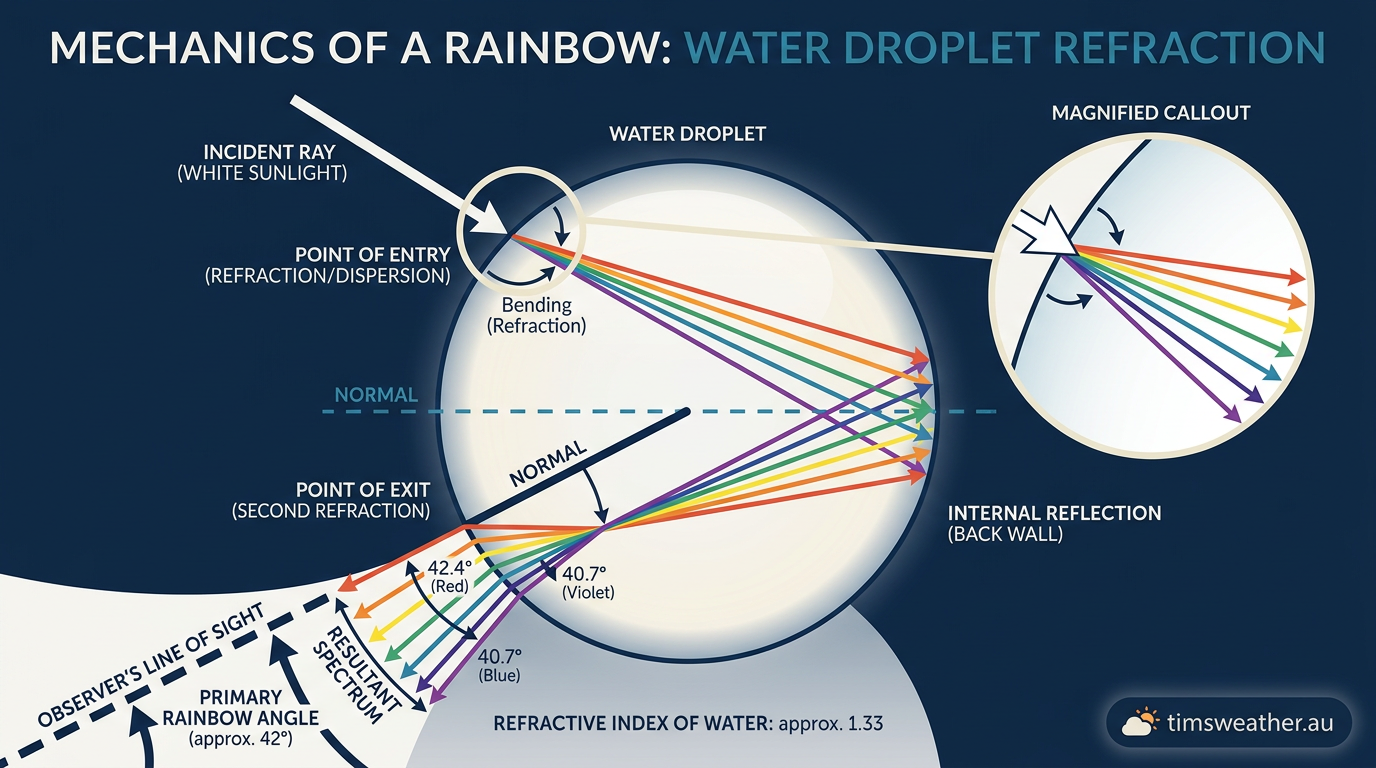
Following this initial bending, the light beam hits the back inner surface of the water droplet and reflects forward. Finally, the separated light waves refract once more as they exit the front of the droplet, projecting the spread spectrum of colours outward toward anyone standing in the correct viewing position.
The role of raindrops in light reflection and dispersion
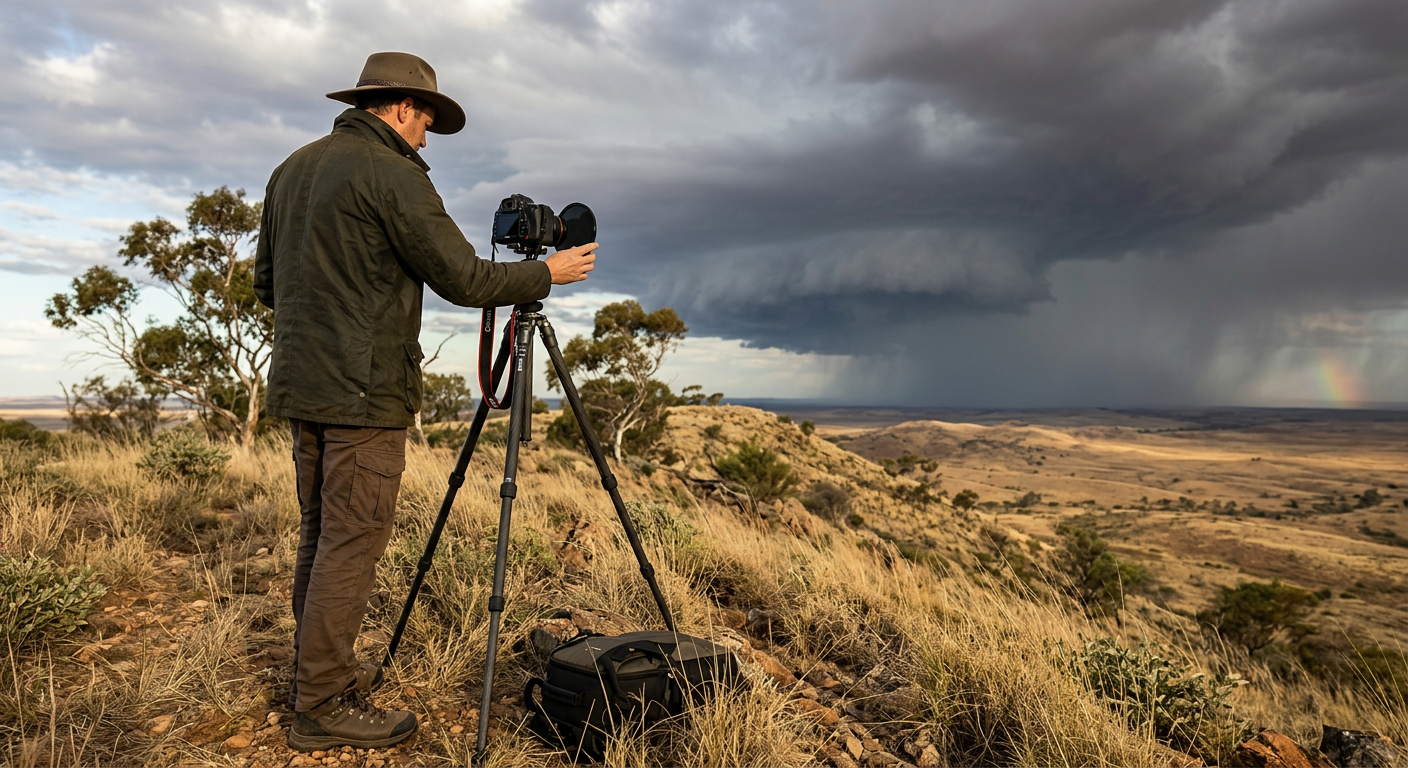
To fully grasp how do rainbows form, you must evaluate the mechanics governing atmospheric moisture. Contrary to popular textbook diagrams, raindrops falling through the atmosphere are not shaped like teardrops. Surface tension pulls small suspended water droplets into nearly perfect spheres. This spherical shape is absolutely necessary for the symmetric, predictable reflection of light that creates a circular arc in the sky. The physical dimensions of these spherical droplets heavily influence the visual intensity of the resulting light spectrum.
When examining the physics of tropical rain vs fine mist formation, meteorologists note that droplet size changes the optical outcome. An Australian Bureau of Meteorology technical perspective on droplet size versus colour vibrance indicates that heavy downpours feature large raindrops often exceeding two millimetres in diameter. These large, stable drops produce exceptionally bright primary arcs featuring a dominant, thick red outer band. In contrast, fine coastal drizzle creates much broader, washed-out pastel bands. How these localized moisture profiles behave often explains how do thunderstorms form and subsequently produce the required clearing conditions for these bright optical events.
High-speed photography analysis of internal reflection within a single raindrop reveals that liquid water is not a perfect mirror. When incoming sunlight hits the back interior wall of a droplet, a massive percentage of the light energy passes straight through the water and is lost to the surrounding air. However, the exact fraction of light that does manage to bounce back is tightly focused by the internal curvature of the droplet. This focused return of solar energy creates the highly concentrated, brilliant colour bands we observe in a strong shower, a mechanism detailed by National Weather Service observations.
Why are rainbows curved in the sky?
Rainbows appear curved because the concentrated light exits the suspended water droplets at a very specific angle relative to the incoming path of the sunlight. The only drops positioned correctly to direct this concentrated light directly into your eyes are those located perfectly along a vast circular path.
You are essentially looking at the wide base of a cone of light extending from your eye outward to the falling rain shaft. The ground beneath you typically blocks the lower half of this enormous circle, leaving only a semicircular arc visible against the sky.
Can a rainbow form without rain?
Yes, a rainbow can form in any natural or artificial situation where suspended water droplets interact with direct, unbroken sunlight. The atmospheric physics remain completely identical whether the water falls heavily from a cumulus cloud or is launched dynamically into the air by other mechanical means.

You can frequently observe bright, localized arcs in the heavy spray of ocean surf, industrial irrigation hoses, or massive water cascades. The formation of rainbows in the spray of major waterfalls like Jim Jim Falls is a persistent daily event when struck by low-angle morning sunlight. Learning how to photograph rainbows in the outback often involves seeking out these localized permanent water sources when regional rainfall is entirely absent.
The 42-degree angle rule and viewing geometry
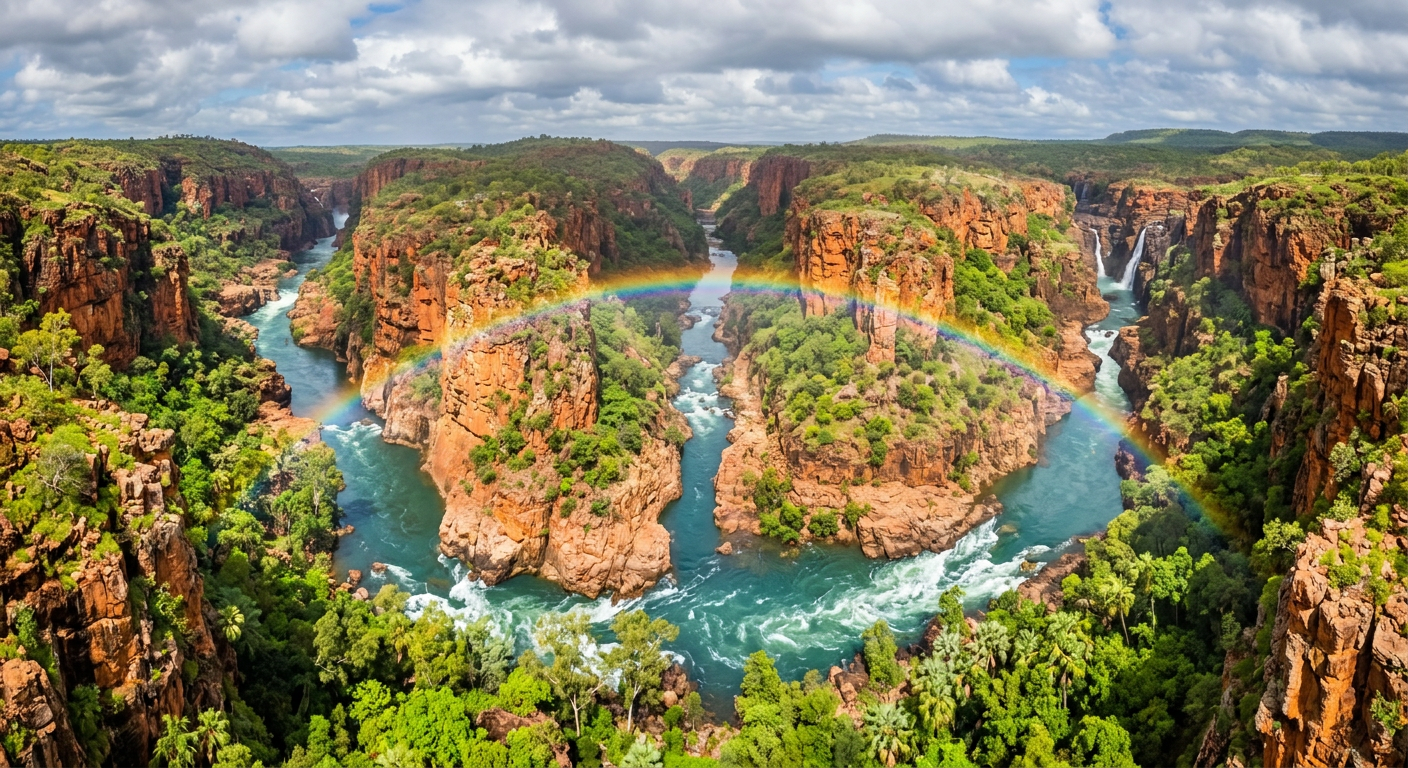
The mathematical predictability of rainbow appearances stems entirely from geometric physics. To observe this lively optical phenomenon, strict spatial alignment is necessary. The observer must stand exactly between the active light source and the concentrated water source. The exact geometric centre of the rainbow always aligns perfectly with the antisolar point. The 42-degree rule: finding the anti-solar point is an essential concept in meteorology, referring to the imaginary point situated directly opposite the sun in the observer's sky.
Educational ray-tracing diagrams typical of NOAA educational materials demonstrate that light exiting a spherical raindrop concentrates most intensely at a specific angle of 42 degrees away from the original path of the incoming sunlight. This geometric constant dictates the boundaries of the arc. Because red light bends slightly less than violet light during refraction, the red band appears exactly at 42.4 degrees from the antisolar point, while the violet band appears tighter at roughly 40.6 degrees.
This slight angular difference explains exactly why red always forms the expansive outer edge of a primary rainbow and violet forms the tighter inner edge. Weather enthusiasts can use this precise geometry to predict daily sightings based on specific cloud layers and the elevation of the sun during early morning or late afternoon atmospheric conditions.
Why do rainbows always face the sun?
Rainbows do not actually face the sun; they form opposite the sun and face the observer directly. The incoming light enters the front of the raindrop facing the sun, reflects off the back interior wall, and travels back out toward the viewer.
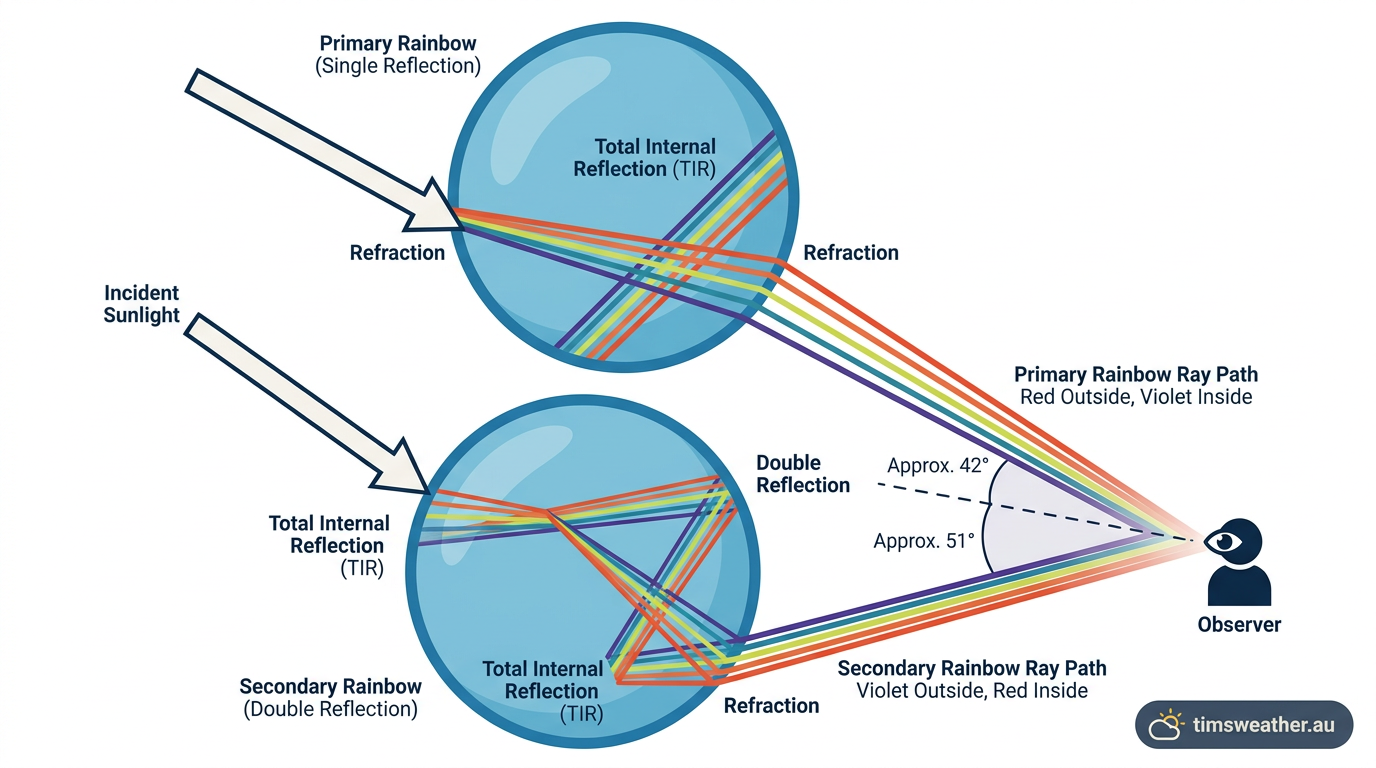
Because the sunlight must physically bounce backward to successfully reach your eyes, you will always have your back turned squarely to the sun when looking at any true rainbow.
Why can't you see a rainbow at noon in Australia?
During the middle of the day in summer, the sun sits very high in the sky. If the sun reaches an elevation higher than 42 degrees above the horizon, the corresponding antisolar point is pushed deeply below the horizon line.
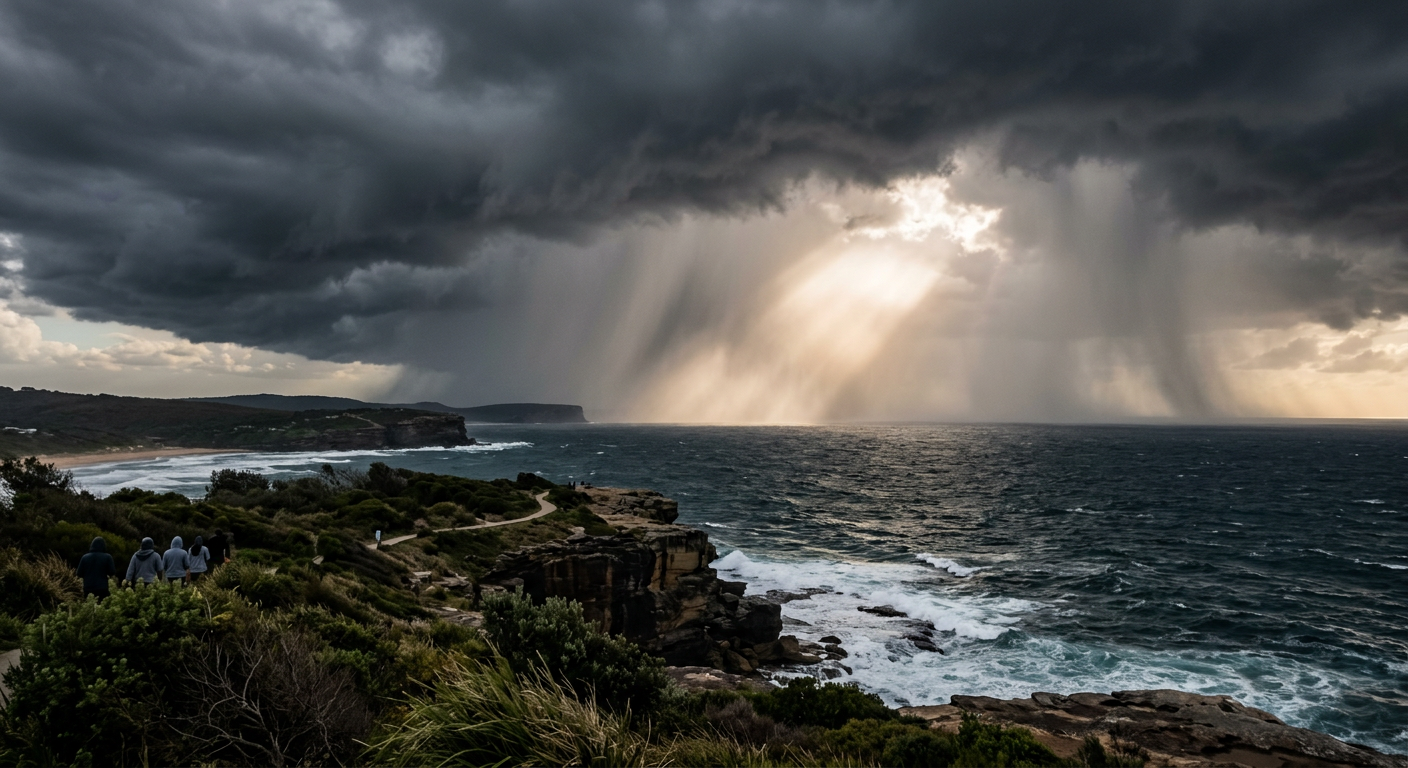
Consequently, the entire 42-degree cone of reflecting light points downward into the ground, making the rainbow physically impossible to see from a flat ground surface. This geometry explains why rainbows are common during Australian storm seasons only in the late afternoon, and how Southern Hemisphere storm patterns influence rainbow visibility windows. The viewing conditions during sunshowers in Sydney and Melbourne are not specifically stated as ideal at dusk, and flatback turtle nesting beaches are on northern Australian beaches, not along the northern coastline as described.
Different types of rainbows explained
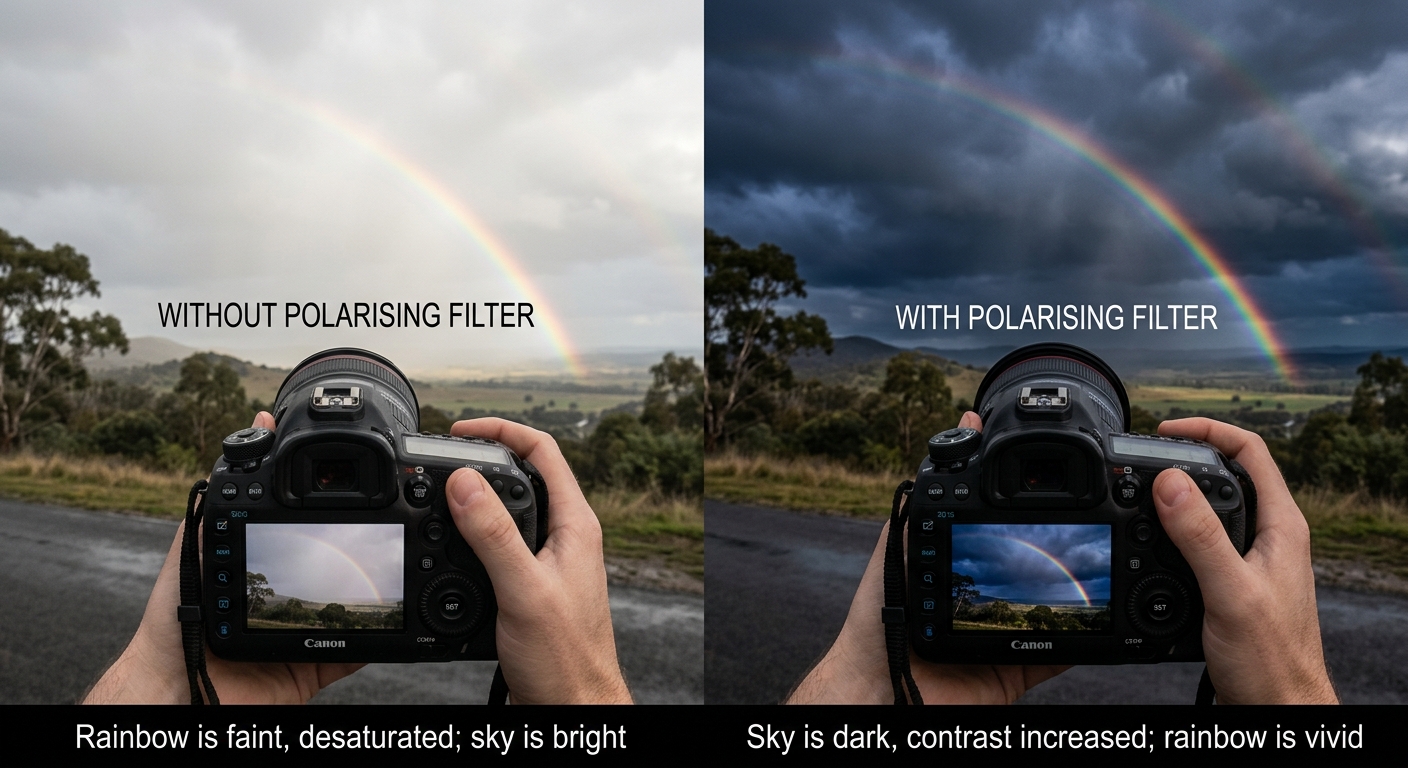
While the standard primary rainbow is the most widely recognised atmospheric arc, the interaction of light and water frequently produces complex secondary features. The visibility of these specific variations depends entirely on the sheer intensity of the ambient sunlight and the absolute uniformity of the falling raindrop sizes within the local weather system.
One visually striking feature is the occasional presence of supernumerary fringes. These are faint, alternating pink and green bands located just inside the primary violet inner edge. Consulting an atmospheric physicist or meteorologist with PhD credentials confirms that these delicate fringes cannot be explained by simple geometric reflection. Instead, they require a deep understanding of wave interference, a concept frequently documented in Physics StackExchange optical discussions. As light waves exit the droplet along slightly different paths, they can either amplify or cancel each other out, producing these rippling interference bands.
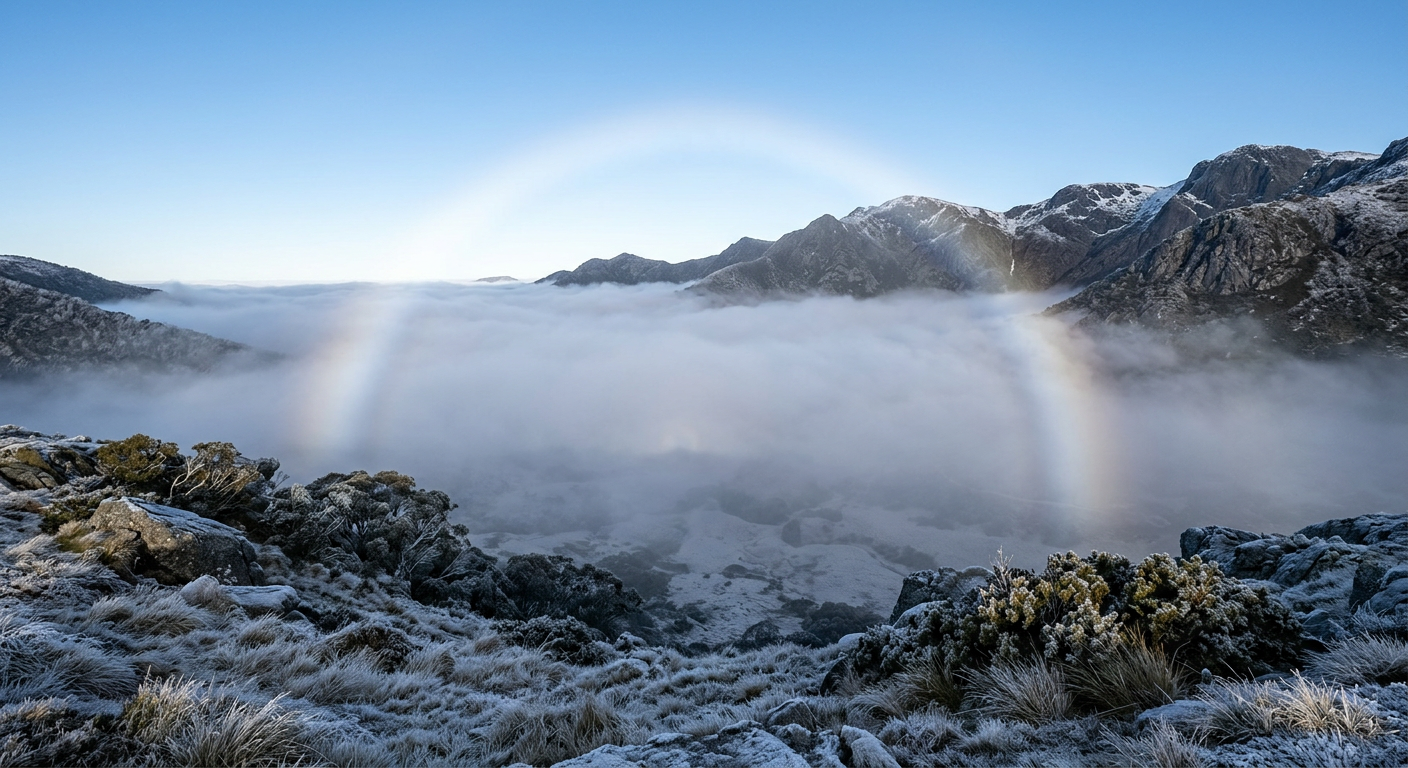
When atmospheric droplets are exceedingly small, measuring less than 0.05 millimetres across, they produce a fogbow. This variation is almost entirely white due to the overlapping of diffracted light waves, which smears the individual colours back together into a pale arc.
What causes a double rainbow to appear?
A double rainbow forms when sunlight undergoes two distinct, separate internal reflections inside the suspended water droplet before finally exiting. This secondary internal reflection requires incoming light to strike the lower, specific portion of the droplet surface.

Because substantial light energy is lost during each internal bounce, the secondary rainbow is noticeably fainter. The double reflection process also reverses the exiting angles, causing the secondary rainbow to display its visible colours in reverse order, placing red on the inside and violet on the outside. The way tropical cyclone rainbands create double rainbows explains why these severe cyclonic systems are excellent producers of brilliant double arcs, as their massive, uniform rain shields provide perfect reflective conditions, according to geographical science publications.
The Role of Alexander’s Band in Optical Phenomena
The role of Alexander’s band in optical phenomena defines the noticeably darker slice of sky located directly between a primary and a secondary rainbow. Named after the ancient philosopher Alexander of Aphrodisias who first recorded the observation, this dark optical void occurs because specific angles of internal reflection direct scattered light entirely away from this region.
Light escaping from the primary bow is cast heavily inward, while light escaping from the secondary bow is cast heavily outward, leaving the intermediate space entirely devoid of reflected sunlight.
Comparing atmospheric optical phenomena
While rainbows are a spectacular global occurrence, specific atmospheric properties dictate how they differ from other visually similar events. Rainbows require liquid water droplets and exact sun angles. In contrast, winter optical effects rely entirely on frozen moisture suspended in entirely different atmospheric levels.
| Phenomenon | Light Source | Medium | Primary Mechanism |
|---|---|---|---|
| Rainbow | Direct Sunlight | Liquid Water Droplets | Refraction and Internal Reflection |
| Solar Halo | Direct Sunlight | Hexagonal Ice Crystals | Refraction |
| Sun Dog | Direct Sunlight | Plate-shaped Ice Crystals | Refraction |
| Corona | Sunlight or Moonlight | Thin Cloud Water/Ice | Diffraction |
These optical effects differ mechanically from ice-crystal phenomena like a 22-degree solar halo or a lively circumhorizontal arc, which require completely different high-altitude cloud structures and freezing temperatures. Similarly, occurrences like lunar and solar coronas are driven by diffraction rather than reflection. Culturally, large-scale optical arcs carry significant historical weight, such as the Indigenous Australian Dreamtime stories involving the Rainbow Serpent (Wanambi/Goorialla), which intimately tie the arrival of essential wet season rains to the appearance of these massive, colourful atmospheric structures.
Frequently asked questions
Rainbows form when sunlight enters water droplets, slowing down and bending as it passes through. The light reflects off the back of the droplet and bends again as it exits. This process, known as refraction, splits white light into its component colours, creating the vibrant arc seen in the sky.
Source: nesdis.noaa.gov
Further reading and resources
Explore trusted articles, books, videos and other resources to go deeper on this topic.
global.canonArticle
Canon Science Lab | How Do Rainbows Form?
In-depth coverage on How Do Rainbows Form? The Atmospheric Physics Explained from global.canon.
education.nationalgeographic.orgArticle
Rainbow
In-depth coverage on How Do Rainbows Form? The Atmospheric Physics Explained from education.nationalgeographic.org.
nesdis.noaa.govReference
What Causes a Rainbow? | NESDIS - NOAA
Background reference on How Do Rainbows Form? The Atmospheric Physics Explained from nesdis.noaa.gov.
science.howstuffworks.comArticle
How Are Rainbows Formed? The Science Behind the Colors
In-depth coverage on How Do Rainbows Form? The Atmospheric Physics Explained from science.howstuffworks.com.
weather.govReference
How Do Rainbows Form?
Background reference on How Do Rainbows Form? The Atmospheric Physics Explained from weather.gov.
youtube.comVideo
How are rainbows formed?
Video coverage on How Do Rainbows Form? The Atmospheric Physics Explained from youtube.com.
ssec.si.eduReference
The Science of Rainbows
Background reference on How Do Rainbows Form? The Atmospheric Physics Explained from ssec.si.edu.
en.wikipedia.orgReference
Rainbow
Background reference on How Do Rainbows Form? The Atmospheric Physics Explained from en.wikipedia.org.
unr.eduReference
Ask the Professor: How do rainbows form?
Background reference on How Do Rainbows Form? The Atmospheric Physics Explained from unr.edu.
physicsclassroom.comArticle
Rainbow Formation - Refraction and Lenses - The Physics Classroom
In-depth coverage on How Do Rainbows Form? The Atmospheric Physics Explained from physicsclassroom.com.
Planning weeks ahead?
Check Australia's long-range seasonal outlook for rainfall, temperature and the climate drivers (ENSO, IOD, SAM, MJO) shaping the next three months.
View Australia's Seasonal Weather Forecast