
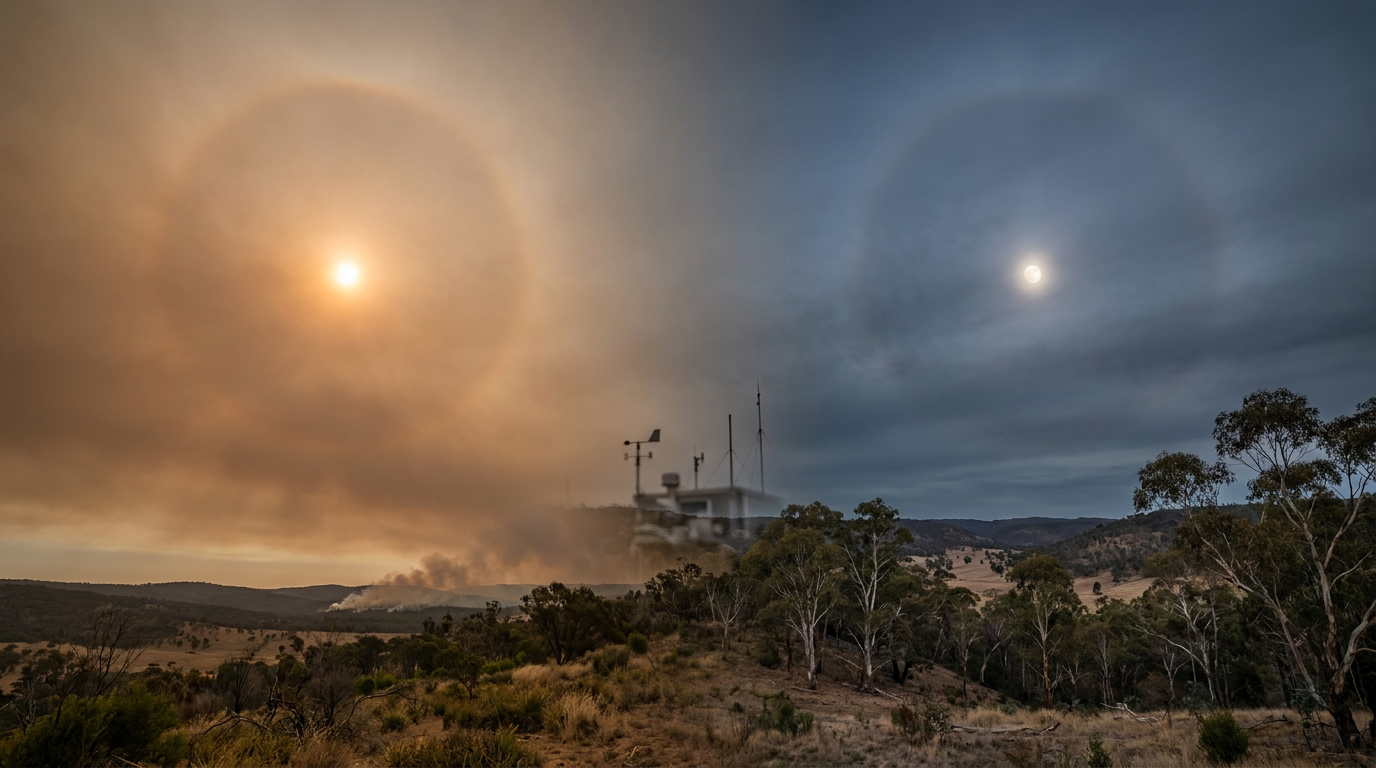
Lunar and solar coronas are optical phenomena caused by the diffraction of light through tiny water droplets in thin cloud, producing small coloured rings close to the Moon or Sun. They are not the same as halos, which sit much farther from the light source and form by refraction through ice crystals.
Key takeaways
The bright centre is called the aureole, with soft colour bands around it.
Coronas are an atmospheric optical phenomenon, not the Sun's outer atmosphere.
Thin cloud such as altocumulus clouds and altostratus clouds often gives the best view.
Coronas usually look smaller than a 22-degree halo, and the pattern changes with droplet size.
If you want to photograph a solar corona, keep your eyes safe and never look straight at the Sun.
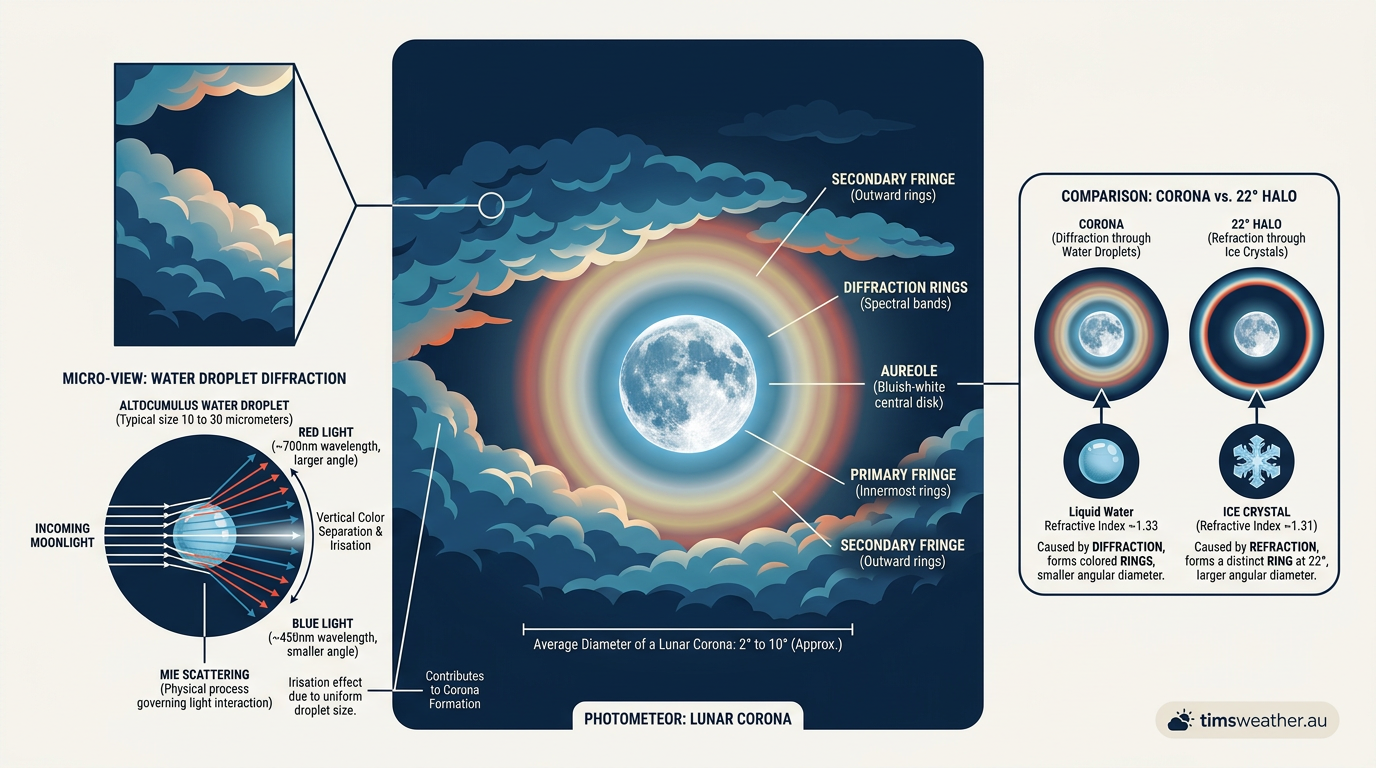
A multi-coloured lunar corona in thin altocumulus cloud at night
How lunar and solar coronas form
Coronas appear when moonlight or sunlight passes through a cloud layer made up of many tiny droplets that are close to the same size. According to Britannica's entry on meteorology, coronas are distinctly formed when light passes through water droplets, as opposed to ice crystals.

A bright moon with a colorful lunar corona, demonstrating how thin clouds create these captivating optical rings. By Darrybuffin - Own work, CC BY-SA 4.0, https://commons.wikimedia.org/w/index.php?curid=98181765
Diffraction of light and Fraunhofer diffraction
The key process is diffraction of light. In simple terms, waves spread out when they meet small obstacles. Fraunhofer diffraction is the name for this wave behaviour when the light source is far away, which suits the Sun and Moon very well. Smaller droplets tend to spread the light more widely, so the corona looks larger. Larger droplets usually make a tighter ring.
Mie scattering, water droplets and cloud appearance
Mie scattering helps explain why the cloud itself often looks white or grey. It describes how light interacts with particles that are about the same size as the wavelength of light. In a corona, Mie scattering shapes the look of the cloud, while diffraction creates the ring pattern. You need both ideas to understand the full view.
Why some clouds show coronas better than others
Thin cloud works best because it contains enough droplets to make the effect visible without hiding the Moon or Sun completely. Cirrocumulus clouds can also produce these effects, although altocumulus are more common settings. Dense cloud usually blocks the light instead of forming neat rings.
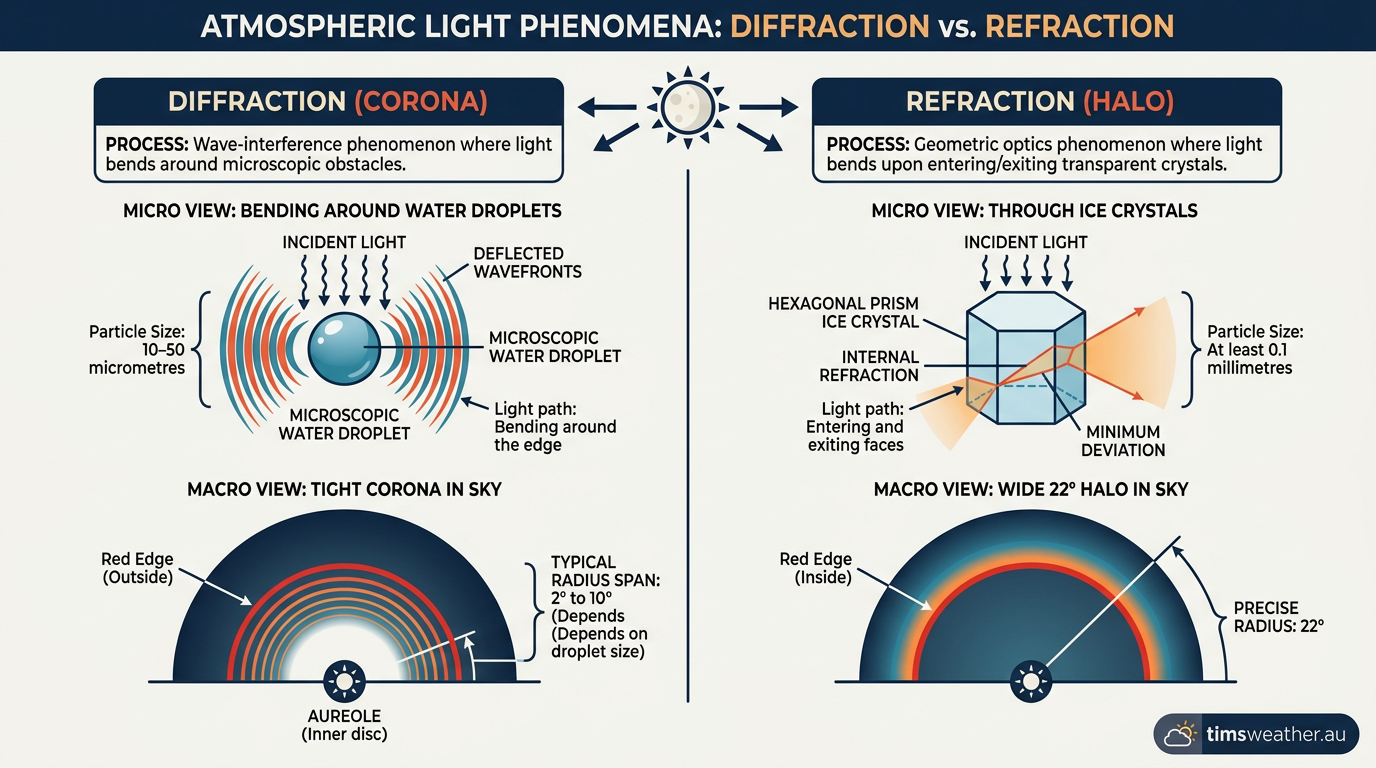
A diagram comparing corona diffraction with halo refraction
What is the difference between a corona and a 22-degree halo?
The main difference is the particle type and the size of the ring. A corona forms from diffraction around water droplets and stays fairly close to the Moon or Sun. A 22-degree halo forms when light passes through hexagonal ice crystals, so the sky inside the ring appears much darker than the sky outside. The Bureau of Meteorology uses this cloud-particle split when it explains common optical effects in the sky.
Diffraction versus refraction
Diffraction means light bends around small particles. Refraction means light changes direction as it passes through a medium. That is why coronas and halos look so different, even though both can appear around the Moon or Sun on a cloudy night.

A vibrant solar corona, an optical ring formed by sunlight diffracting through thin clouds, as explained in our article. By Callicious - Own work, CC BY-SA 4.0, https://commons.wikimedia.org/w/index.php?curid=109189731
Angular diameter and ring size
The angular diameter of a corona changes with droplet size and how uniform those droplets are. When the droplets are small and similar in size, the ring can look broader and the colours can stand out more clearly. The 22-degree halo, by contrast, keeps about the same size because it is set by the geometry of the ice crystals.
Feature | Lunar and solar coronas | 22-degree halo |
|---|---|---|
Main process | Fraunhofer diffraction | Refraction |
Particles | Small water droplets | Ice crystals |
Ring size | Small and variable | About 22 degrees |
Cloud type | Thin cloud such as altocumulus or altostratus | High cloud with ice crystals |
Where Bishop's Ring and volcanic aerosols fit in
Bishop's Ring is another atmospheric optical phenomenon, but it is linked to volcanic aerosols rather than ordinary cloud droplets. It can show a broad, diffuse glow around the Sun after major volcanic eruptions. That makes it different from the tighter corona rings caused by water droplets in thin cloud.
What about iridescent clouds and a pollen corona?
Coronas are related to, but not the same as, iridescent clouds. Both can show colour, yet iridescent clouds usually appear as patchy colour in cloud edges rather than as a neat ring around the Moon or Sun. A pollen corona is a local version of the same idea, where pollen grains replace water droplets. The particle size still matters, because it controls how the light spreads.
How to safely photograph a solar corona in Australia
Use care any time the Sun is involved. Check the Weather Warnings or local forecasts first, then work in shade, a covered area, or under an awning so you do not stare at the Sun. If the light is too bright, stop. Never point optical gear at the Sun unless you are using the right solar filter for the camera and lens. For many readers, the safer option is to photograph a lunar corona at night.
Choose thin cloud with the Sun partly veiled, not fully hidden.
Use live view or a remote trigger so your eye stays away from the viewfinder.
Keep the Sun out of the frame if possible.
Do not use improvised filters, sunglasses or exposed film.
If you are unsure, do not shoot the Sun at all.
Why coronas matter for sky watchers
Coronas tell you a lot about the cloud above you. They point to small, fairly even droplets in thin cloud, which is why they often appear around the edges of changing weather systems. If you watch the sky often, coronas can be a useful sign that mid-level cloud is spreading in from nearby weather, which can be cross-referenced with your local Weather Glossary terms for better understanding.
Frequently asked questions
A corona is a series of coloured rings around the Sun or Moon, caused by the diffraction of light through tiny water droplets or particles in thin cloud. It appears much smaller and closer to the celestial body than a halo, often showing a bluish-white centre with a reddish outer edge.
Source: timsweather.au
Further reading and resources
Explore trusted articles, books, videos and other resources to go deeper on this topic.
www.britannica.comReference
Corona | meteorology - Britannica
A concise encyclopedia overview of coronas as atmospheric optical phenomena, distinguishing them from ice crystal halos.
en.wikipedia.orgReference
The Coronas - Wikipedia
The Coronas are an Irish rock band that originated in Dublin. They release their music by their own independent record label, 3ú Records, and are based ...
Tres Coronas - Wikipedia
Tres Coronas (alternatively known by the nickname Triple Crown) were a group of three MCs, formed in early 2001 in Queens, New York.
www.goodreads.comBook
Books by João Coronas (Author of The Life After Pandemic )
João Coronas has 3 books on Goodreads with 10 ratings. João Coronas's most popular book is The Life After Pandemic : MENSAGEM DE EXTRATERRESTRES (Portugu...
news.ucmerced.eduDocumentary
Empathy is the Central Theme of Todo Cambia Film Festival
An image from the documentary "Coronas Negras." Friday, March 6. The day will revolve around the experiences of Black people in Latin cultures.
www.abc.net.auArticle
Irish rockers The Coronas' set to tour Oz - ABC listen
From opening for Bruce Springsteen in Hyde Park to performing in front of American President Joe Biden, Irish rock band The Coronas have made ...
Get a copy of Las Tres Coronas- La Noche de Reyes - Goodreads
Get a copy of Las Tres Coronas- La Noche de Reyes · Amazon · Audible · Barnes & Noble · AbeBooks · Kobo · Apple Books · Google Play · Alibris ...
www.smh.com.auArticle
Bono, watch your back. The Coronas are coming
Coronas are bigger than U2, according to Irish music fans. They recently voted to help the pop-rock quartet edge out Bono and the boys, ...
search.worldcat.orgBook
Historia iuris : estudios dedicados al profesor Santos M. Coronas ...
Historia iuris : estudios dedicados al profesor Santos M. Coronas González | WorldCat.org.
www.theguardian.comArticle
'It's not our fault!' Are the Coronas the unluckiest band of 2020? | Music
Witness the dilemma of Irish rock band the Coronas, celebrated chart-toppers in their homeland, now suddenly the most feared band on the planet ...
Planning weeks ahead?
Check Australia's long-range seasonal outlook for rainfall, temperature and the climate drivers (ENSO, IOD, SAM, MJO) shaping the next three months.
View Australia's Seasonal Weather Forecast