
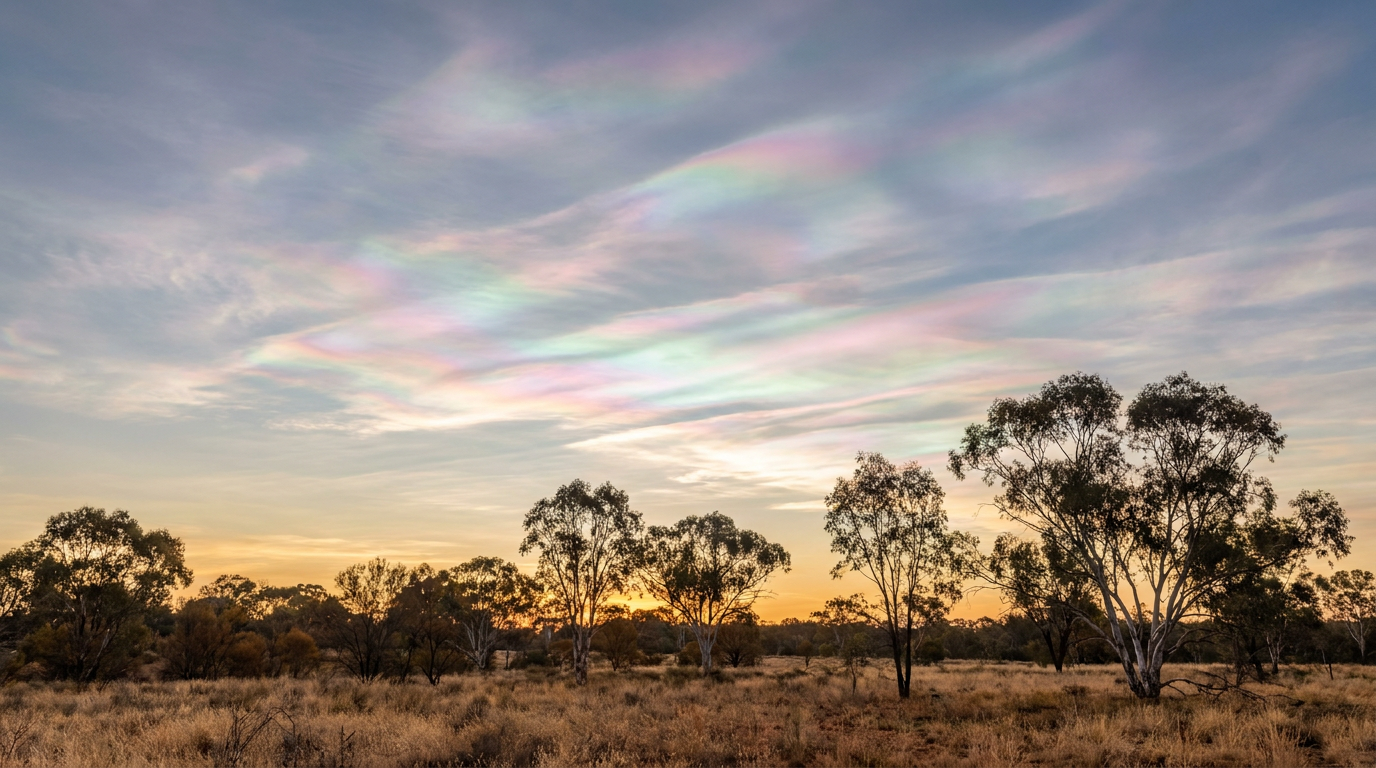
Cloud iridescence is a colourful atmospheric optics display caused when sunlight is diffracted by tiny, similar-sized water droplets or ice crystals in thin cloud. It can make cloud edges glow with pastel pink, green, blue, and purple colours. In Australia, it is often seen in altocumulus, cirrocumulus, and lenticular clouds, and it is not a sign of severe weather.
Key takeaways
- Cloud iridescence is an optical phenomenon caused by diffraction, not refraction.
- The coloured cloud effect appears when sunlight passes through very small, evenly sized water droplets or ice crystals.
- A rainbow cloud from Newport, Victoria was featured in the January slot of the 2026 Australian Weather Calendar.
- The Bureau of Meteorology notes rainbow clouds are more often visible in newly formed clouds.
- Cloud iridescence is different from a rainbow, a corona, and nacreous clouds.
What cloud iridescence means

Cloud iridescence is the name for coloured bands or patches that appear on thin cloud when light bends around tiny particles in the cloud. The effect can look like a rainbow, but it is usually softer and more patchy than a normal rainbow.
In Australian skies, people often notice this effect near the Sun, especially when thin cloud is passing across a bright blue sky. It is sometimes called rainbow clouds phenomenon or opalescent clouds, though the more precise term is cloud iridescence.
How the coloured clouds optical effect forms
Cloud iridescence is an atmospheric optics effect caused by diffraction. Sunlight meets small water droplets or ice crystals that are close to the same size. The light waves spread out and overlap, which separates the white light into different colours.
This is why the colours often appear in thin, pastel bands rather than in a full arc. The cloud has to be thin enough for sunlight to pass through, but also dense enough to contain many similarly sized droplets or crystals.
The effect is not the same as a standard rainbow. Rainbows form through refraction and reflection inside raindrops, while cloud iridescence depends on diffraction.
Cloud types that can show iridescence
Thin, young clouds are the best place to look for this effect. The Bureau of Meteorology notes that rainbow clouds are more often visible in newly formed clouds, when the droplets or crystals are still similar in size.
Altocumulus

Altocumulus clouds are one of the most common cloud types to show iridescence. They are mid-level clouds that form in patches, rolls, or small clumps. Their thin edges can turn pink, green, and blue when sunlight strikes them at the right angle.
Cirrocumulus

Cirrocumulus clouds are high, rippled clouds made mostly of ice crystals. Because they are thin and often made of small, uniform particles, they can produce delicate iridescent colour. These clouds are sometimes seen as rows that resemble fish scales.
Lenticular clouds

Lenticular clouds form near mountain waves and can also show iridescence. Their smooth, lens-shaped form can make the colour bands stand out clearly when sunlight passes through the leading edge of the cloud.
Stratocumulus

Stratocumulus clouds can sometimes show a faint iridescent edge, but they are usually too thick for strong colour. When the cloud is breaking apart or forming, the thin edges may briefly show pastel tones.
Cloud colours atmospheric optics: why the colours look pastel
The colours in cloud iridescence are often pale because the effect comes from interference between many light waves at once. The result is usually a soft mix of pink, green, violet, and blue. Stronger colour often appears where the cloud is thinnest, or where the droplets or ice crystals are more uniform in size.
This is why the display may fade quickly as the cloud changes shape. Even a small shift in cloud thickness can alter the colour pattern.
Cloud iridescence and corona
A corona is a ring of colour around the Sun or Moon, formed by diffraction through tiny cloud particles. Cloud iridescence is closely related, but it often appears as broken patches, streaks, or short arcs rather than a full ring.
If the cloud layer is even and uniform, a corona is more likely. If the cloud is uneven or patchy, the colour may appear as scattered iridescent spots instead.
Nacreous clouds vs iridescent clouds

People sometimes confuse iridescent cloud with nacreous cloud. The two are different.
Nacreous clouds vs iridescent clouds comes down to altitude and temperature. Nacreous clouds form much higher in the stratosphere and are usually seen in polar regions. Cloud iridescence usually appears in ordinary tropospheric clouds such as altocumulus, cirrocumulus, and lenticular clouds.
Nacreous clouds can also show bright colour, but they are a separate type of cloud rather than a general optical effect in common cloud types.
Sun dog vs iridescence
Sun dog vs iridescence is another common comparison. A sun dog is a bright patch of light that appears on one or both sides of the Sun, usually caused by sunlight passing through hexagonal ice crystals in high cloud. Cloud iridescence, by contrast, appears as pastel colour within or along the edge of thin cloud.
So, while both are forms of cloud colours atmospheric optics, they have different causes and different shapes in the sky.
Iridescent clouds Australia: when to look
In Australia, iridescent clouds are most likely when thin cloud is moving across a bright sky and the Sun is partly hidden. They are often easier to spot when the cloud is newly formed and the particle size is fairly even.
A notable Australian example was a rainbow cloud captured in Newport, Victoria, and featured in the January slot of the 2026 Australian Weather Calendar. The Bureau of Meteorology also says its weather network uses over 11,000 pieces of equipment, and radars measure water in the atmosphere.
That same atmospheric monitoring helps forecasters track cloud, rain, and moisture patterns that can support these optical displays.
How to spot cloud iridescence safely
Never stare directly at the Sun. If you want to look for cloud iridescence, shield the Sun with a building, tree, or your hand and watch the thin cloud nearby. The best views usually last only a short time.
A camera with a good dynamic range can help bring out the colours, especially when the cloud is faint to the eye.
Related guides
Frequently asked questions
Cloud iridescence is caused by sunlight scattering through very small, similarly-sized water droplets or ice crystals within a cloud. The colours appear due to light interference when these particles are nearly identical in size, creating colourful patterns rather than a typical rainbow.
Source: weather.gov
Further reading and resources
Explore trusted articles, books, videos and other resources to go deeper on this topic.
www.nesdis.noaa.govReference
What Are Rainbow Clouds?
Provides a comprehensive overview of cloud iridescence, explaining its causes and appearance for general readers.
en.wikipedia.orgReference
Cloud iridescence - Wikipedia
An in-depth reference entry detailing the phenomenon, its related optical effects, and scientific explanations.
www.abc.net.auArticle
The science behind auroras, red skies and coloured clouds
An article from an Australian perspective discussing various atmospheric optical phenomena, including cloud iridescence.
theconversation.comArticle
Explainer: what are the 'nacreous clouds' lighting up the winter skies?
Explains nacreous clouds, which are often confused with iridescent clouds, clarifying the differences and conditions for each.
www.youtube.comVideo
Rare cloud iridescence turns Indonesia's sky into a rainbow spectacle
A short video showcasing a spectacular cloud iridescence event, offering a visual example of the phenomenon.
Crazy Rainbow Clouds! - Cloud Iridescence - YouTube
A visual explanation of cloud iridescence, highlighting the vibrant colours and the role of ice crystals.
www.theguardian.comArticle
Busking rabbits and cloud iridescence: Thursday's best photos
Features a photo of cloud iridescence among other striking images, demonstrating its visual impact.
www.smh.com.auArticle
Tourist captures spectacular 'fire rainbow cloud' phenomenon on ...
An Australian news article detailing a specific instance of cloud iridescence captured by a tourist.
Cool cloud spotted in Maine! Have you seen cloud iridescence ...
Check out this cloud iridescence in Westbrook, Maine, on Monday! This happens when light diffracts through water droplets or ice crystals in ...
Rare Atmospheric Optical Phenomena Ranked - YouTube
... Cloud Iridescence 12:45 Crown Flash 13:15 Green Flash 13:55 Blue ... Further Reading/Where I Got 95% of My Info: https://atoptics.co.uk ...
Planning weeks ahead?
Check Australia's long-range seasonal outlook for rainfall, temperature and the climate drivers (ENSO, IOD, SAM, MJO) shaping the next three months.
View Australia's Seasonal Weather Forecast