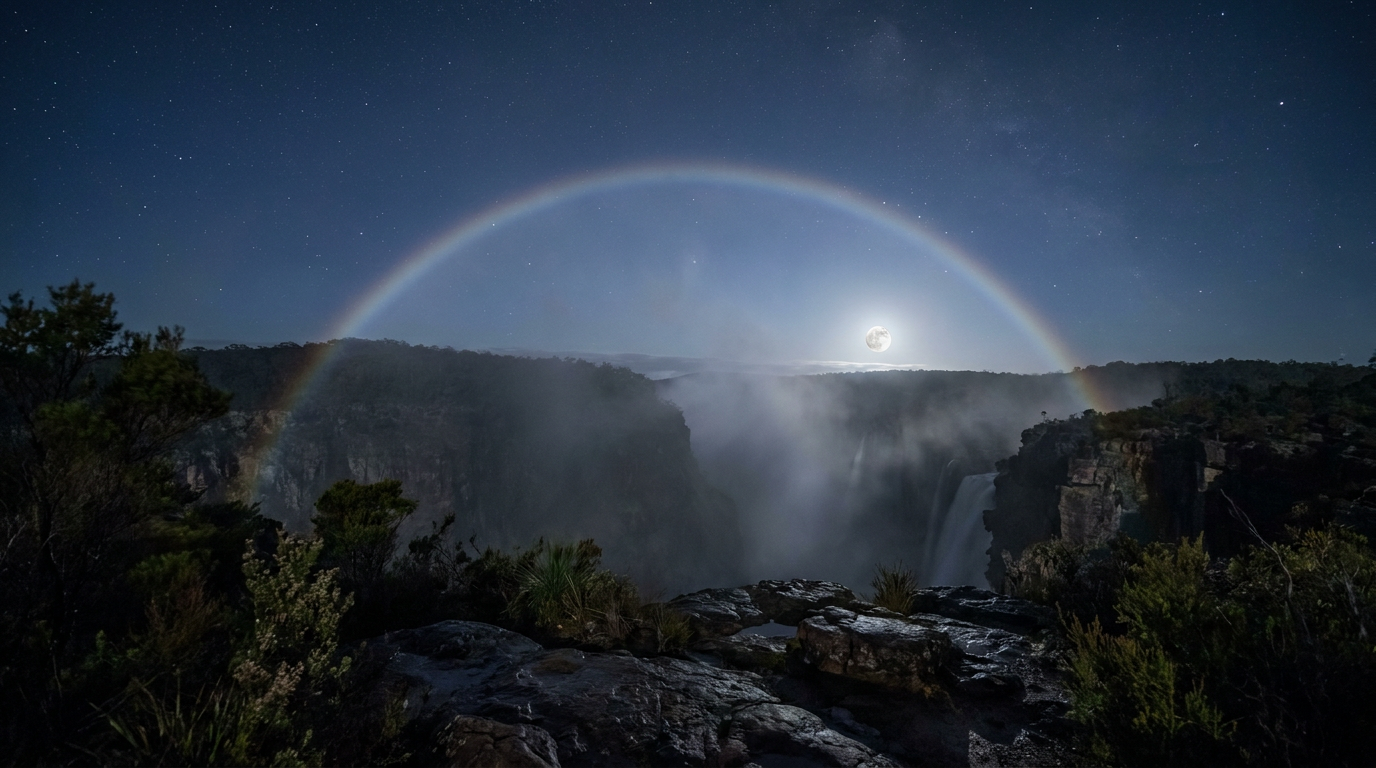
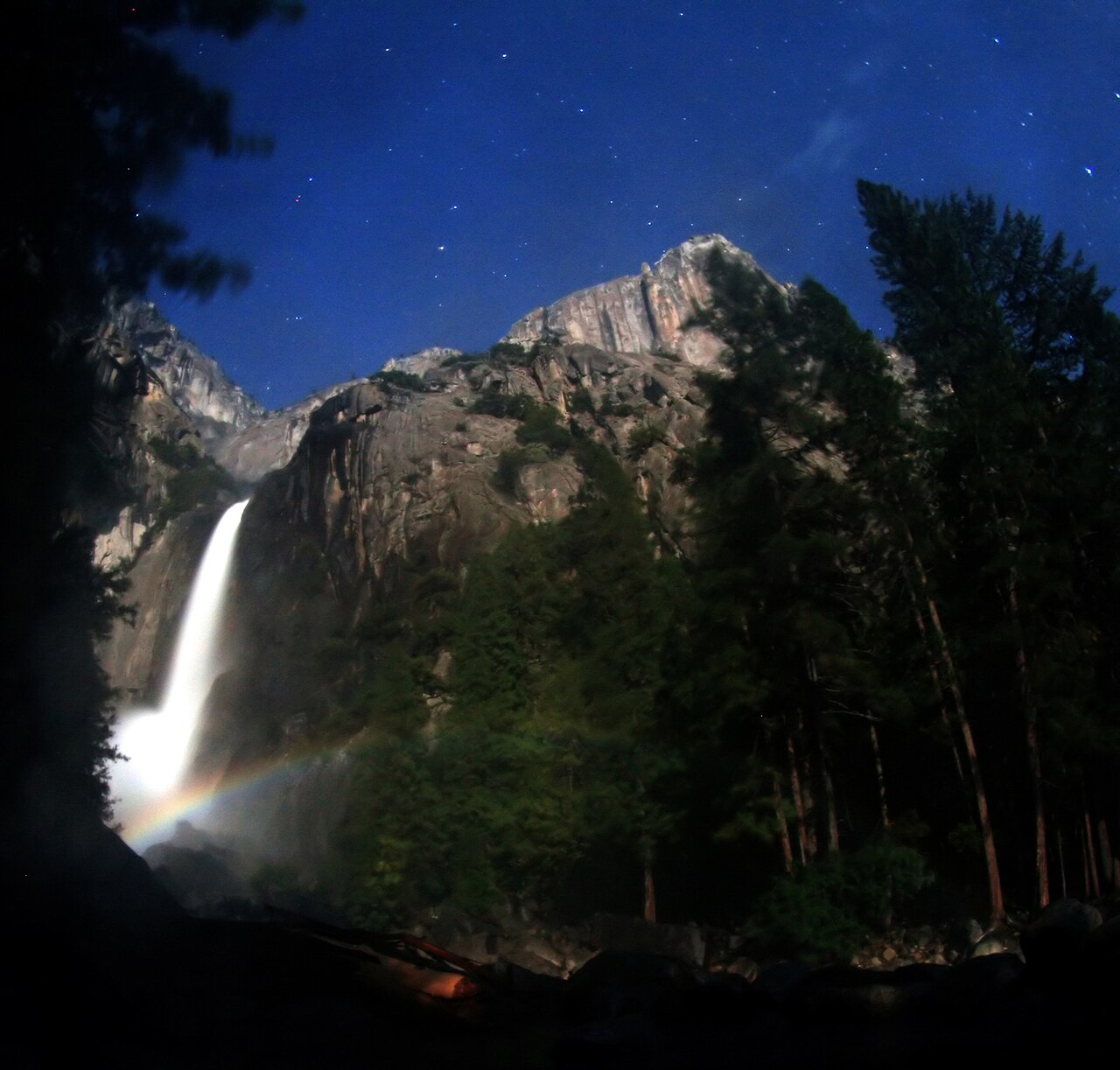
How to see a moonbow? Stand with a bright, nearly full moon behind you, face the spray, mist or rain in front of you, and give your eyes time to adapt to the dark. A moonbow, also called a lunar rainbow, forms when moonlight refracts through water droplets, but it usually looks pale white to the naked eye because moonlight is much dimmer than sunlight.
Key takeaways
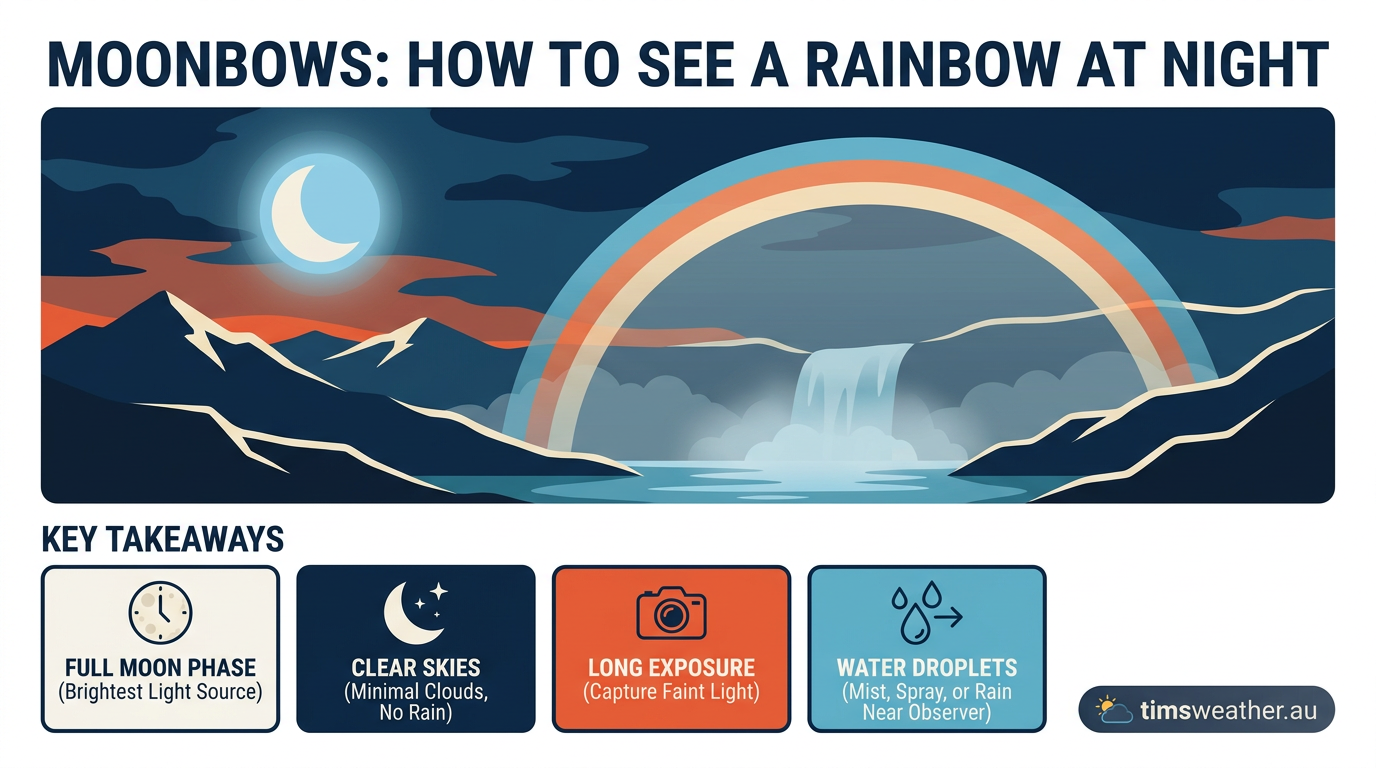
Moonbows are nocturnal atmospheric phenomena formed by moonlight refracting through water droplets.
The best viewing conditions usually involve a nearly full moon, a dark sky and moisture in the air.
At least 20 to 30 minutes in darkness is needed for your eyes to properly adjust for spotting a faint night arc.
Dark adaptation matters because your eyes need time to adjust to low light.
Long exposure photography can reveal colours that are hard to see by eye.
What is a moonbow and why is it so faint?
A moonbow is the night-time version of a rainbow. It forms in the same basic way: light enters water droplets, bends, reflects inside the droplet, then bends again as it leaves. The result is an arc of light in the opposite part of the sky from the moon.
The Almanac explains that moonbows are created by moonlight refracting through water droplets and that they are usually seen as white rather than strongly coloured because the light source is so weak. That faintness is what makes moonbows one of the more subtle cloud optical phenomena and a good example of atmospheric optics at work.
The same geometry that creates a daytime rainbow still applies here, but the light levels are far lower. Moonlight is reflected sunlight, so it begins much weaker than direct daylight. That is why the arc often looks washed out to your eye, even when a camera can record colour more easily. If you want the clearest mental model, think of it as a lunar rainbow that sits near the edge of what human vision can detect.
What conditions do you need to see a moonbow?
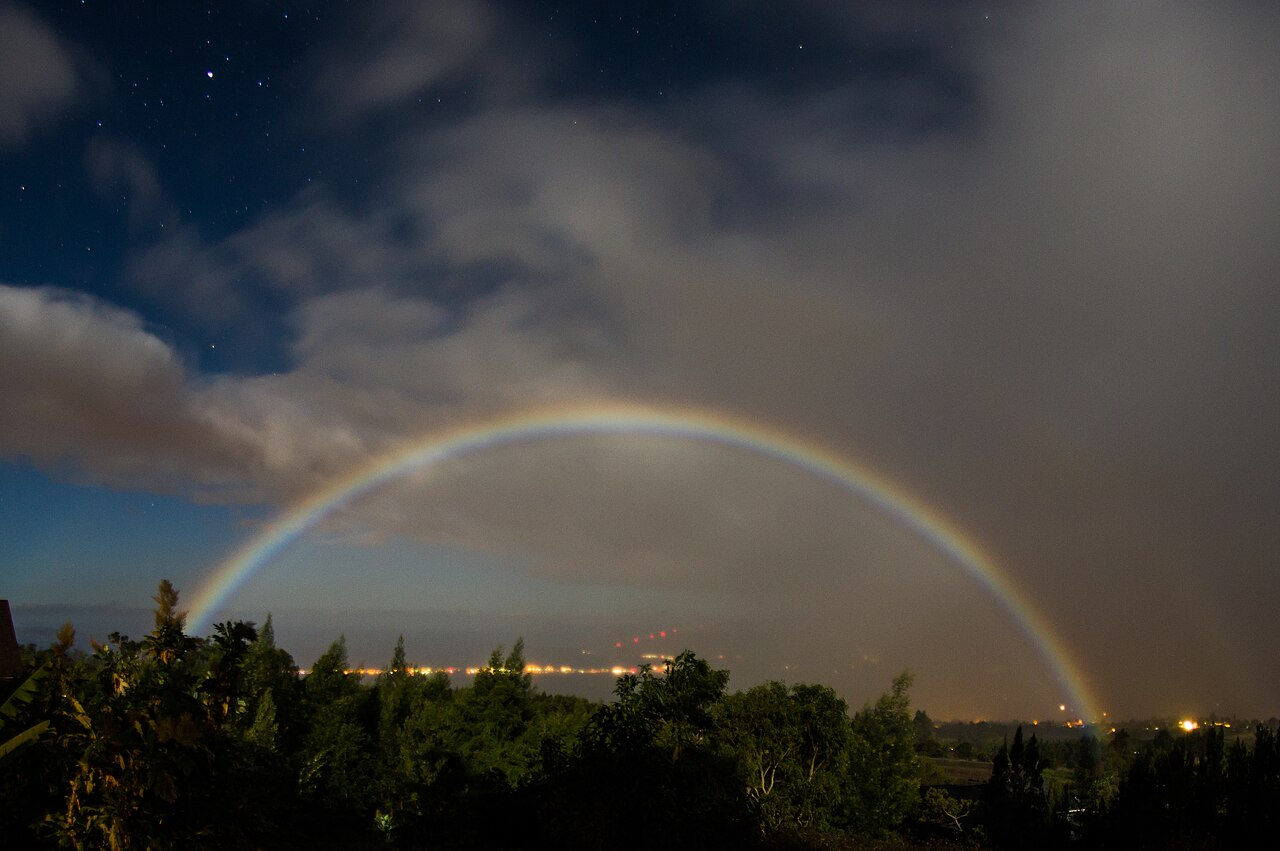
The best moonbow displays need three things at once: a bright moon, water droplets, and a dark sky. The moon should be close to full and low enough in the sky to cast light across the droplets while the observer stands with the moon behind them. The droplets can come from rain, waterfall spray or mist.
The Reserve Nature Cumberland Falls moonbow guide says the clearest viewing windows are around nearly full moons, with a clear sky and water droplets in the air. That is why waterfall sites are often the most reliable places to watch for moonbows.
Condition | What to look for | Why it matters |
|---|---|---|
Moon phase | Nearly full moon | Provides enough light for the arc to form and be seen |
Moon position | Low in the sky, behind you | Creates the right viewing angle for the lunar rainbow |
Moisture | Rain, mist or waterfall spray | Supplies the water droplets that split the light |
Sky clarity | Dark, clear conditions | Reduces background glare and improves contrast |
Light pollution | As little as possible | Lets your eyes stay adapted to the dark |
Moon phase observation matters because the moon’s brightness changes across the month. A full moon gives you the strongest chance, but not every full moon will produce a moonbow. You still need the water droplets and the right line of sight. In practice, that means checking the weather, the lunar calendar and the terrain together before you go out.
Why the moon has to be behind you
The viewing angle is simple once you picture the light path. The moon sits behind the observer, the droplets are in front, and the bow appears opposite the moon. That is the same arrangement used for a daytime rainbow. If you stand in the wrong direction, you will not see the arc, even if the moonbow is there. A clear line of sight is more useful than searching every part of the sky.
How does dark adaptation help you spot a moonbow?
Dark adaptation helps because the human eye becomes far more sensitive after it has been away from bright light for a while. In low light, rods do most of the work and colour vision drops away, which is why many moonbows look white or grey.
If you look at a phone screen, torch or car headlights, you reset that adaptation and make the arc harder to spot. The Royal Meteorological Society has long described moonbows as faint night-time arcs that are often better recorded by camera than by eye.
Give yourself at least 20 to 30 minutes in the dark before you expect to see much. Avoid white light if you can. If you need a torch, use the dimmest setting possible and keep it pointed down. This is one of the few times when patience matters more than speed, because your eyes need time to do their part.
How Rayleigh scattering affects what you see
Rayleigh scattering helps explain why the night sky is never perfectly black and why a weak moonbow can be hard to pick out. Shorter wavelengths scatter more easily through the atmosphere, which softens contrast and adds a faint background glow.
That does not create the moonbow, but it does make the arc less obvious against the sky. On a clear, dry night away from city lights, the bow stands out more clearly because there is less competing light in the atmosphere.
Where should you go to see a moonbow?
The best places are sites with a reliable source of spray or mist and an open view of the sky. Waterfalls are the classic example because they can produce fine droplets over a broad area, which gives moonlight a better chance of forming a visible arc.
Cumberland Falls is often mentioned because its moonbows are well documented, but the same basic idea applies anywhere with the right mix of water droplets, dark sky and a suitable moon phase. The Reserve Nature guide also focuses on waterfall viewing windows, which shows how site selection can matter as much as the moon itself.
If you are choosing a spot, look for a place where you can stand with the moon behind you and the mist in front of you. An open viewing area is better than a narrow gorge unless the local terrain gives you a clean line of sight. The main goal is simple: keep the moon in your back view and the droplets in the opposite sky.
Moonbow viewing checklist
Check for a nearly full moon.
Pick a location with mist, spray or rain.
Arrive early so your eyes can adapt to the dark.
Face away from the moon and towards the moisture.
Turn off bright lights and wait.
How to photograph a moonbow
Long exposure photography usually gives the best result because a phone or camera can collect more light than your eyes can see in the moment. Use a tripod if you have one, keep the ISO as low as practical, and expose for longer than you would in daylight.
A camera may reveal colour even when the bow looks white to your eye. The Almanac and Reserve Nature both point to photography as a useful way to record what is otherwise a very faint scene.
If you are shooting by hand, brace yourself against a solid surface and keep the frame steady. Focus on the mist or waterfall edge first, then take a few test shots. Because the scene is dark, automatic settings can overdo noise or blur, so a manual or night mode setting often works better. For many people, the camera is the easiest way to confirm that a moonbow is there at all.
Low light photography tips
Try a shutter speed of a few seconds to start, then adjust from there. Use the widest practical aperture on your lens, and avoid pointing at stray lights that could wash out the arc. If the moon is too bright in the frame, shift your angle rather than chasing a shorter exposure. The goal is not a perfect sector shot, but a clean record of the lunar rainbow and the droplets that created it.
Why moon phase observation matters so much
Moon phase observation is one of the easiest ways to improve your odds. A nearly full moon gives you enough light to form the bow, while a crescent moon often does not. That is why the phrase Optimal Lunar Phases for Lunar Rainbow Observation usually points to the days around full moon, not just any night. The light has to be bright enough to pass through the droplets and still remain visible after the scattering and refraction process.
This is also why moonbows are much rarer than daytime rainbows. The conditions need to line up: the right phase, the right moon position, the right moisture source and the right amount of darkness. Miss one piece, and the bow may never appear to your eye, even though the physical process is still there.
How to see a moonbow on your next clear night
If you want the shortest path to success, plan around a nearly full moon, choose a waterfall or misty location, and arrive before dark so your eyes can adjust. Keep the moon behind you, face the droplets, and give the scene time. A moonbow is one of the best examples of nocturnal atmospheric phenomena, but it rewards patience more than luck. When the light, water and viewing angle line up, the arc is there for anyone who knows where to stand.
Sources
dcceew.gov.au PDF reference (dcceew.gov.au)
CSIRO atmospheric science reference (publications.csiro.au)
space.gov.au PDF reference (space.gov.au)
CSIRO Data Access Portal (data.csiro.au)
Australian Transport Safety Bureau weather-related aviation reference (atsb.gov.au)
Does stargazing take your heart? Let us know in our poll (abc.net.au)
Comets, eclipses and the 'moonbow' (abc.net.au)
Fog bow | International Cloud Atlas (cloudatlas.wmo.int)
Last verified: 2026-09-24
Frequently asked questions
A moonbow is a rare rainbow produced by moonlight rather than sunlight. While both rely on the refraction and reflection of light within water droplets, moonbows are significantly fainter. Consequently, they often appear white or pale to the naked eye, lacking the vibrant colours seen in standard daylight rainbows.
Source: blog.sailtrilogy.com
Further reading and resources
Explore trusted articles, books, videos and other resources to go deeper on this topic.
sierraclub.orgArticle
How to See One of Nature's Rarest Celestial Events - Sierra Club
In-depth coverage on How to See a Moonbow: Best Conditions, Moon Phase and Photography Tips from sierraclub.org.
science.nasa.govReference
Lunar Photography Guide - NASA Science
Background reference on How to See a Moonbow: Best Conditions, Moon Phase and Photography Tips from science.nasa.gov.
youtube.comVideo
How I Photographed My First MOONBOW! - YouTube
Video coverage on How to See a Moonbow: Best Conditions, Moon Phase and Photography Tips from youtube.com.
quora.comArticle
Which phases of the moon phases make for the best photographs?
In-depth coverage on How to See a Moonbow: Best Conditions, Moon Phase and Photography Tips from quora.com.
darksky.orgArticle
5 Stunning “Moonbow” Photos - DarkSky.org
In-depth coverage on How to See a Moonbow: Best Conditions, Moon Phase and Photography Tips from darksky.org.
timeanddate.comArticle
Moonbow Is a Moon Rainbow - Time and Date
In-depth coverage on How to See a Moonbow: Best Conditions, Moon Phase and Photography Tips from timeanddate.com.
skybrary.aeroArticle
Moonbow | SKYbrary Aviation Safety
In-depth coverage on How to See a Moonbow: Best Conditions, Moon Phase and Photography Tips from skybrary.aero.
firefallphotography.comArticle
Photo Tips for Yosemite Moonbows: A Photographic How-To Guide
In-depth coverage on How to See a Moonbow: Best Conditions, Moon Phase and Photography Tips from firefallphotography.com.
photopills.comArticle
Moon Photography: The Definitive Guide (2026) - PhotoPills
In-depth coverage on How to See a Moonbow: Best Conditions, Moon Phase and Photography Tips from photopills.com.
en.wikipedia.orgReference
Moonbow - Wikipedia
Background reference on How to See a Moonbow: Best Conditions, Moon Phase and Photography Tips from en.wikipedia.org.
Planning weeks ahead?
Check Australia's long-range seasonal outlook for rainfall, temperature and the climate drivers (ENSO, IOD, SAM, MJO) shaping the next three months.
View Australia's Seasonal Weather Forecast