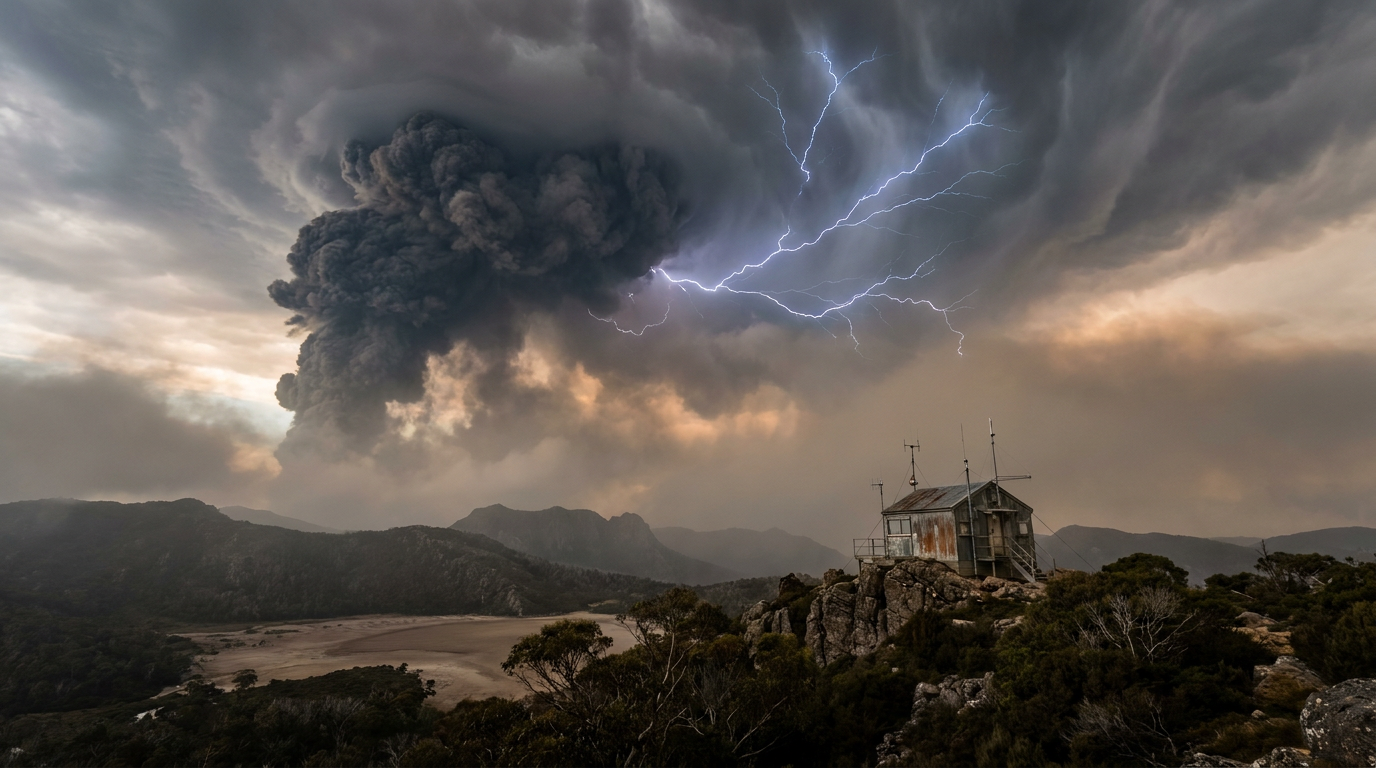
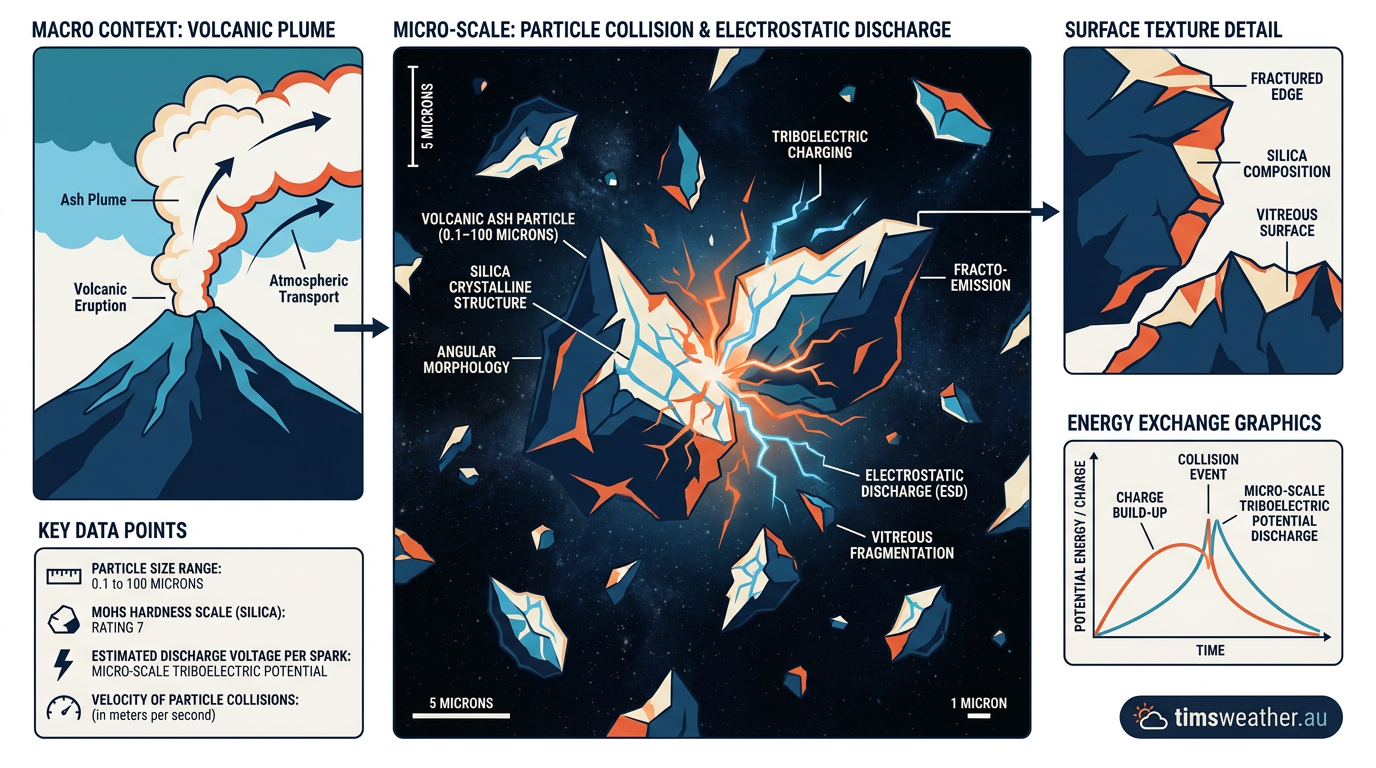
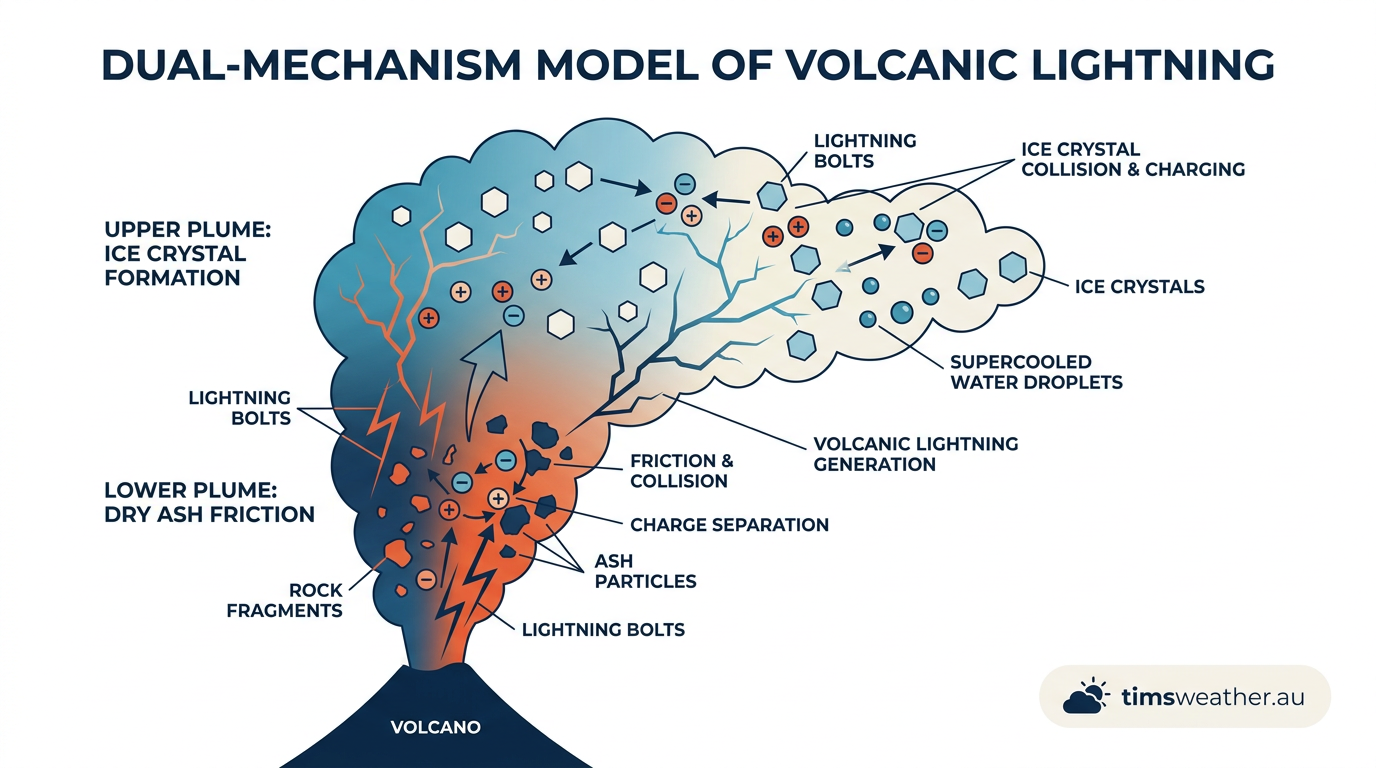
Volcanic lightning forms through charge separation driven by particle collisions. Volcanic lightning occurs when volcanic ash particles and tephra collide in an eruptive plume, creating static electricity through the triboelectric effect. In larger plumes, the freezing of water vapor into ice crystals further amplifies this charge separation, triggering high-voltage discharges.
Key takeaways
The electrification of ash plumes relies on intense friction between fragmented rocks and silicate particles.
Scientists use a dual-mechanism model to explain the process, involving both dry friction near the vent and ice formation at higher altitudes.
Large explosive events generate significantly more electrical activity than smaller, effusive eruptions.
Monitoring volcanic electrical activity provides aviation authorities with essential real-time data on hidden ash clouds.
Author: Tim, Geophysics and Atmospheric Science Educator
How does volcanic lightning form: the physics explained
The dual-mechanism model of ash and ice
How eruption magnitude influences volcanic lightning
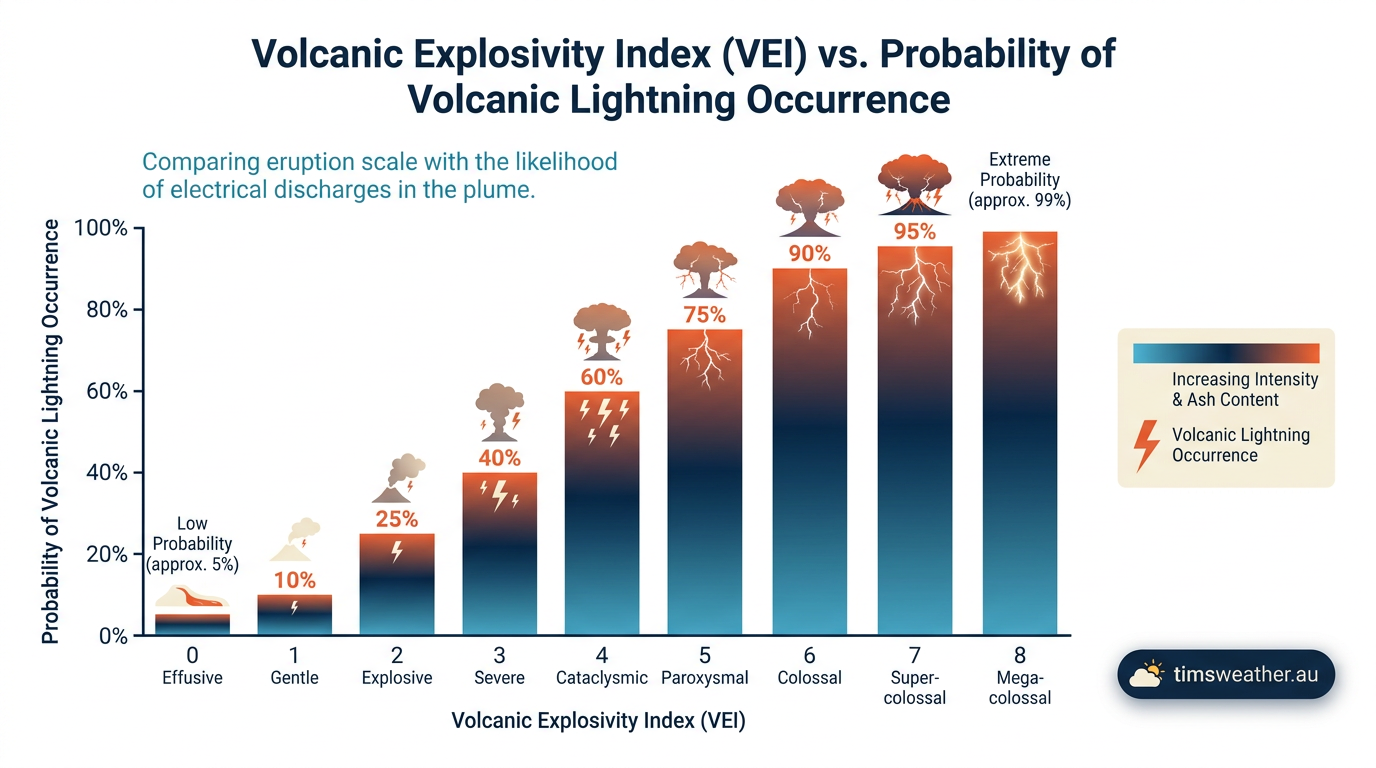
Not all volcanoes produce lightning. The occurrence of electrical discharge is heavily tied to the scale, speed, and composition of the eruptive event. Effusive eruptions, such as slow-moving lava flows found in Hawaii, lack the explosive updrafts necessary for significant charge separation. In contrast, highly explosive eruptions provide the perfect environment.
Plinian eruption columns and the Volcanic Explosivity Index (VEI)
A comprehensive global review of eruptions between April 2009 and February 2022 mapped 490 eruptions across 170 volcanoes, finding that 308 of those eruptions featured volcanic lightning (link.springer.com). The researchers relied heavily on records matched against the Smithsonian Institution Global Volcanism Program.
The probability of observing a volcanic thunderstorm rises sharply with the eruption size. Lightning is reported in fewer than 2% of minor VEI 1–2 events. However, this leaps to roughly 8% for moderate VEI 3–5 eruptions, and reaches 10% or higher for massive VEI 6 eruptions. Massive Plinian eruptions eject large quantities of ash and gas, and volcanic lightning is linked to charge separation in the ash cloud, but supersonic ejection and friction charging are not the standard basis for the mechanism.
Analyzing the Tonga-Hunga Ha'apai eruption and Mount Etna
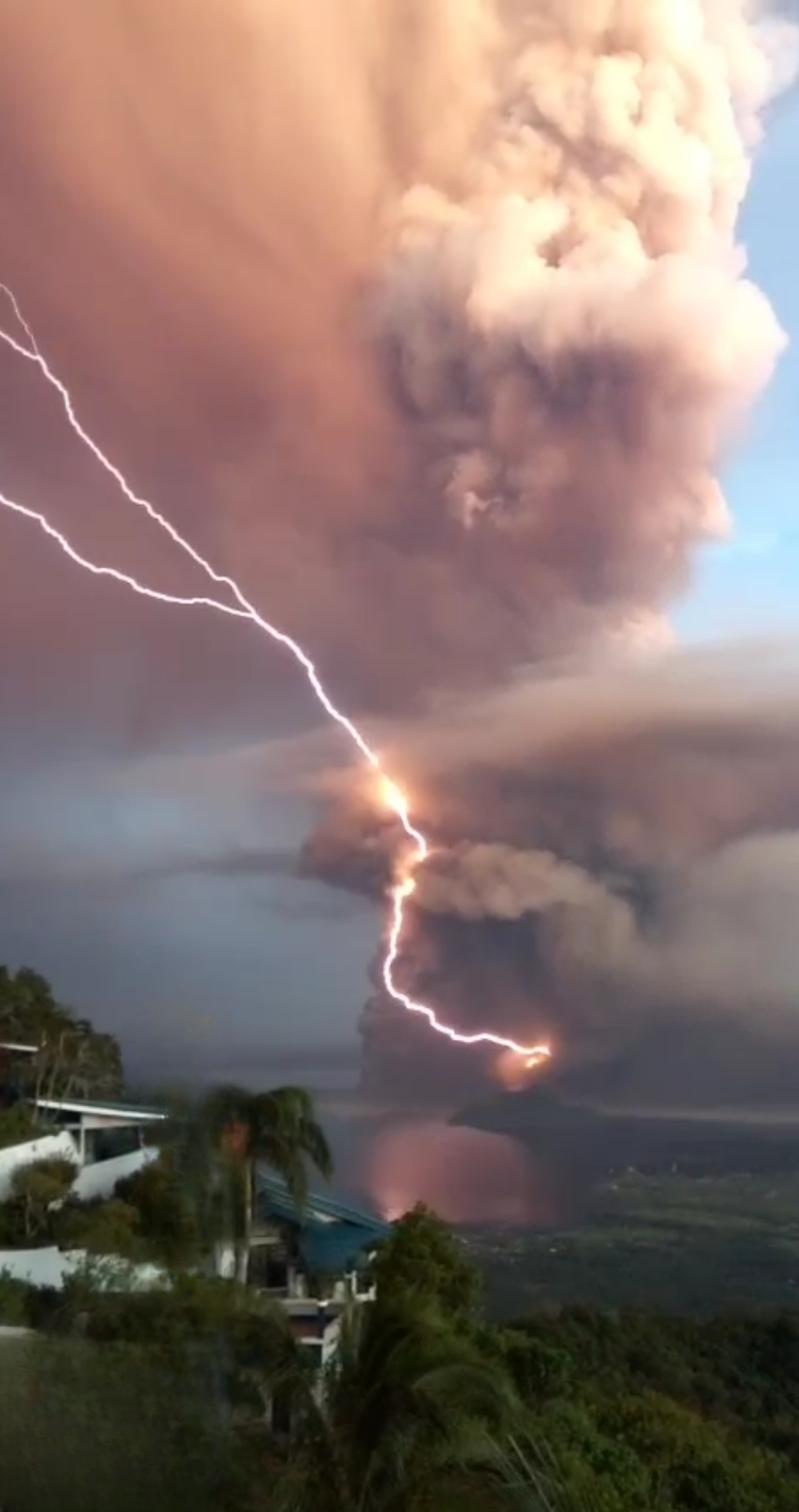
The 15 January 2022 Tonga-Hunga Ha'apai eruption stands as one of the most electrically active events ever recorded. The submarine volcano blasted a massive volume of seawater into the stratosphere alongside its ash, providing extreme amounts of moisture for high-altitude ice nucleation. The resulting umbrella cloud generated thousands of lightning flashes over a few hours, not hundreds of thousands, and it was described as the most intense electrical storm ever detected by global networks.
Similarly, prolonged eruptive phases at Mount Etna frequently generate visible electrical activity. High-resolution observations during nocturnal eruptions have captured dense networks of lightning flashing continuously inside the ash plume of Mount Etna in Sicily (www.facebook.com). These recurring events allow geophysicists to continuously refine their models of particle interaction.
Distinguishing Volcanic Lightning from Meteorological Storms
While a volcanic cloud might look like a dark, towering cumulonimbus, its internal electrical structure differs from a standard weather storm. Researchers must carefully separate eruption-driven discharges from ambient atmospheric electricity to accurately assess volcanic hazards.
Comparing electromagnetic signatures
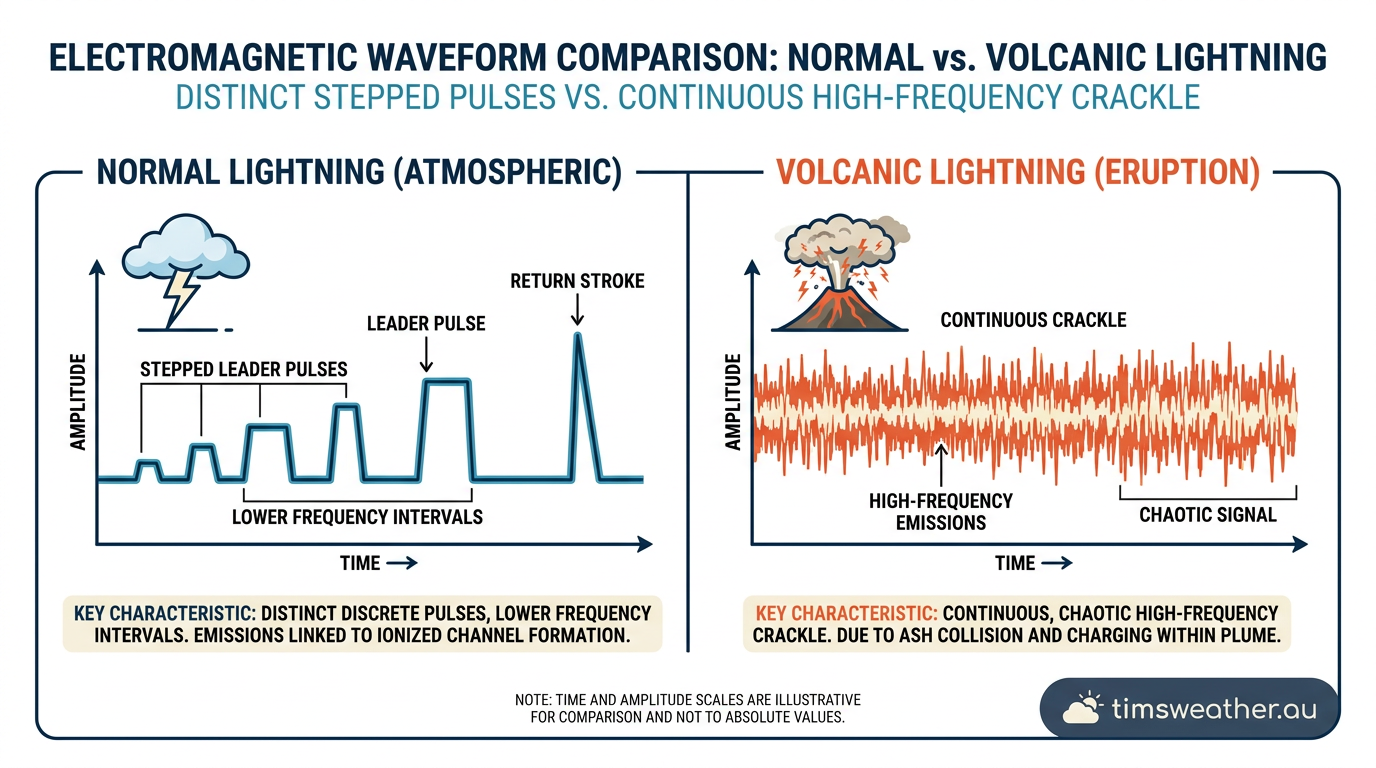
Meteorological lightning typically produces discrete, well-separated flashes driven by the interaction of ice and supercooled water. If you look at how does cloud-to-ground lightning form, the stepped leader process creates specific radio frequency signatures. Volcanic lightning, particularly near the vent, produces a much higher rate of continuous, highly branched discharges.
The electromagnetic signatures of these short vent discharges occur at higher frequencies than normal lightning. Because the charge is distributed across billions of tiny, closely packed ash particles rather than distinct zones of precipitation, the electrical breakdown happens over shorter distances. This creates a signature "crackle" on radio frequency monitoring equipment, distinguishing it immediately from standard storm strikes.
Interactions with the ionosphere
Extremely large volcanic plumes disrupt the global atmospheric electric circuit. When a towering ash column punches through the tropopause and into the stratosphere, it acts as a massive conductive channel. The high concentration of ions and charged aerosols alters the local electric field, facilitating unique high-altitude discharges that reach upward toward the ionosphere, similar to the rare transient luminous events sometimes seen above severe weather systems.
Instrumental Monitoring: How Scientists Detect Eruption-Driven Discharges
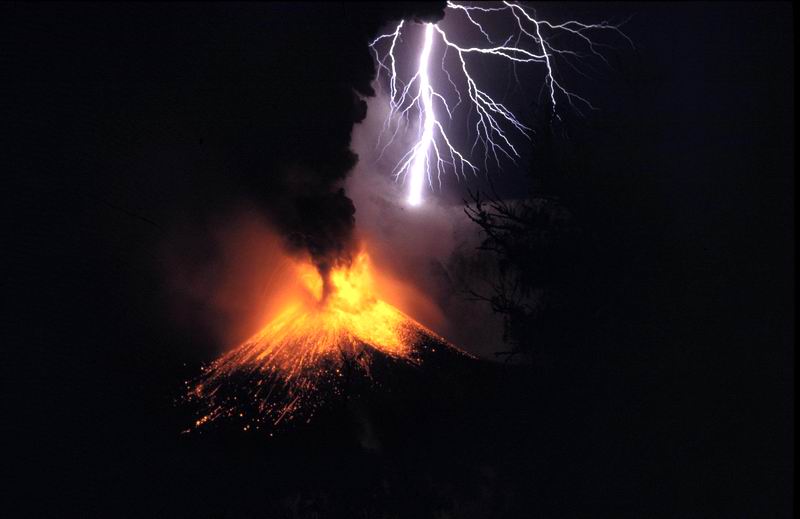
Visual observation of volcanic lightning is incredibly difficult because the flashes are usually hidden deep inside an opaque curtain of ash. To study and monitor these events, scientists rely on specialized remote sensing technology and global networks.
Global lightning detection networks
Historical accounts show that Pliny the Younger first recorded the phenomenon during the eruption of Mount Vesuvius, but modern monitoring relies on the World Wide Lightning Location Network (WWLLN) (www.thehindu.com). The WWLLN tracks the very low frequency (VLF) radio waves generated by lightning strikes worldwide.
By correlating WWLLN data with thermal anomalies from satellites, agencies like the United States Geological Survey can detect explosive eruptions in remote areas instantly. Also, the Geostationary Lightning Mapper (GLM) aboard modern weather satellites provides continuous optical scanning of the Earth, capturing the sudden optical pulses of volcanic lightning even when the plume is hundreds of kilometres away from populated areas.
Field observations and high-speed photography
Close-range field observations require extreme precision and risk. Vulcanologists deploy very high frequency (VHF) lightning mapping arrays around active volcanoes to create three-dimensional models of charge distribution inside the plume. Combined with high-speed photography operating at thousands of frames per second, researchers can finally watch the precise moment a stepped leader forms across a cloud of colliding silicates.
Aviation safety and hazard detection
The study of volcanic lightning extends far beyond academic geophysics; it is a critical component of international aviation safety. Volcanic ash is catastrophic to jet engines, capable of melting inside the combustion chamber and causing total engine failure.
Tracking pyroclastic density currents
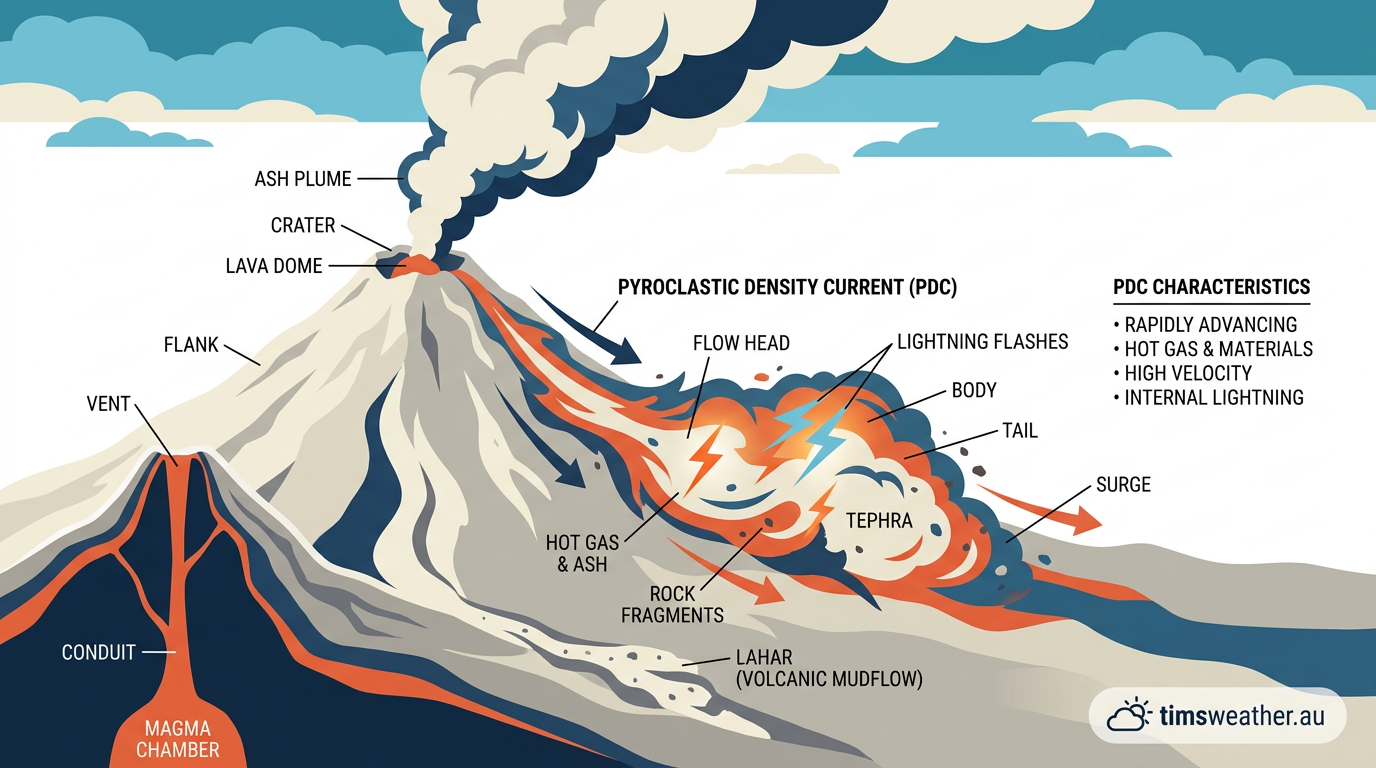
Lightning is not limited to the vertical eruption column. Electrification also occurs within pyroclastic density currents—superheated avalanches of gas and rock that sweep down the flanks of a volcano. These currents generate extreme friction, producing internal lightning strikes that can be detected by regional sensors. Tracking the path of these discharges allows emergency management agencies to map the invisible footprint of a pyroclastic flow in real-time, even at night or during heavy weather.
Warning systems for regional airspace
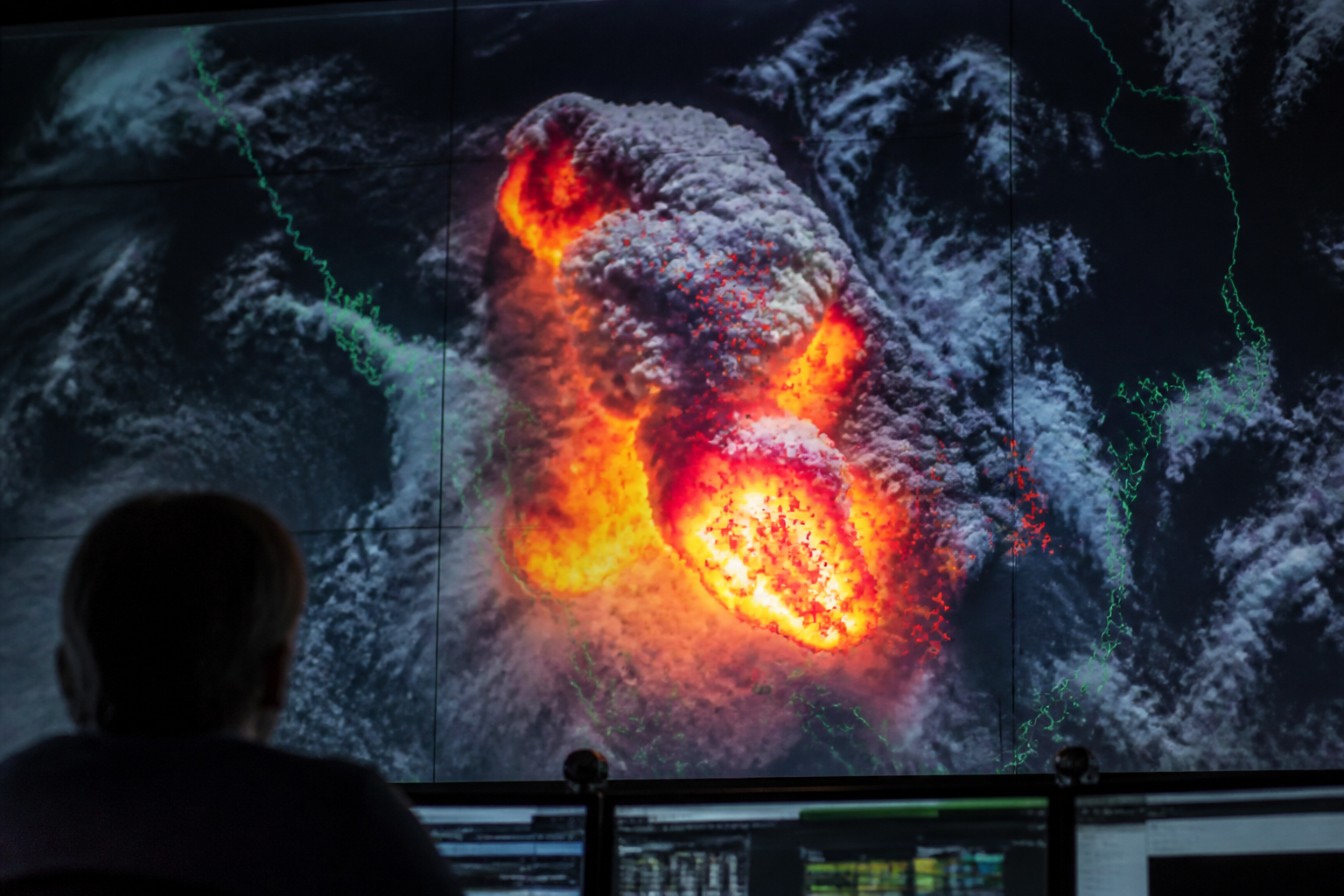
The 2010 eruption of Eyjafjallajökull in Iceland proved how disruptive ash clouds can be to global transport. During that event, continuous electrical monitoring became a vital tool for mapping the plume's density and trajectory. Because weather radar often struggles to differentiate between fine volcanic ash and standard meteorological clouds, lightning frequency serves as a proxy for ash concentration. A sudden spike in electrical activity within a suspected volcanic plume immediately alerts air traffic controllers that a severe, ash-rich explosive phase is underway, allowing them to rapidly reroute commercial flights away from the hazard zone.
Sources
January 15, 2022 Tonga Volcanic Eruption and Tsunami (ncei.noaa.gov)
NOAA weather and atmospheric science reference (repository.library.noaa.gov)
NOAA weather and atmospheric science reference (repository.library.noaa.gov)
Hunga Tonga Hunga Haapai Volcanic Eruption And Tsunami (dfat.gov.au)
Lightning Rings and Gravity Waves: Insights Into the Giant Eruption Plume From Tonga's Hunga Volcano on 15 January 2022 (repository.library.noaa.gov)
NCEI/WDS Global Significant Volcanic Eruptions Database, 4360 BC to Present (ncei.noaa.gov)
Bureau of Meteorology weather reference (bom.gov.au)
NOAA weather and atmospheric science reference (data.noaa.gov)
Last verified: 2026-09-12
Frequently asked questions
Volcanic lightning occurs when erupting ash and rock fragments become electrically charged, then separate into distinct regions within the plume. Once the electrical potential difference becomes sufficiently large, the air breaks down, resulting in a lightning discharge. This process mirrors weather-based storms but relies on volcanic materials instead of ice.
Source: science.nasa.gov
Further reading and resources
Explore trusted articles, books, videos and other resources to go deeper on this topic.
vaisala.comArticle
Eruptive Electricity – The Shocking Presence of Volcanic Lightning
In-depth coverage on How Does Volcanic Lightning Form? The Physics of Ash Cloud Electrification from vaisala.com.
pmc.ncbi.nlm.nih.govReference
Volcanic electrification: recent advances and future perspectives
Background reference on How Does Volcanic Lightning Form? The Physics of Ash Cloud Electrification from pmc.ncbi.nlm.nih.gov.
volcano.oregonstate.eduReference
Volcanic Lightning | Volcano World - Oregon State University
Background reference on How Does Volcanic Lightning Form? The Physics of Ash Cloud Electrification from volcano.oregonstate.edu.
en.wikipedia.orgReference
Volcanic lightning - Wikipedia
Background reference on How Does Volcanic Lightning Form? The Physics of Ash Cloud Electrification from en.wikipedia.org.
nationalgeographic.comArticle
See how volcanoes spark lightning storms | National Geographic
In-depth coverage on How Does Volcanic Lightning Form? The Physics of Ash Cloud Electrification from nationalgeographic.com.
youtube.comVideo
Lightning Storm Inside A Volcano - YouTube
Video coverage on How Does Volcanic Lightning Form? The Physics of Ash Cloud Electrification from youtube.com.
newscientist.comArticle
The mystery of how volcanic lightning happens has been solved
In-depth coverage on How Does Volcanic Lightning Form? The Physics of Ash Cloud Electrification from newscientist.com.
pbs.orgArticle
How Volcanic Lightning Is Making the World a Safer Place | Season 2 - PBS
In-depth coverage on How Does Volcanic Lightning Form? The Physics of Ash Cloud Electrification from pbs.org.
blogs.egu.euArticle
Volcanic Lightning: Impacts on plume-suspended ash particles
In-depth coverage on How Does Volcanic Lightning Form? The Physics of Ash Cloud Electrification from blogs.egu.eu.
hilo.hawaii.eduReference
Lightning in the Volcanic Plume - UH Hilo
Background reference on How Does Volcanic Lightning Form? The Physics of Ash Cloud Electrification from hilo.hawaii.edu.
Planning weeks ahead?
Check Australia's long-range seasonal outlook for rainfall, temperature and the climate drivers (ENSO, IOD, SAM, MJO) shaping the next three months.
View Australia's Seasonal Weather Forecast