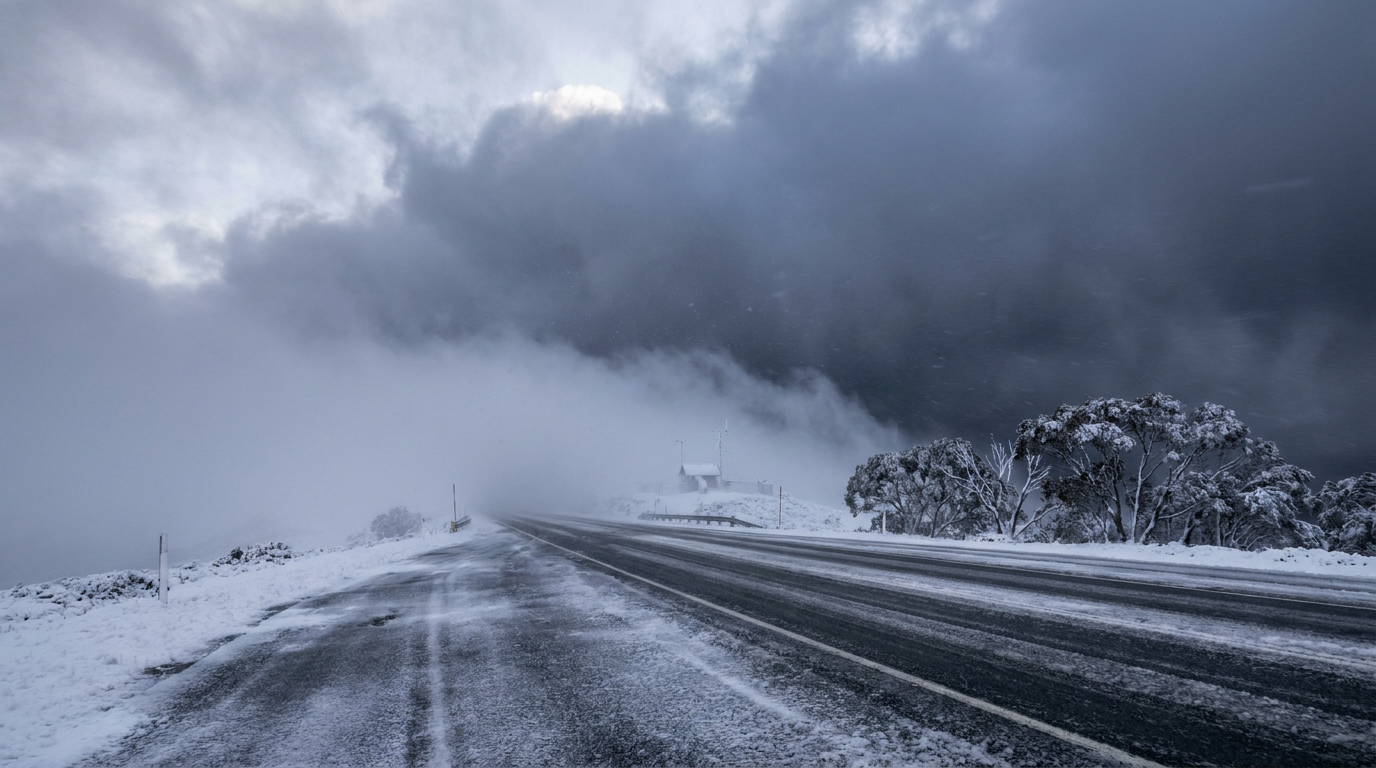
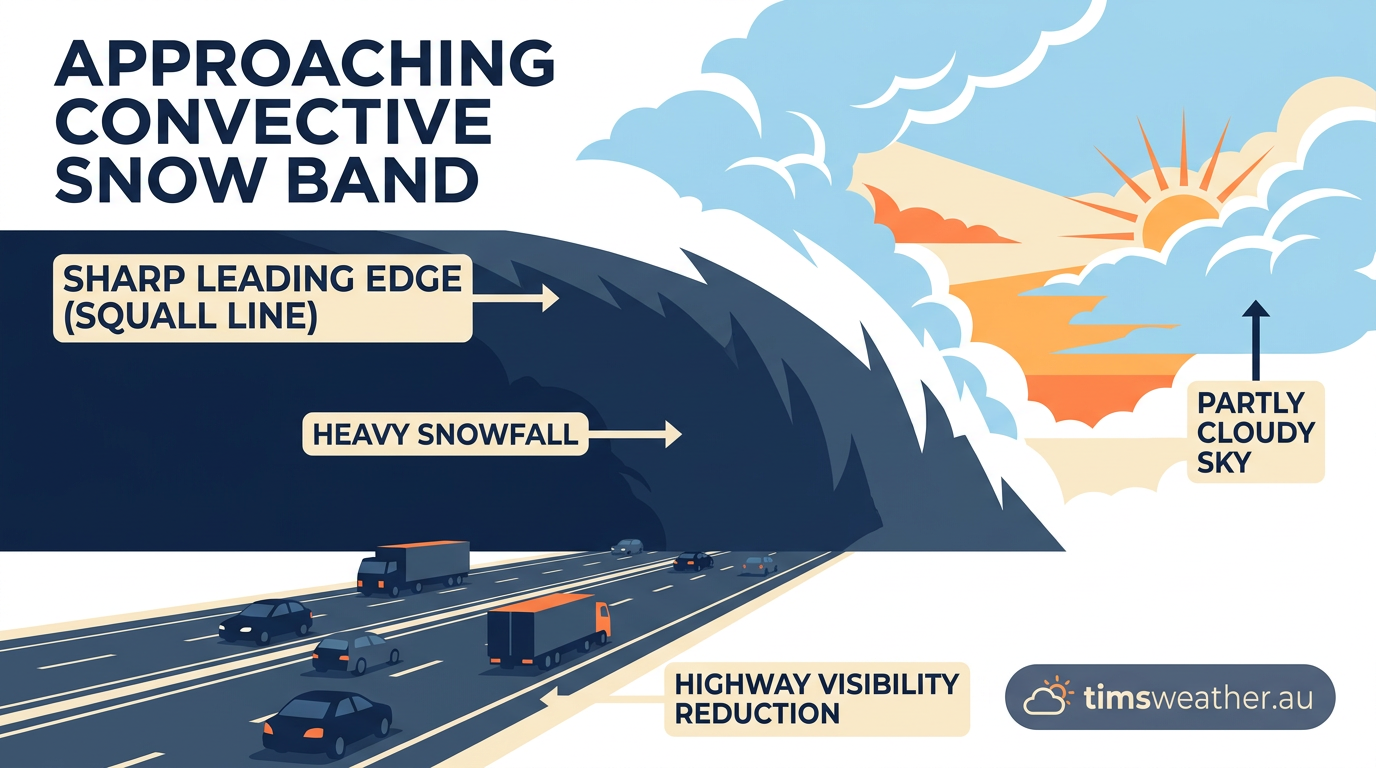
A snow squall is a short-lived burst of sudden heavy snowfall paired with gusty winds that drives visibility to near zero. Driven by extreme atmospheric instability, these transient events create instant whiteout conditions and flash-freeze hazards on highways, often catching drivers completely by surprise.
Key takeaways
A snow squall typically lasts between 15 and 60 minutes but delivers blinding snowfall and rapid icing.
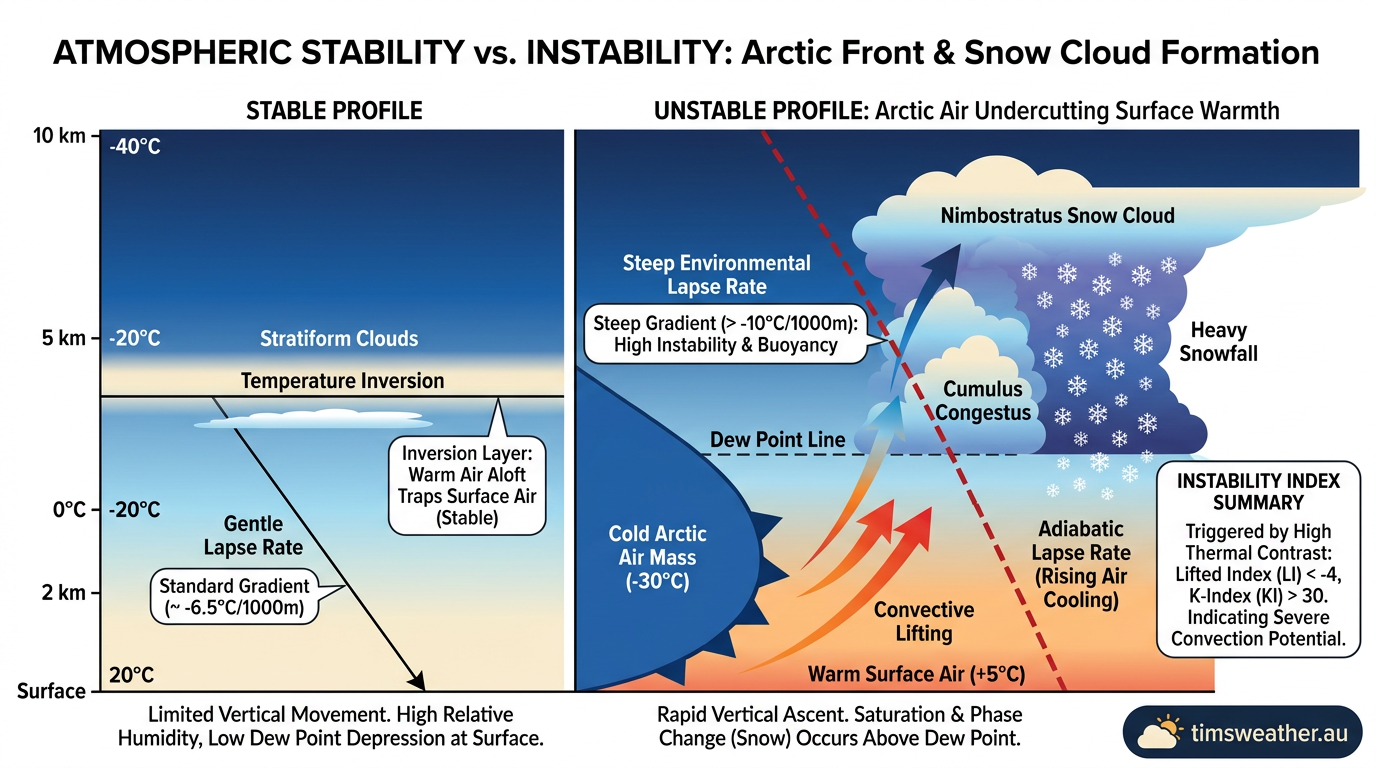
These events are driven by steep environmental lapse rates and intense atmospheric instability rather than deep storm systems.
The primary danger is not total snow accumulation, but the instantaneous transition from clear skies to zero visibility.
Warning times are exceptionally short, meaning drivers must act immediately when a squall approaches.
Anatomy of a 15-Minute Whiteout: Why Speed Matters
Meteorological Drivers: The Instability Behind the Snow Band
Contrast: Snow Squalls vs Standard Lake-Effect Snow
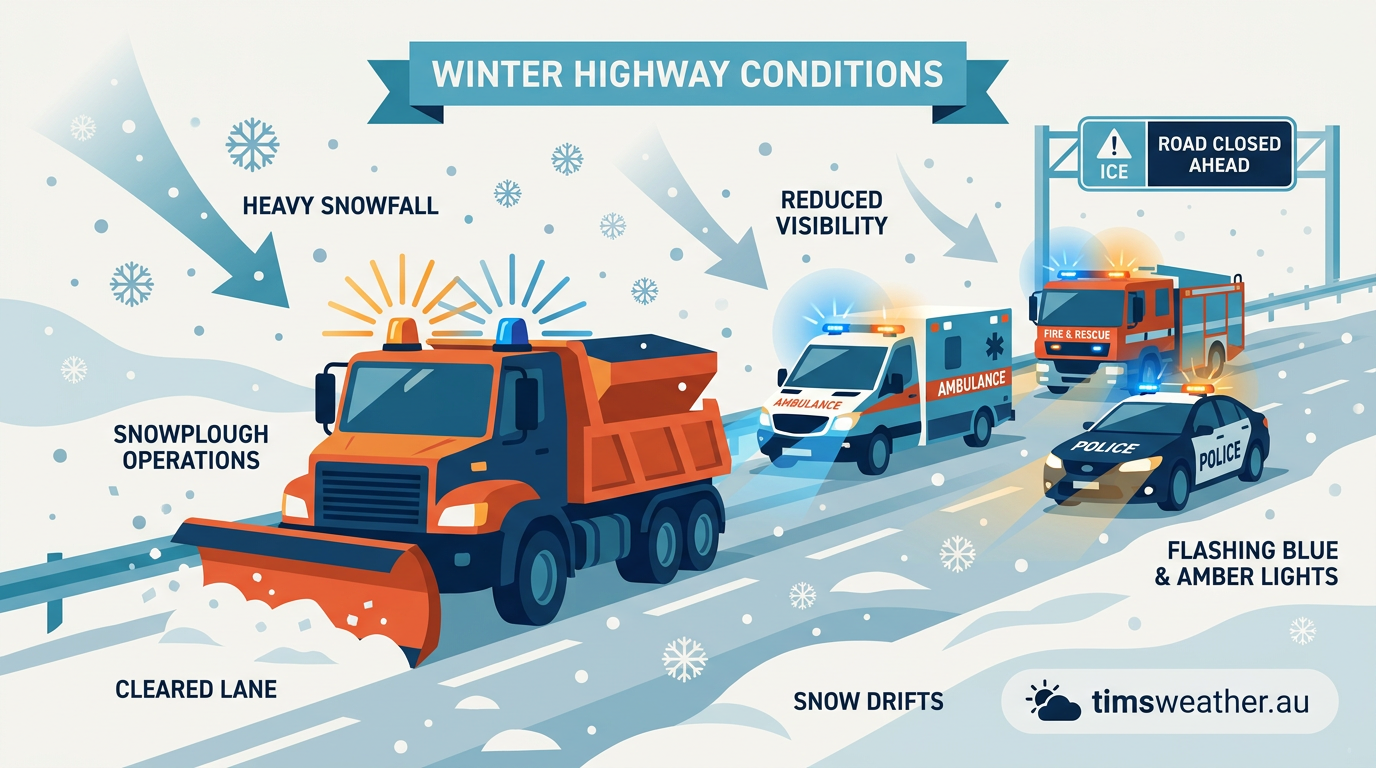
How the distinction between different types of winter precipitation is vital for accurately perceiving the risk. While lake-effect snow and snow squalls share similar convective origins, their impacts on the ground manifest in entirely different ways.
Standard lake-effect snow bands often remain stationary over a single location for hours or even days, dropping massive accumulations of snow. A snow squall is highly transient. It is moving rapidly, driven by the background wind field and the steering currents of the jet stream aloft. The squall does not stay in place long enough to bury a town in snow, but its transient nature means it covers vast distances, impacting numerous major highways and catching hundreds of thousands of commuters off guard.
Feature | Snow Squall | Blizzard | Lake-Effect Snow |
|---|---|---|---|
Duration over one spot | 15 to 60 minutes | Several hours to days | Hours to several days |
Visibility Reduction | Near-zero instantly | Consistently low over time | Variable depending on band location |
Total Accumulation | Minimal (Under 5 cm) | High (Over 15 cm) | Extremely high (Often over 30 cm) |
Primary Threat | Flash freezing and multi-vehicle pileups | Prolonged exposure and large snow drifts | Deep snow accumulation burying infrastructure |
The transient nature of a squall is exactly what makes it so lethal. Drivers who check the daily forecast might see predictions of less than 2 centimetres of snow and assume travel will be safe. They fail to realise that the entire total will fall in a terrifying 15-minute window accompanied by wind gusts exceeding 80 km/h (50 mph).
Predictive Forecasting: Decoding NWS Snow Squall Warnings
Forecasting these rapid events is one of the most challenging tasks in mesoscale meteorology. Global weather models operate on grid spacings that are often too large to resolve a convective snow band that is only 5 kilometres wide. Consequently, forecasters must rely heavily on high-resolution mesoscale models and real-time observational tools to issue life-saving warnings.
Doppler Radar Velocity Signatures
Meteorologists use Doppler radar to track the physical structure of the approaching snow band. They look for sharp gradients in the base reflectivity products, which indicate a solid wall of heavy precipitation. More importantly, they analyse base velocity products to detect low-level convergence and abrupt wind shifts along the leading edge of the squall. When strong inbound winds meet stationary or outbound winds, it signals powerful rising air that will fuel intense snowfall rates.
The Short Lead Time Challenge
Because these storms develop and evolve so rapidly, warning lead times are inherently short. The National Weather Service typically issues Snow Squall Warnings with a lead time of just 30 to 60 minutes. This danger is clearly demonstrated by warnings issued by NBC Chicago during morning commutes along the busy I-57 and I-65 corridors, urging drivers to delay travel immediately before the bands hit the metropolitan area.
A Snow Squall Warning is treated with the same urgency as a Severe Thunderstorm Warning or a Tornado Warning. It triggers emergency alerts on mobile phones because the threat to life and property is imminent. Forecasters integrate these warnings with the Winter Storm Severity Index to communicate how an ostensibly low-snowfall event can generate a high-impact travel disaster.
Highway Hazards: Quantifying the Multi-Vehicle Pileup Risk
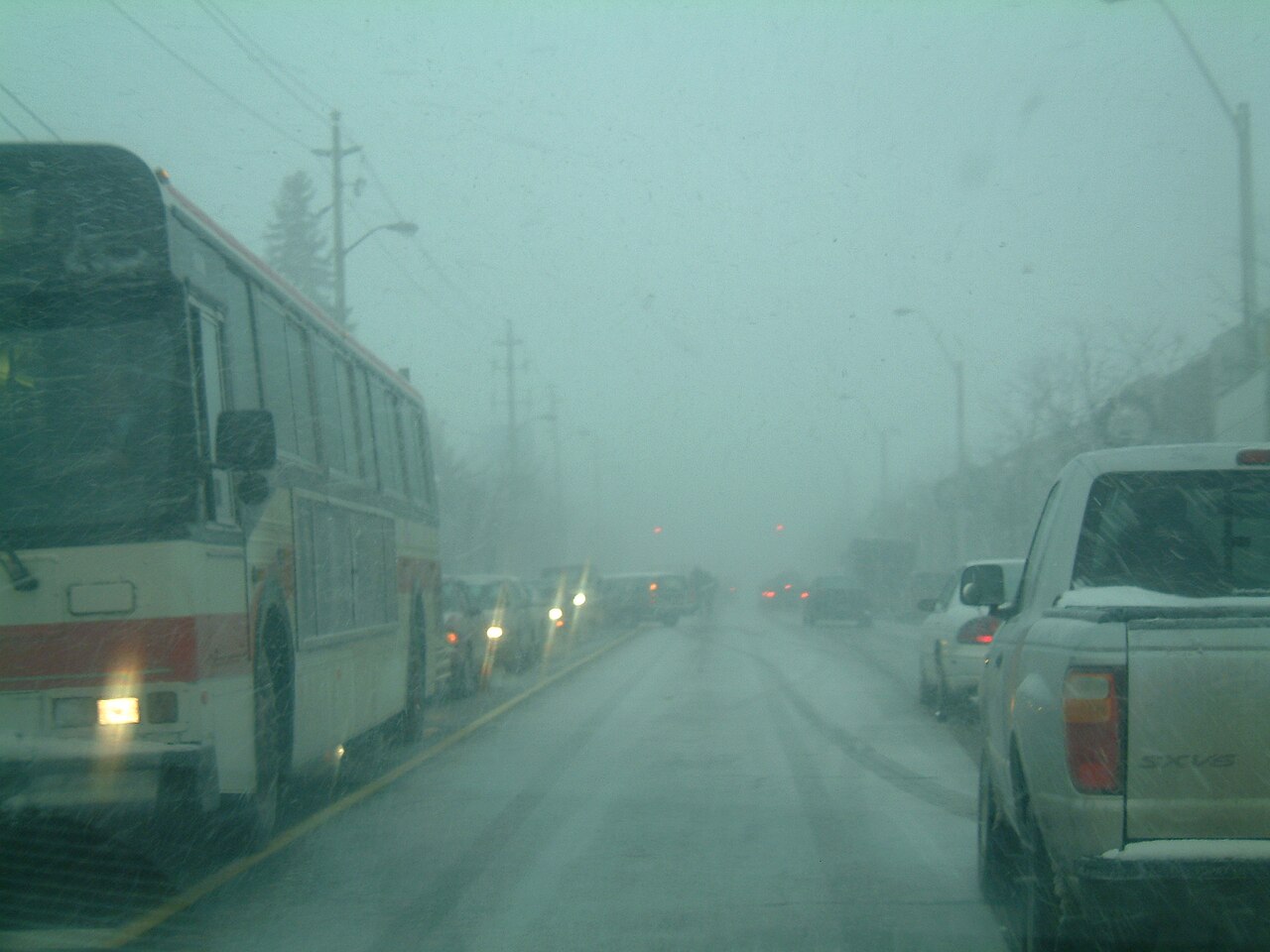
When a snow squall intersects with a major interstate highway, the results are frequently catastrophic. The combination of intense snowfall, plunging temperatures, and high-speed traffic creates a perfect storm for mass-casualty accidents.
The Mechanics of a Flash Freeze
The most insidious component of a squall is the flash-freeze effect. When the squall first begins, the initial snowflakes may melt upon contacting road surfaces that have been warmed by earlier sunshine or vehicle friction. However, the squall drags a violently cold Arctic air mass down to the surface with it. Within minutes, the ambient air temperature and the road surface temperature plummet well below freezing.
The melted water on the road instantly crystallizes into a sheer sheet of black ice, which is immediately covered by a fresh layer of blowing snow. This process removes all available traction from the asphalt. When panicked drivers hit the brakes due to the sudden loss of visibility, their tyres lock up on the ice, turning their vehicles into unguided kinetic projectiles.
Historical Case Studies and Multi-Vehicle Impacts
The National Weather Service in State College notes that high-impact events like the catastrophic Interstate 81 crash in Pennsylvania during March 2022 resulted in three fatalities and dozens of injuries. In incidents like this, chain-reaction collisions involve dozens of tractor-trailers and passenger cars.
At highway speeds, a vehicle travelling 100 km/h (62 mph) covers roughly 28 metres every second. In a severe whiteout, forward visibility can drop to less than 10 metres. By the time a driver perceives the brake lights of a stopped vehicle ahead, they have already traveled past the point of safe stopping distance. The resulting pileups are characterized by repeated, high-speed secondary impacts as following vehicles plunge blindly into the wreckage.
Safety Protocols: Immediate Action When Visibility Drops to Zero
Surviving a snow squall on the highway requires rapid, calm decision-making. Defensive driving principles change entirely when traction and visibility vanish simultaneously.
Visual evidence gathered by Fox Weather through timelapses sweeping across cities like Altoona, Pennsylvania, reveals how quickly the horizon vanishes behind a solid wall of white. Drivers must not wait for the snow to become heavy before acting. The moment a dark, ominous snow band is visible on the horizon, or an emergency alert is received, motorists should seek the nearest exit and pull into a safe parking area off the highway.
Safety bulletins from the National Weather Service Cleveland during winter awareness campaigns stress that immediate speed reduction is the only reliable way to survive a sudden whiteout. If exiting the road is impossible, drivers must gradually reduce their speed without slamming on the brakes, turn on their low-beam headlights and hazard lights to increase their visibility to others, and maintain a generous following distance. Stopping entirely on the active lanes of a highway is highly dangerous, as trailing vehicles may crash into stationary cars from behind.
How the distinction between an advisory and a warning is essential for public safety. A winter weather advisory indicates that conditions will cause inconvenience, whereas a Snow Squall Warning means that life-threatening conditions are imminent and active travel must be paused until the brief, violent band passes.
Sources
NOAA weather and atmospheric science reference (ready.noaa.gov)
Radar Color Tables - Snow Squalls and Snow Squall Warnings (vlab.noaa.gov)
Other - Snow Squalls and Snow Squall Warnings (vlab.noaa.gov)
NOAA weather and atmospheric science reference (repository.library.noaa.gov)
WMO e-Library (library.wmo.int)
NOAA weather and atmospheric science reference (repository.library.noaa.gov)
NOAA weather and atmospheric science reference (repository.library.noaa.gov)
Last verified: 2026-09-18
Frequently asked questions
A snow squall is a brief, intense burst of heavy snow and gusty winds that causes sudden whiteout conditions and slick roads. It is particularly dangerous because visibility and traction can vanish within minutes, often catching drivers by surprise and leading to high-speed pile-ups on busy highways.
Source: weather.gov
Further reading and resources
Explore trusted articles, books, videos and other resources to go deeper on this topic.
freep.comArticle
Snow squalls lead to major crash, close U.P. roads. What causes them?
In-depth coverage on Snow Squalls: The 15-Minute Whiteout That Closes Highways from freep.com.
weather.govReference
Snow Squall Science, Communication, and Safety
Background reference on Snow Squalls: The 15-Minute Whiteout That Closes Highways from weather.gov.
nbcchicago.comArticle
What is a snow squall? Warning issued in Chicago area
In-depth coverage on Snow Squalls: The 15-Minute Whiteout That Closes Highways from nbcchicago.com.
[PDF] Article Snow Squalls: Forecasting and Hazard Mitigation
Background reference on Snow Squalls: The 15-Minute Whiteout That Closes Highways from weather.gov.
youtube.comVideo
Snow Squalls - How to Stay Safe and Prepared! - YouTube
Video coverage on Snow Squalls: The 15-Minute Whiteout That Closes Highways from youtube.com.
Snow Squall - National Weather Service
Background reference on Snow Squalls: The 15-Minute Whiteout That Closes Highways from weather.gov.
noaa.govReference
Snow squall warnings now available nationwide - NOAA
Background reference on Snow Squalls: The 15-Minute Whiteout That Closes Highways from noaa.gov.
itsmichigan.orgArticle
[PDF] Snow Squall Warnings: An Overview - ITS Michigan
In-depth coverage on Snow Squalls: The 15-Minute Whiteout That Closes Highways from itsmichigan.org.
4 tips to keep you safe during a snow squall - NOAA
Background reference on Snow Squalls: The 15-Minute Whiteout That Closes Highways from noaa.gov.
dispartilaw.comArticle
What is a Snow Squall and Why Are They So Dangerous?
In-depth coverage on Snow Squalls: The 15-Minute Whiteout That Closes Highways from dispartilaw.com.
Planning weeks ahead?
Check Australia's long-range seasonal outlook for rainfall, temperature and the climate drivers (ENSO, IOD, SAM, MJO) shaping the next three months.
View Australia's Seasonal Weather Forecast