
How dew point vs humidity helps explain how air actually feels. Dew point is the temperature at which air becomes saturated with water vapour, while relative humidity shows how close the air is to saturation at a given temperature. That makes dew point a steadier guide to comfort, especially on hot Australian days.
Key takeaways
- Dew point gives a direct read on atmospheric moisture and is often a better comfort guide than relative humidity.
- Relative humidity changes with temperature, so the percentage can fall on a hot afternoon even if the moisture content stays the same.
- The Bureau of Meteorology (BOM) explains that dew point is a clearer way to judge how sticky the air feels.
- High dew points reduce evaporative cooling, so sweat does not dry as easily and comfort levels drop.
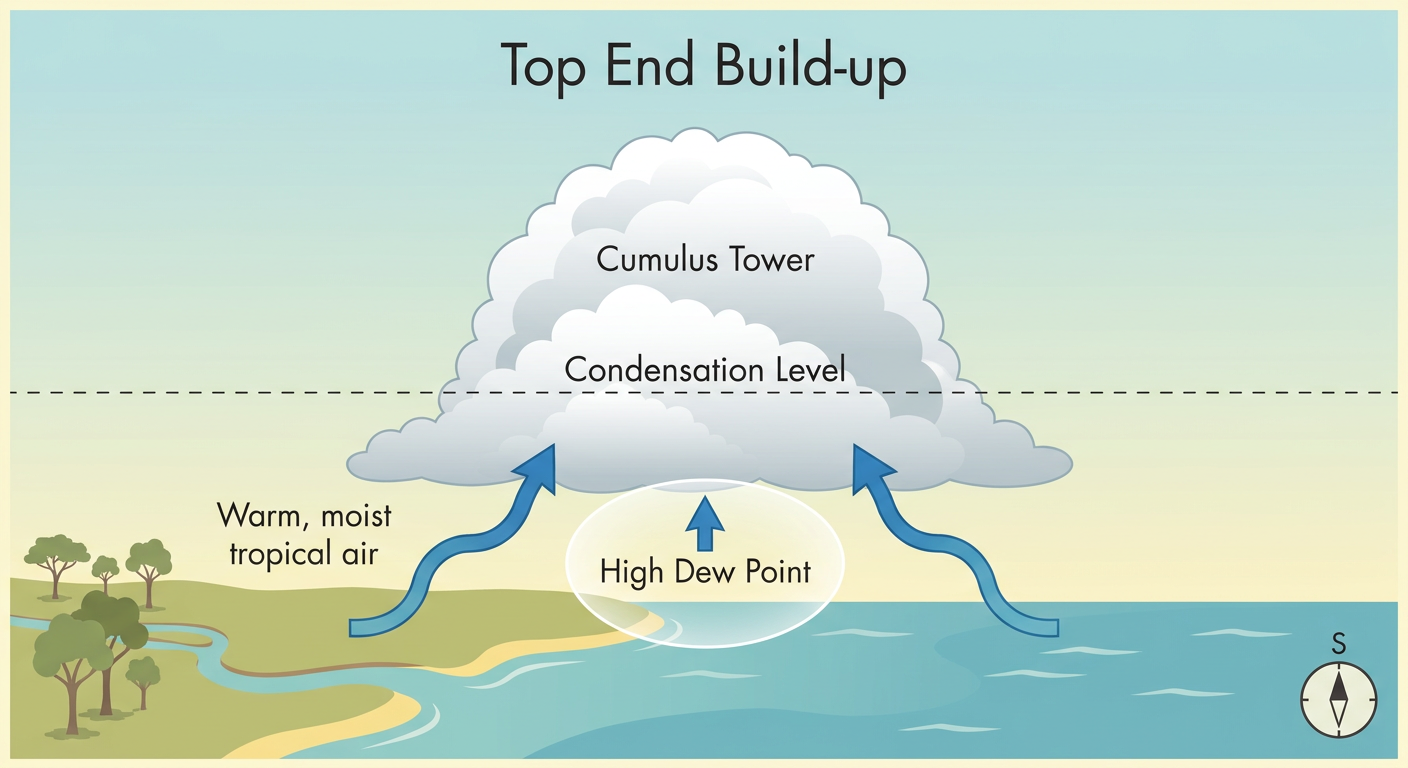
- In northern Australia, high dew points are a common sign of the Top End Build-up before the wet season.
Dew Point vs Humidity: Key Differences
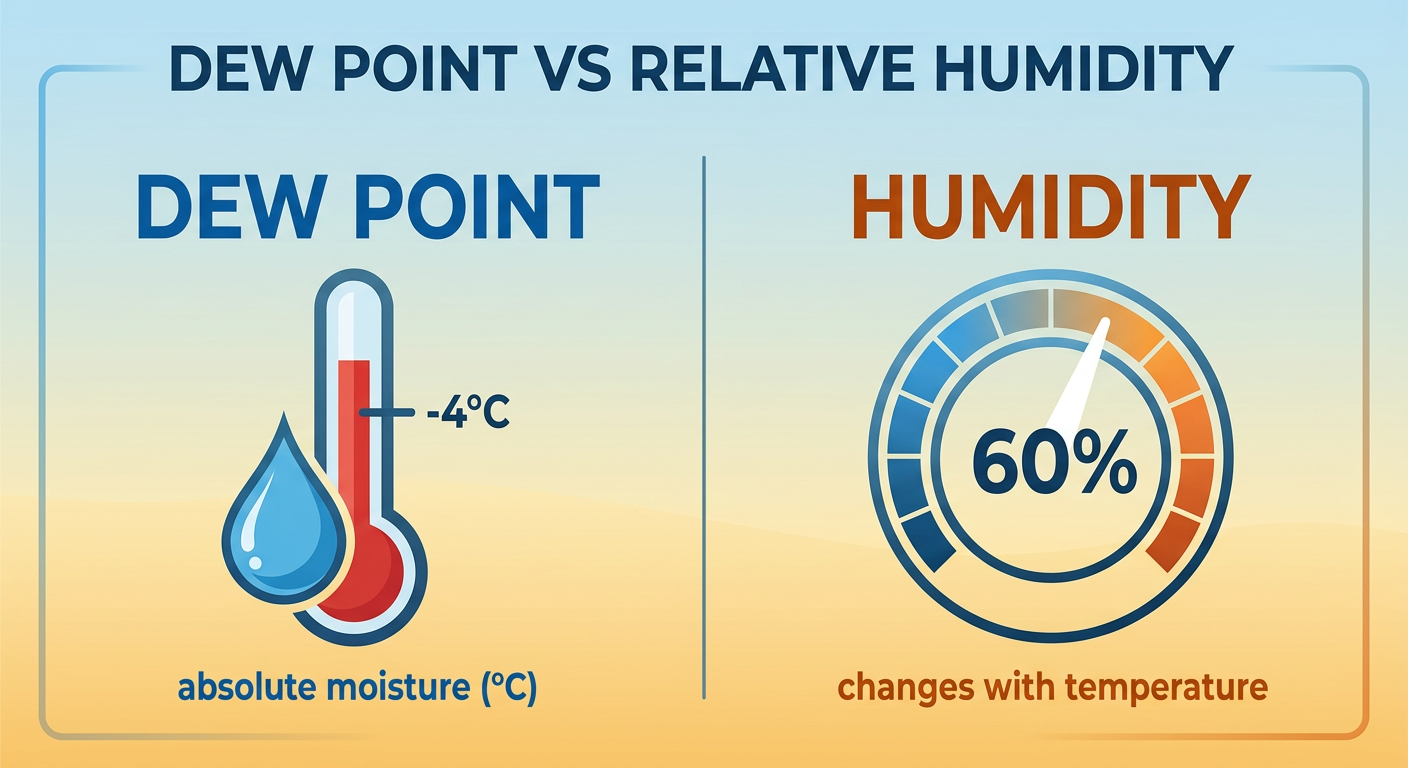
Dew point and relative humidity describe the same air mass in different ways. Dew point gives the moisture level directly, while relative humidity changes as temperature changes.
The BOM notes that dew point is a more useful measure when you want to know how muggy the air feels. Relative humidity is still useful, but it can look misleading on warm afternoons because warmer air can hold more water vapour.
What dew point tells you
Dew point is the temperature the air must cool to before water vapour starts to condense. If air cools to the dew point, it reaches saturation and condensation can form as dew, fog or frost.
That is why dew point works well as a measure of moisture content. It stays tied to the actual amount of water vapour in the air, not just to the current dry bulb temperature.
Why relative humidity changes so fast
Relative humidity is a percentage. It compares the moisture in the air with the maximum amount that air could hold at that temperature.
As the day warms, the same air can show a lower percentage even if no water vapour has been lost. That is one reason a forecast can show 90% humidity at dawn and a much lower reading by mid-afternoon.
For a plain-language definition of these terms, see our Weather Glossary.
Why Dew Point Is Better for Comfort Prediction
For day-to-day comfort, dew point usually tells you more than relative humidity. It links more directly to evaporative cooling, which is how sweat removes heat from your body.
How evaporative cooling works
When sweat evaporates, it takes heat away from the skin. Dry air can take up that moisture more easily, so sweat dries faster and you feel cooler.
When dew point is high, the air already holds a lot of water vapour. Sweat evaporates more slowly, so your body has a harder time shedding heat. That is why a humid 28°C day on the New South Wales coast can feel more tiring than a dry inland afternoon at a higher temperature.

Why the 18-degree rule matters
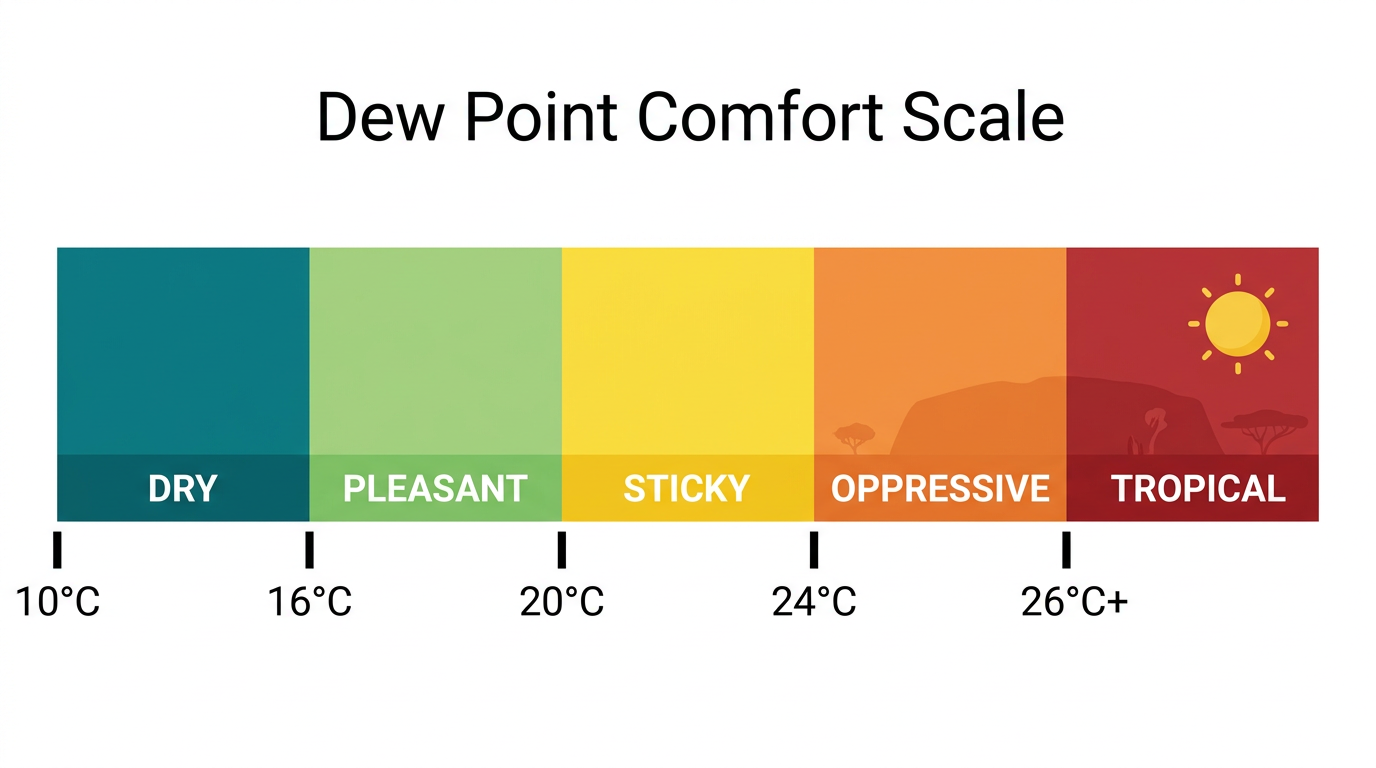
A dew point near 18°C is often used as a practical marker for muggy tropical air. It is not a hard scientific boundary, but it does help show when moisture levels are high enough for comfort to drop quickly.
That is why you may see talk of The 18-Degree Rule: Identifying Tropical Air Masses on BOM Maps. Once dew points sit in that range, the air often feels sticky, especially when winds are light and cloud cover holds heat in overnight.
Wet Bulb Globe Temperature and Heat Stress Index
Heat safety tools such as Wet Bulb Globe Temperature and the Heat Stress Index go beyond a simple humidity percentage. They combine several factors, including temperature, moisture and radiation load, to estimate how hard it is for the body to cool itself.
That matters for outdoor work, sport and emergency response. Dew point helps explain why those tools rise so quickly on still, humid days, when latent heat and water vapour make evaporative cooling less effective.
Psychrometrics, dry bulb temperature and moisture content
Psychrometrics is the study of air and water vapour mixtures. It links dry bulb temperature, moisture content, relative humidity and dew point in one framework.
In simple terms, psychrometrics explains why the same moisture level can feel comfortable on one day and oppressive on another. The air temperature sets the capacity, while the water vapour already present sets how close the air is to saturation.
How Dew Point Affects Clouds, Rain and Storms
Dew point also helps explain cloud base, rainfall and storm potential. When air cools to its dew point, condensation starts, and that can build cloud where rising air keeps lifting moisture upward.
Adiabatic cooling over the Great Dividing Range
The Great Dividing Range forces moist air to rise. As that air rises, it expands and cools in a process called adiabatic cooling.
If the air already has a high dew point, it reaches saturation sooner. That helps form cloud on the eastern side of the range and contributes to the higher rainfall totals often seen there compared with inland areas west of the ranges.
For rain and thunder updates, see our Rainfall & Thunderstorm Forecast resources.
Latent heat and severe weather
When water vapour condenses into cloud droplets, it releases latent heat. That heat adds energy to rising air and can strengthen updrafts inside thunderstorms.
High dew points do not cause storms on their own, but they give storms more fuel to work with. In tropical Australia, that moisture load also matters for cyclone development, because warm, humid air helps support deep convection around the core of the system.
Why Dew Point Outperforms Humidity for Australian Comfort Prediction
For everyday weather reading, dew point is often the better number to watch. This is why many forecasters refer to dew point rather than humidity when they talk about muggy conditions.
BOM guidance points readers to dew point observations and forecasts because the value changes less with temperature swings. That makes it easier to compare a cool, damp morning with a hot afternoon and still judge how much water vapour is in the air.
In practice, this helps in three common situations:
- Coastal summer days, where sea breezes bring moist air inland.
- Winter mornings, when relative humidity can spike without the air feeling especially damp.
- Tropical build-up periods, when high dew points signal sticky nights and poor relief after sunset.
What the Top End Build-up tells you
The Top End Build-up is the hot, sticky run-up to the wet season in northern Australia. High dew points are a big part of why it feels so heavy.
During this period, the air often stays warm and moist overnight, so mornings begin with little relief. That is one reason dew point is so useful for people living in Darwin, Kakadu and nearby parts of the Northern Territory.
How to use dew point in a forecast
Use dew point to judge comfort, moisture and the chance of sticky air. Use relative humidity to understand how close the air is to saturation at that moment.
- Check dew point first if you want to know how muggy the day will feel.
- Look at relative humidity to see how that moisture compares with the day’s temperature.
- Watch for rising dew points ahead of humid nights, cloud build-up and stormy weather.
- On hot days, compare dew point with wind and cloud cover, because both affect comfort levels.
If you are checking a BOM forecast map, a rising dew point usually gives a clearer comfort signal than the humidity percentage alone.
Related guides
Frequently asked questions
Dew point provides a stable measure of stickiness regardless of temperature changes. While relative humidity might drop during a hot afternoon, a high dew point indicates that significant water vapour remains, often making it feel much muggier and more uncomfortable for residents in tropical or coastal Australian regions.
Source: hvacmensch.substack.com
Further reading and resources
Explore trusted articles, books, videos and other resources to go deeper on this topic.
theguardian.comArticle
Dew point and sticky sweat: why humidity is so uncomfortable
In-depth coverage on Dew Point vs Humidity: What It Means for Aussie Weather from theguardian.com.
foxweather.comArticle
Dew point vs. humidity: Which one is a better measure of how muggy the air ...
In-depth coverage on Dew Point vs Humidity: What It Means for Aussie Weather from foxweather.com.
weather.govReference
Dew Point vs Humidity
Background reference on Dew Point vs Humidity: What It Means for Aussie Weather from weather.gov.
smartvent.co.nzArticle
How does dew point relate to comfort and humidity?
In-depth coverage on Dew Point vs Humidity: What It Means for Aussie Weather from smartvent.co.nz.
media.bom.gov.auReference
Social > Feeling hot and bothered? It's not the humidity, it's the dew point
Background reference on Dew Point vs Humidity: What It Means for Aussie Weather from media.bom.gov.au.
en.wikipedia.orgReference
Dew point
Background reference on Dew Point vs Humidity: What It Means for Aussie Weather from en.wikipedia.org.
nesdis.noaa.govReference
What Is Humidity? | NESDIS - NOAA
Background reference on Dew Point vs Humidity: What It Means for Aussie Weather from nesdis.noaa.gov.
abc.net.auArticle
Dew point vs humidity: Unraveling the science behind Queensland's ...
In-depth coverage on Dew Point vs Humidity: What It Means for Aussie Weather from abc.net.au.
boards.straightdope.comArticle
Explain "dew point" like I'm a stupid child plz? - Page 2 - Factual Questions
In-depth coverage on Dew Point vs Humidity: What It Means for Aussie Weather from boards.straightdope.com.
Planning weeks ahead?
Check Australia's long-range seasonal outlook for rainfall, temperature and the climate drivers (ENSO, IOD, SAM, MJO) shaping the next three months.
View Australia's Seasonal Weather Forecast