
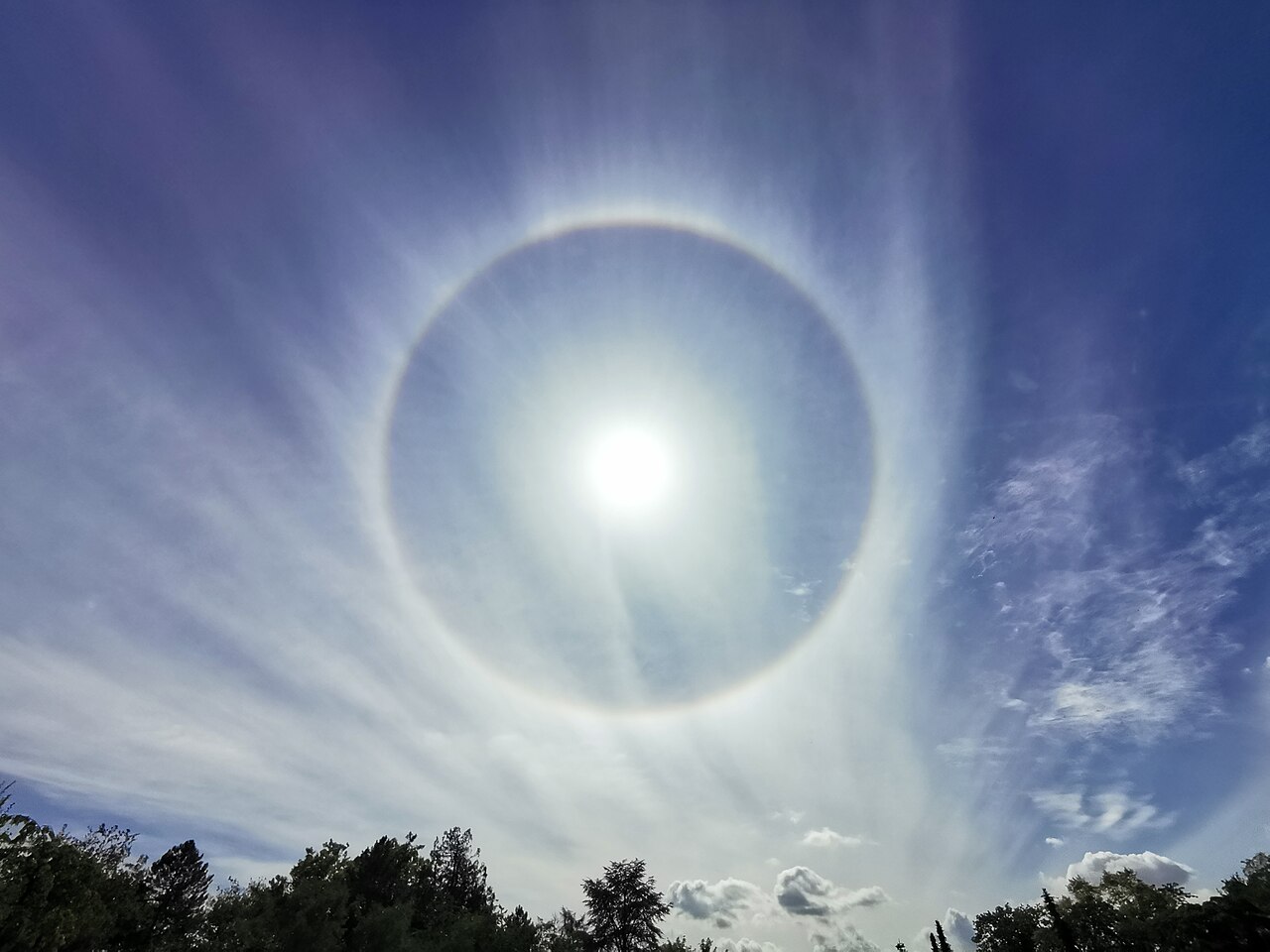
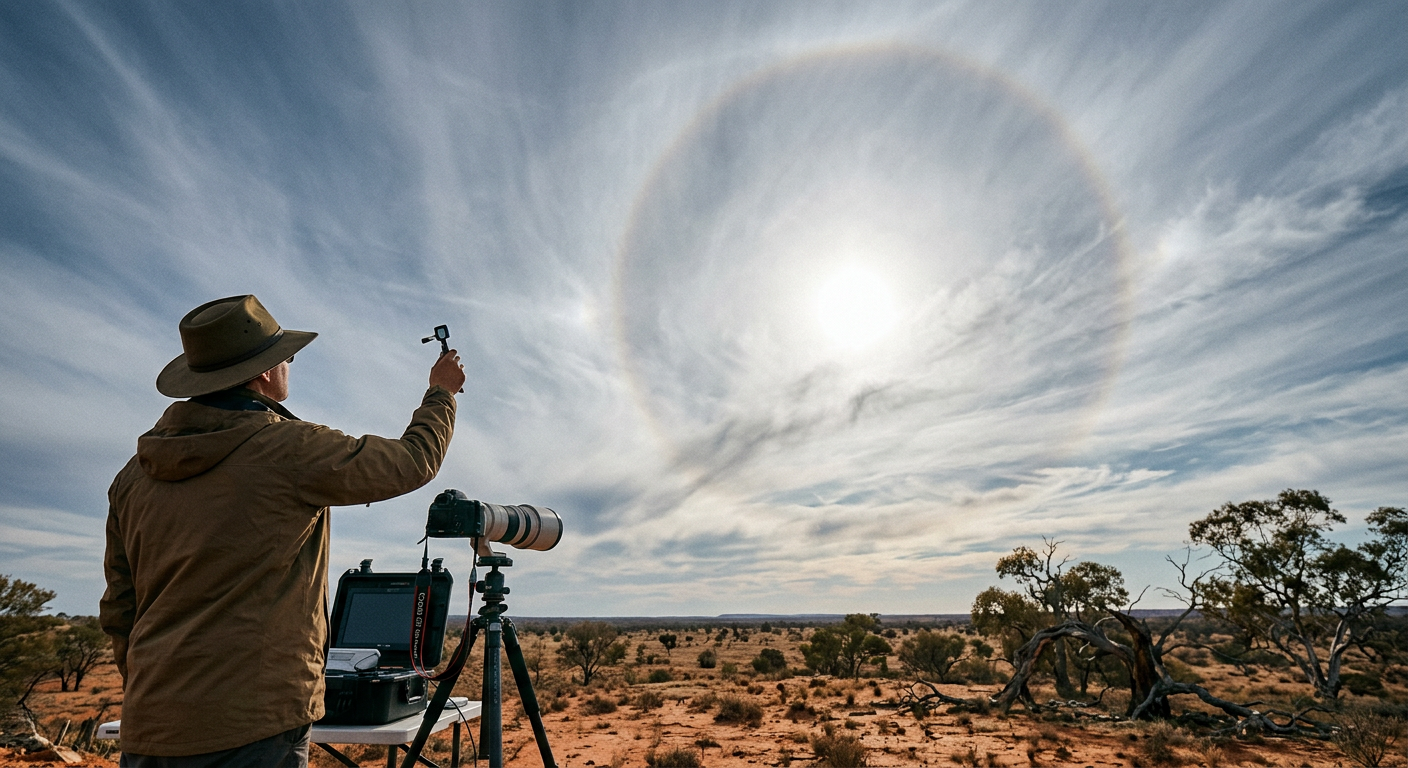
These circular optical rings develop when sunlight or moonlight passes through randomly oriented hexagonal ice crystals suspended in high-altitude cirrostratus clouds. As light enters these microscopic prisms, it undergoes refraction, bending at a minimum deviation angle of exactly 22 degrees to create a distinct, luminous circle.
Key takeaways
A 22-degree halo is a fixed geometric optical effect caused by light refraction through hexagonal ice crystals in the upper troposphere.
The precise radius of the ring results from a minimum deviation angle of 21.84 degrees, which is a constant governed by the optical physics of solid ice prisms.
Thin, high-altitude cirrostratus clouds are the primary cloud type responsible for creating these continuous circular rings around the sun or moon.
While meteorological folklore links these halos directly to imminent rain, weather forecasters view them as reliable indicators of advancing high-level moisture that often precedes frontal systems.
The science behind how do 22 degree halos form
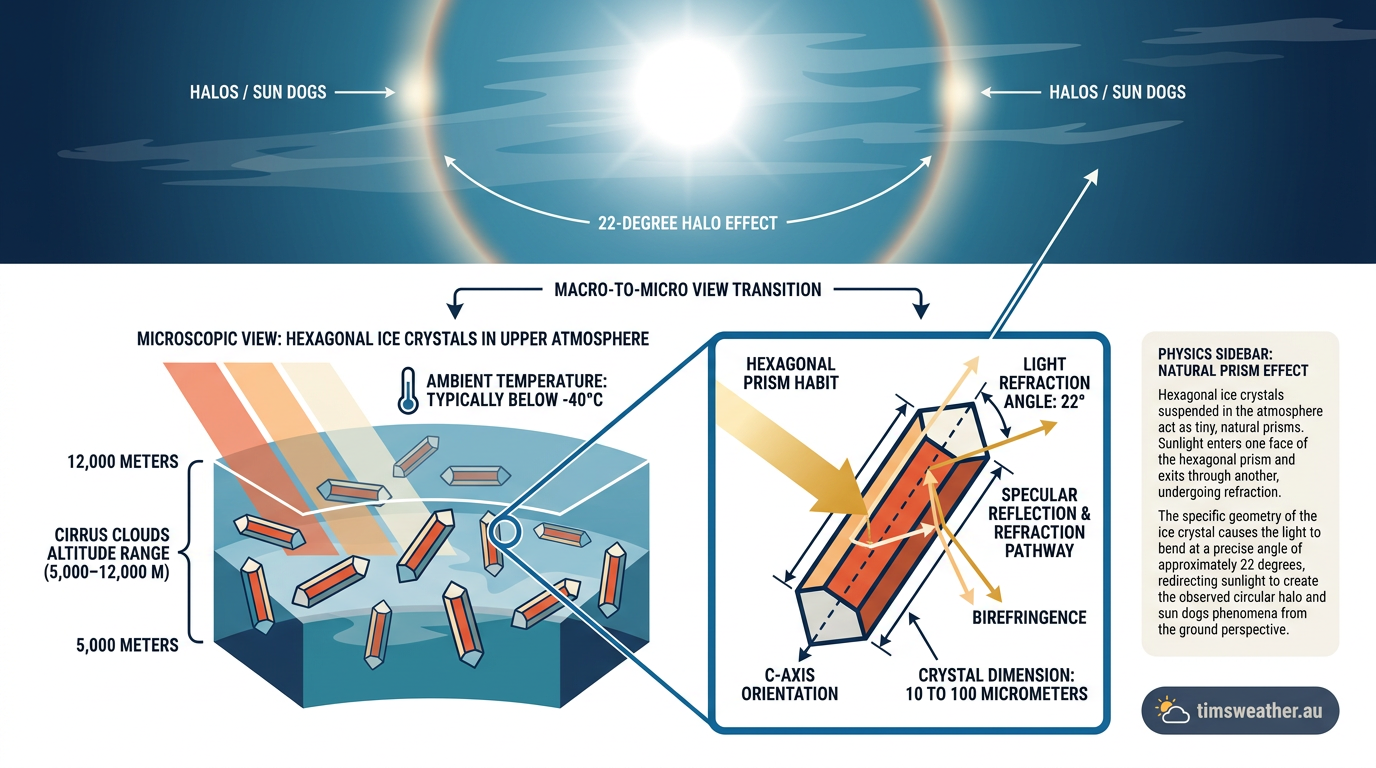
To fully answer how do 22 degree halos form, it is necessary to examine the physical conditions of the upper atmosphere. The troposphere is a dynamic layer of air where temperature drops steadily with altitude. At elevations above 6,000 metres, ambient temperatures regularly fall below -20 °C. At these extreme heights, moisture does not condense into liquid water droplets. Instead, water vapour undergoes deposition, transforming directly from a gas into solid ice.
These ice crystals are the foundational building blocks for a wide variety of cloud optical phenomena. Unlike liquid water droplets, which create rainbows through a combination of internal reflection and refraction, solid ice crystals act entirely as microscopic prisms. The incoming light passes straight through the crystal body, bending as it enters and bends again as it exits, casting a specific geometric pattern into the sky.
How do 22 degree halos form?
How do 22 degree halos form? They materialise when sunlight interacts with millions of microscopic hexagonal ice crystals drifting randomly in the upper atmosphere. Because these tiny ice structures act as optical prisms, they refract incoming light beams. The specific geometric shape of the ice forces the incoming sunlight to bend by at least 22 degrees, forming a continuous, luminous circular ring around the celestial body.
The role of high-altitude environments
The formation of these optical rings is strictly dependent on the specific atmospheric conditions found in the upper troposphere. According to field observations from the American Alpine Institute, mountaineers frequently observe brilliant solar halos at high elevations because they are physically closer to the cloud deck and looking upward through thinner, less polluted layers of the atmosphere.
The density and concentration of these ice crystals are equally important. If the ice crystals are too sparse, the refracted light will be too faint for the human eye to detect against the natural blue glare of the daytime sky. Conversely, if the cloud layer is too thick and saturated, the incoming sunlight will scatter randomly in all directions. This heavy scattering blocks the halo entirely and casts a flat, grey overcast shadow over the ground. A perfectly balanced, thin layer of ice cloud is required to allow the sunlight to penetrate while still interacting with enough crystals to form a visible optical ring.
Atmospheric optics and ice crystal refraction
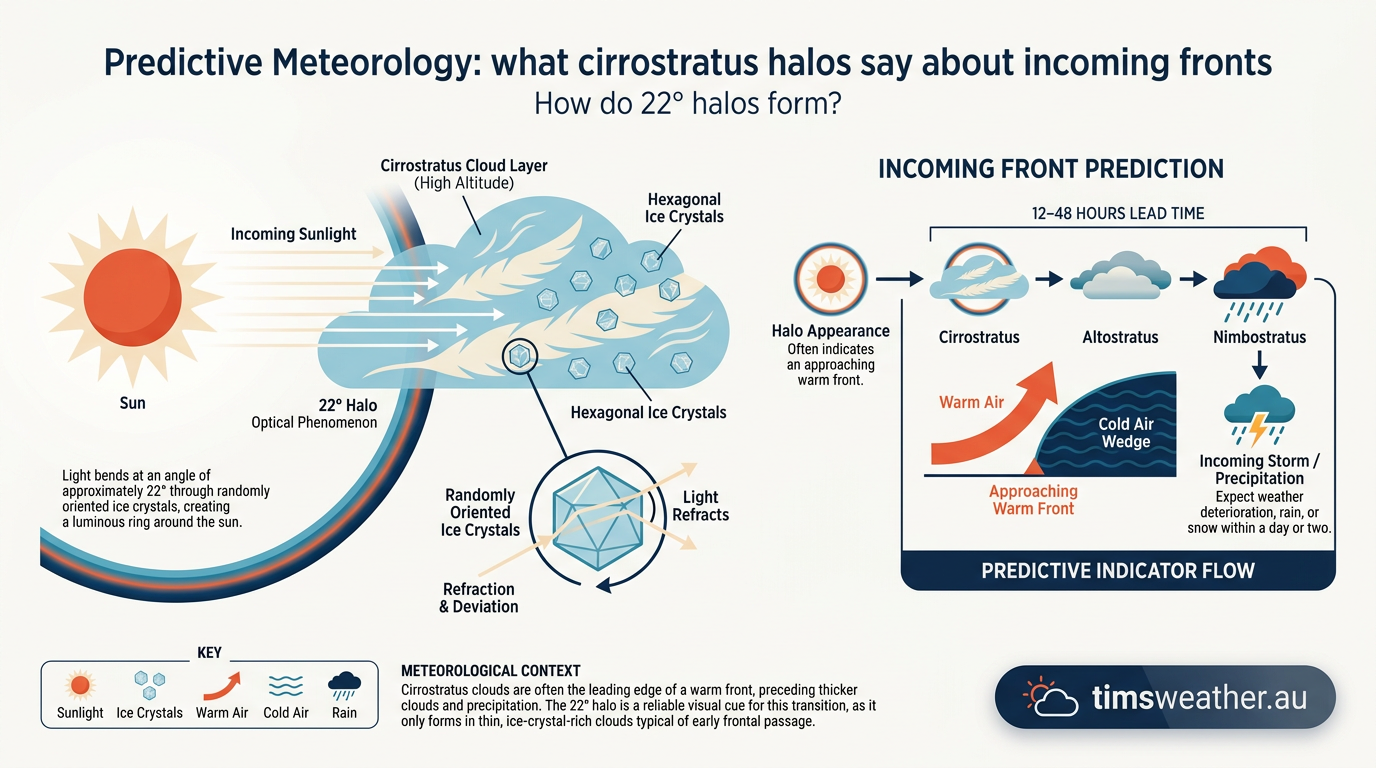
The official classification of these events rests heavily on the principles of atmospheric optics. The WMO International Cloud Atlas defines a halo as a group of optical phenomena in the form of rings, arcs, or pillars produced by the refraction or reflection of light by ice crystals suspended in the atmosphere. The 22-degree variant is by far the most commonly observed type of halo globally. It typically appears as a large, bright ring centred on the sun or moon, featuring a sharply defined inner edge and a more diffuse, washed-out outer boundary.
The visible spectrum and light scattering
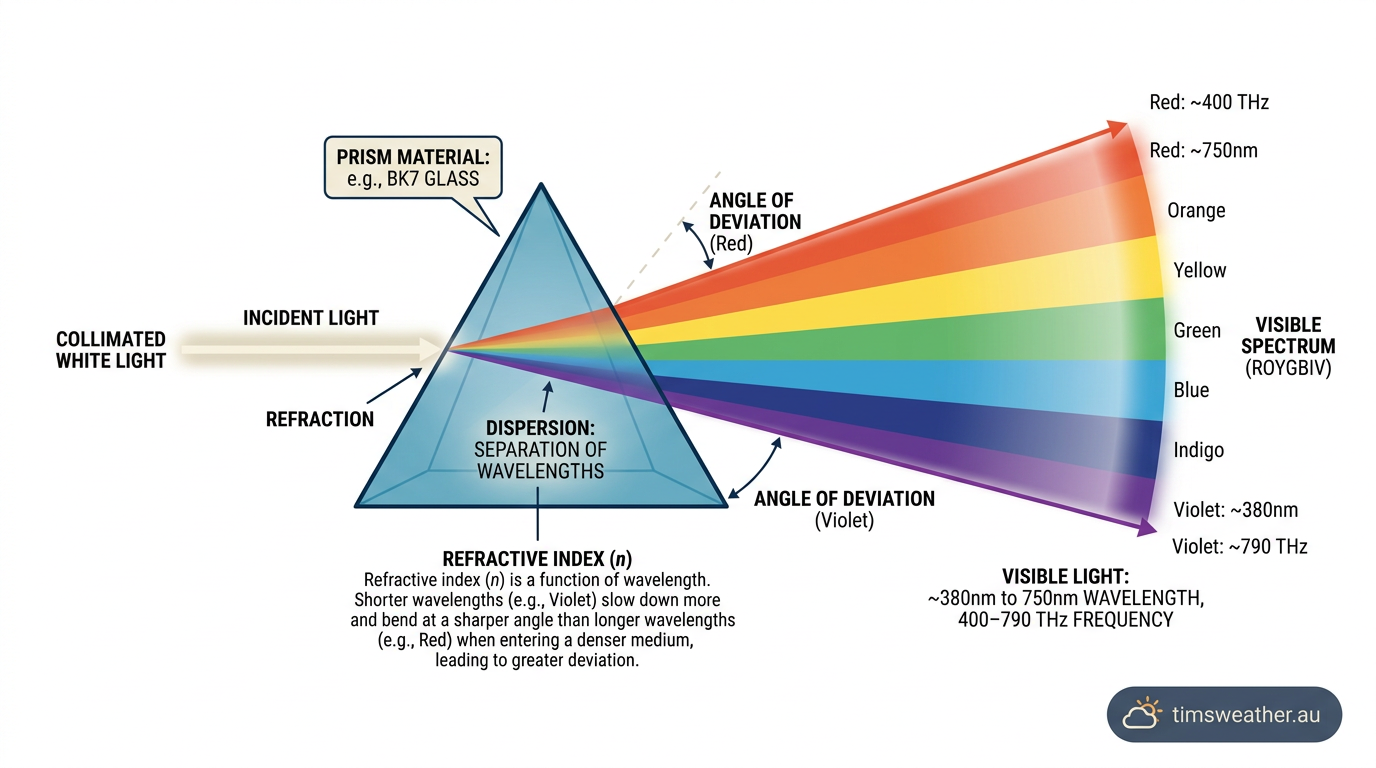
When white sunlight strikes these ice clouds, it carries the full visible spectrum of electromagnetic light. As the light enters the ice lattice, it immediately slows down and bends. Because different colours of light possess different wavelengths, they respond to the ice differently and bend by slightly different amounts. This physical process, known as light dispersion, separates the white light into its component colours.
Shorter wavelengths, such as blue and violet light, bend more sharply when passing through an optical medium. Longer wavelengths, such as red light, bend far less. Because of this slight separation, the light exiting the ice crystal spreads out into a miniature spectrum. This dispersion is exactly what gives the inner edge of the halo its faint, warm-toned colouring. Observers looking up will notice that the ring is often red or pale orange on the inside, fading outward into yellow, green, and finally a diffuse blue on the outer edge.
Refractive index and the speed of light in ice
The extent to which the light bends depends entirely on the refractive index of the materials involved. The refractive index is a mathematical value that describes how fast light travels through a specific medium compared to its speed in a pure vacuum. The refractive index of the surrounding atmospheric air is approximately 1.0003, which is practically identical to a vacuum. However, the refractive index of solid ice is roughly 1.31.
When the light beam crosses the boundary from the thin air into the dense ice, its speed drops significantly. This sudden deceleration forces the light wave to pivot, changing its trajectory. When it exits the other side of the crystal back into the air, it accelerates back to its original speed, bending a second time. This double-bending action is the mechanical engine driving all ice crystal refraction phenomena in the atmosphere.
The Physics of 22 Degrees: Why Does the Halo Stop There?
The defining feature of a 22-degree halo is its exact, unchanging size. Regardless of the time of day, the season, or the geographic location of the observer, the inner edge of the halo always rests exactly 22 degrees away from the central light source. This consistency is not a random coincidence; it is a strict mathematical result governed by the molecular shape of frozen water.
Snell's Law and the minimum deviation angle
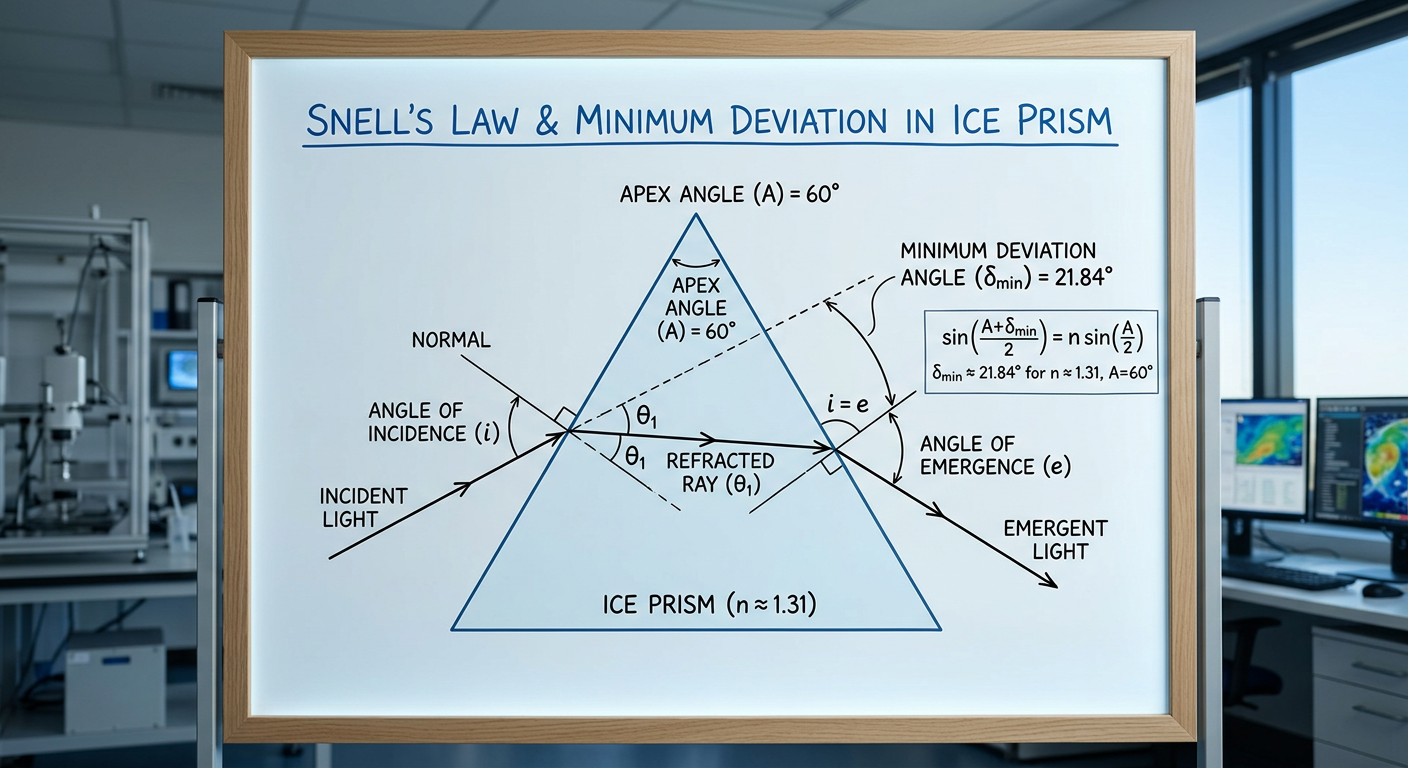
To determine exactly how light bends when crossing boundaries of varying density, atmospheric physicists rely on a foundational principle called Snell's Law. This law calculates the exact angle of refraction based on the incoming angle of the light and the refractive indices of the two materials.
Research published in the Journal of the Optical Society of America demonstrates that when light passes through a 60-degree ice prism, Snell's Law mathematically prevents the light from bending by any angle smaller than 21.84 degrees. This absolute minimum deviation angle causes the light rays to bunch up and concentrate heavily at this specific boundary. Because no light can be refracted at an angle less than 21.84 degrees, the sky immediately inside the halo appears notably darker than the rest of the atmosphere. The concentrated light then fades gradually outward up to about 50 degrees, creating a bright, sharp inner ring that diffuses softly outward.
The 60-degree prism geometry
The shape of the crystal itself is what establishes this specific mathematical minimum. When water freezes into ice under normal atmospheric conditions, its molecular structure forces it to form a rigid hexagonal lattice. In high-level clouds, this molecular alignment often results in pencil-shaped hexagonal columns. These microscopic columns feature flat top and bottom plates alongside six identical rectangular side faces.
If you measure the angle between any two alternating side faces on a regular hexagon, it forms exactly 60 degrees. The National Weather Service explains that as sunlight enters one side face of the column and exits through an alternating side face, it is forced through this rigid 60-degree wedge. This specific prism angle is the direct mechanical cause of the 22-degree optical boundary observed from the surface.
The Role of Crystal Orientation and Randomization
The shape of a single ice crystal only explains half of the optical phenomenon. If there were only one perfectly shaped ice crystal in the sky, an observer on the ground would simply see a tiny, faint pinprick of light located 22 degrees away from the sun. To create a continuous, glowing circular ring, millions of these crystals must work together in a vast atmospheric display.
Individual crystal behavior vs collective cloud-wide effects
For a full circular halo to form, the hexagonal columns must be randomly oriented as they fall through the air. Turbulence, wind shear, and variable air currents in the upper atmosphere tumble the tiny ice columns in every possible direction. Because there are millions of crystals tilted at every conceivable angle, the 22-degree refraction reaches the observer's eye from every possible point along the complete 360-degree circle around the sun. The collective optical output of this randomised cloud-wide scattering is what constructs the unbroken ring.
Sun dogs and horizontal alignment
When the ice crystals are not randomly oriented, entirely different optical phenomena appear in the sky. If the atmosphere is very calm with minimal turbulence, flat, plate-shaped hexagonal crystals will drift downward horizontally, maintaining a stable, flat posture like autumn leaves gently falling from a tree. This uniform horizontal alignment focuses the refracted light into intense, highly concentrated spots on either side of the sun, rather than scattering it into a full diffuse circle.
These bright, colourful patches are known as sun dogs or parhelia. They still appear at a strict distance of 22 degrees from the sun, owing to the same minimum deviation physics of the 60-degree prism, but they are concentrated at the exact same elevation as the sun itself.
Predictive Meteorology: What Cirrostratus Halos Say About Incoming Fronts
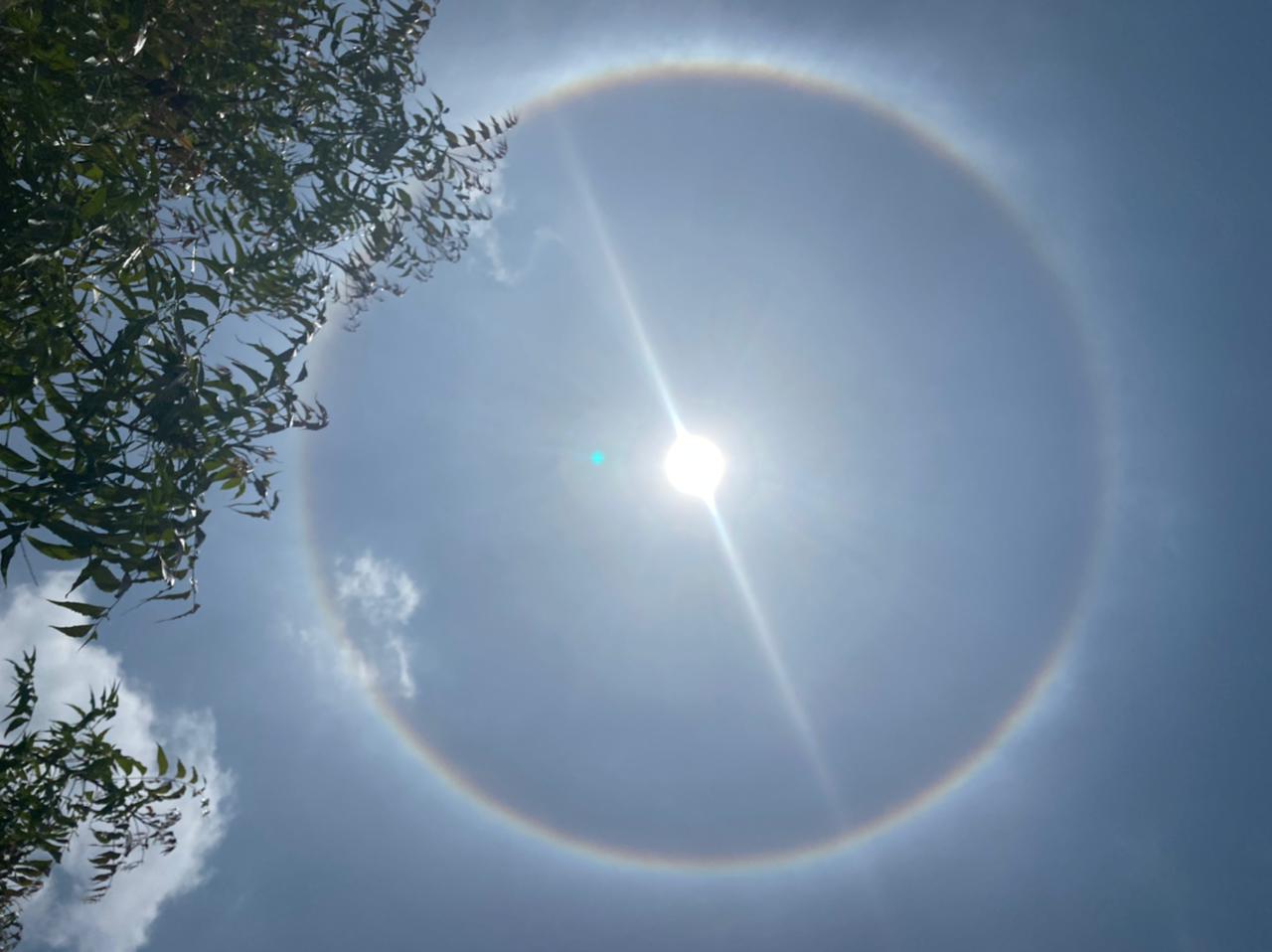
For centuries, agricultural folklore has suggested that a ring around the sun or moon means rain is on the way. Unlike many weather myths, this specific piece of folklore has a strong, verifiable foundation in synoptic meteorology, linking high-altitude atmospheric optics directly to changing surface weather patterns.
Bridging atmospheric optics and synoptic meteorology
A halo is essentially a clear visual signature confirming the presence of cirrostratus clouds overhead. These high-level, moisture-laden clouds often form when warm, moist air is forced upward over a wedge of denser, colder air at the surface. If you study how do warm fronts form, you will see that this gradual lifting process creates vast, thin sheets of ice crystals that can span hundreds of kilometres ahead of the actual surface front.
Because the high-altitude cirrostratus clouds travel much faster than the surface-level rain bands, they often arrive overhead first. The Met Office notes that spotting a halo can frequently indicate that an active frontal system is approaching, with measurable precipitation often following within 12 to 24 hours. However, it is vital to remember that the halo itself does not cause the rain; it is merely a passive indicator of increasing moisture aloft.
Cirrus cloud classification
Not all high-level clouds produce perfect, continuous halos. How how do cirrus clouds form helps explain why some halos are patchy or incomplete. Dense, fibrous cirrus clouds, known as cirrus spissatus, may only produce fragments of a halo because their uneven thickness blocks the refracting light unpredictably. To see a flawless, unbroken 22-degree ring, an observer needs a uniform, widespread layer of cirrostratus clouds, specifically cirrostratus nebulosus, which act as a smooth, continuous optical screen across the entire sky.
Comparison of Common Atmospheric Halo Phenomena
To help observers distinguish between different optical events in the sky, the following table compares the physical structures and light paths responsible for various halo types across the troposphere.
Phenomenon | Crystal Shape | Light Interaction | Typical Position |
|---|---|---|---|
22° Halo | Randomly oriented hexagonal columns | Refraction through 60° alternating prism faces | Circular ring 22 degrees from the sun or moon |
Sun Dogs (Parhelia) | Horizontally aligned hexagonal plates | Refraction through 60° alternating prism faces | Level with the sun, 22 degrees to the left and right |
Sun Pillars | Horizontally aligned ice plates or columns | Reflection off flat crystal surface faces | Vertical shaft of light directly above or below the sun |
46° Halo | Randomly oriented hexagonal columns | Refraction through 90° corner prism faces | Large circular ring 46 degrees from the sun or moon |
Visual Identification: Distinguishing 22° Halos from Coronas
Even for experienced weather observers, it can be easy to confuse a halo with a corona. Both phenomena present as circular rings that appear around a light source in cloudy conditions, but they differ significantly in their actual physical size, their underlying optical physics, and their implications for local weather.
Size, structure and angular distance
A corona is substantially smaller than a 22-degree halo. Coronas appear to hug the sun or moon tightly, often displaying repeating, compact rings of blue, green, and red light. They are caused by light diffraction bending around microscopic liquid water droplets in mid-level clouds, not by refraction through solid ice crystals.
To tell them apart, observers can measure the angle in the sky using their hands. If you hold your arm straight out and spread your fingers wide, the distance from the tip of your thumb to the tip of your little finger covers approximately 20 to 22 degrees of the sky. If the luminous ring perfectly matches the width of your fully spread hand, it is a true 22-degree halo. If the ring is much smaller and sits entirely behind your palm, you are looking at lunar and solar coronas.
Nighttime lunar halos
Finally, the optical physics responsible for solar halos operate in exactly the same way at night. Moonlight is simply sunlight reflecting off the lunar surface back toward Earth. When this reflected moonlight travels through the same cirrostratus ice crystals, it refracts at the identical 22-degree minimum deviation angle.
As reported by WRAL during winter weather events, these lunar halos usually appear pale white or silvery to the naked eye. This apparent lack of colour occurs because moonlight is much weaker than direct sunlight, and it struggles to trigger the colour-sensitive cone cells in human eyes. Even though the physical dispersion of red and blue light is still occurring in the cold night atmosphere, our eyes perceive the halo as a faint, ghostly white circle surrounding the moon.
Sources
22° halo | International Cloud Atlas (cloudatlas.wmo.int)
Explainer: what are halos? (media.bom.gov.au)
Manuals Standards (casa.gov.au)
Thresholds Calculator (climatechangeinaustralia.gov.au)
Heat Flow Interpretations for the Australian Continent: Release 1 (data.gov.au)
NOAA weather and atmospheric science reference (ngdc.noaa.gov)
NOAA weather and atmospheric science reference (ncei.noaa.gov)
phys.unsw.edu.au PDF reference (phys.unsw.edu.au)
Last verified: 2026-09-15
Frequently asked questions
A 22° halo forms when sunlight passes through millions of tiny, randomly oriented hexagonal ice crystals suspended in high-altitude cirrus or cirrostratus clouds. As the light enters and exits these prisms, it refracts, bending by approximately 22 degrees to create a distinct, luminous ring encircling the Sun.
Source: science.nasa.gov
Further reading and resources
Explore trusted articles, books, videos and other resources to go deeper on this topic.
geo.libretexts.orgArticle
22.3: Ice Crystal Optics - Geosciences LibreTexts
In-depth coverage on How Do 22 Degree Halos Form? The Science of Ice Crystal Optics from geo.libretexts.org.
ww2010.atmos.uiuc.eduReference
a ring of light 22 degrees from the sun or moon - WW2010
Background reference on How Do 22 Degree Halos Form? The Science of Ice Crystal Optics from ww2010.atmos.uiuc.edu.
en.wikipedia.orgReference
Halo (optical phenomenon) - Wikipedia
Background reference on How Do 22 Degree Halos Form? The Science of Ice Crystal Optics from en.wikipedia.org.
22° halo - Wikipedia
Background reference on How Do 22 Degree Halos Form? The Science of Ice Crystal Optics from en.wikipedia.org.
gi.alaska.eduReference
Ice Crystal Halos | Geophysical Institute
Background reference on How Do 22 Degree Halos Form? The Science of Ice Crystal Optics from gi.alaska.edu.
cloudatlas.wmo.intArticle
22° halo | International Cloud Atlas
In-depth coverage on How Do 22 Degree Halos Form? The Science of Ice Crystal Optics from cloudatlas.wmo.int.
geographical.co.ukArticle
What is an Ice halo or the 22° halo - Geographical Magazine
In-depth coverage on How Do 22 Degree Halos Form? The Science of Ice Crystal Optics from geographical.co.uk.
youtube.comVideo
What is a 22-degree halo and how do they form? - YouTube
Video coverage on How Do 22 Degree Halos Form? The Science of Ice Crystal Optics from youtube.com.
snowcrystals.comArticle
Ice Crystal Halos - SnowCrystals.com
In-depth coverage on How Do 22 Degree Halos Form? The Science of Ice Crystal Optics from snowcrystals.com.
22halo.bandcamp.comArticle
22º Halo - Bandcamp
In-depth coverage on How Do 22 Degree Halos Form? The Science of Ice Crystal Optics from 22halo.bandcamp.com.
Planning weeks ahead?
Check Australia's long-range seasonal outlook for rainfall, temperature and the climate drivers (ENSO, IOD, SAM, MJO) shaping the next three months.
View Australia's Seasonal Weather Forecast