
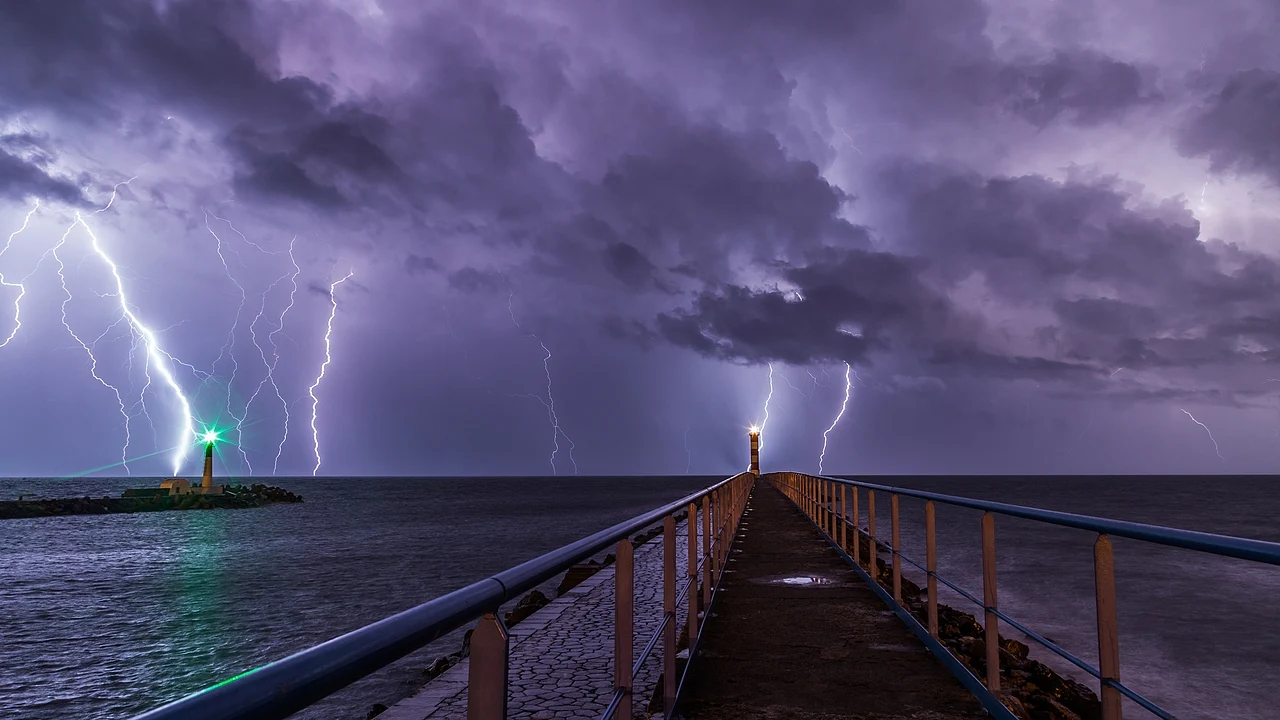
How does thunder form? It is the acoustic sound produced by the rapid expansion of air surrounding a lightning discharge. When lightning strikes, it instantly heats the air to approximately 30,000 degrees Celsius. This extreme heat causes a violent pressure wave to expand outward, creating the sonic shock wave we hear as thunder.
Key takeaways
- Thunder is the direct acoustic result of extreme atmospheric superheating caused by an electrical discharge.
- A lightning channel can heat the surrounding air to roughly 30,000 degrees Celsius in just a few microseconds.
- The sharp crack of a nearby strike becomes a rolling rumble over a distance due to sound wave reflections off terrain and clouds.
- You can estimate the distance of an approaching storm by counting the seconds between the lightning flash and the resulting sound.
The Physics of Rapid Air Expansion: From Plasma to Sound
To understand the science behind the sound of thunder, meteorologists look closely at the extreme thermodynamics occurring within the troposphere. The process begins with a powerful electrostatic discharge during an electrical storm. In normal weather conditions, the air surrounding us acts as an excellent insulator. However, when the electrical charge difference between a storm cloud and the ground becomes too great, the insulating capacity of the air completely fails. This critical moment is known as dielectric breakdown.
Electrostatic discharge and dielectric breakdown
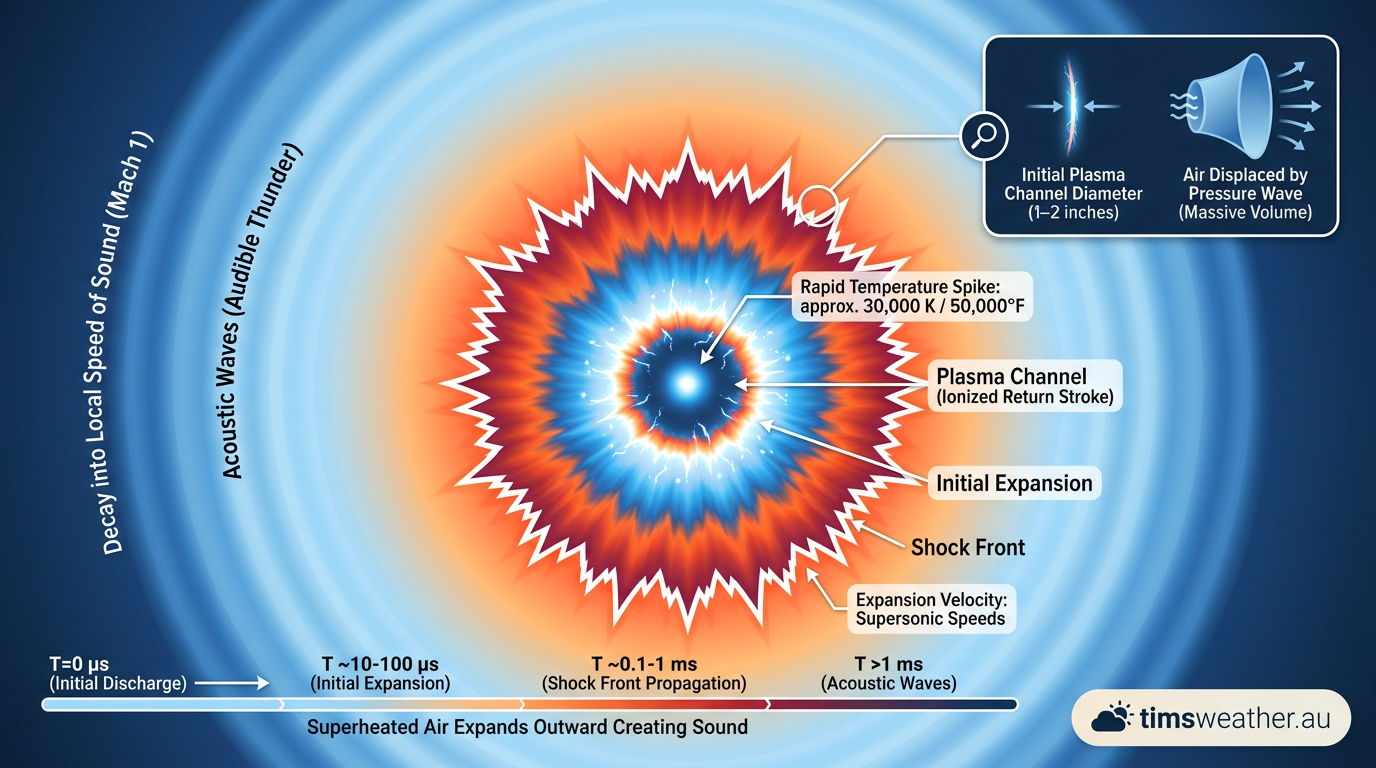
This breakdown allows vast amounts of electricity to flow rapidly through a narrow atmospheric path. As this lightning discharge travels, it heavily superheats a narrow channel of air, forcing it to expand explosively. The thermodynamic laws of rapid air expansion dictate that when a gas is heated this violently, the pressure inside the channel increases immensely before the volume has time to change. According to atmospheric measurements, the air directly in the lightning path can reach roughly 30,000 degrees Celsius in a fraction of a second (www.nesdis.noaa.gov). To put this extreme energy into perspective, that temperature is roughly five times hotter than the surface of the sun.
The transition from air to plasma
When studying the primary acoustic cause, the exact molecular transition from air to plasma and back to a gaseous state provides the answer. The immense heat strips electrons away from the air molecules in the immediate channel, creating a highly conductive and unstable plasma. Because this superheating happens in just a few millionths of a second, the surrounding air does not have any time to expand smoothly or gently. Instead, it undergoes a violent isobaric expansion. The immediate outward expansion and the subsequent rapid cooling create the distinct crack, boom, or rumble of thunder as the atmospheric pressure attempts to normalise.
From physical shock wave to acoustic wave
Initially, the expanding air moves outward from the lightning channel significantly faster than the speed of sound, creating a true physical sonic boom. Within the first few metres of travel, this intense physical shock wave rapidly loses energy, slows down, and degrades into a standard acoustic wave. The World Meteorological Organization officially defines thunder as the audible manifestation of electrical discharge, caused directly by the violent heating and expansion of the atmosphere around the lightning path (community.wmo.int). While folktales often suggest thunder is the sound of clouds colliding, the physics proves it is strictly the acoustic response to sudden, extreme heating.
How Does Thunder Form During a Storm?
The entire thunder and lightning formation process is deeply tied to the structure and life cycle of the storm cell itself. The meteorological setting for these electrical events is almost always a deep, turbulent storm cloud characterised by intense internal convection. For those wondering how do thunderstorms form, the process begins when warm, highly moist air is forced upward rapidly into the cooler, freezing layers of the upper troposphere.
Charge separation in cumulonimbus clouds
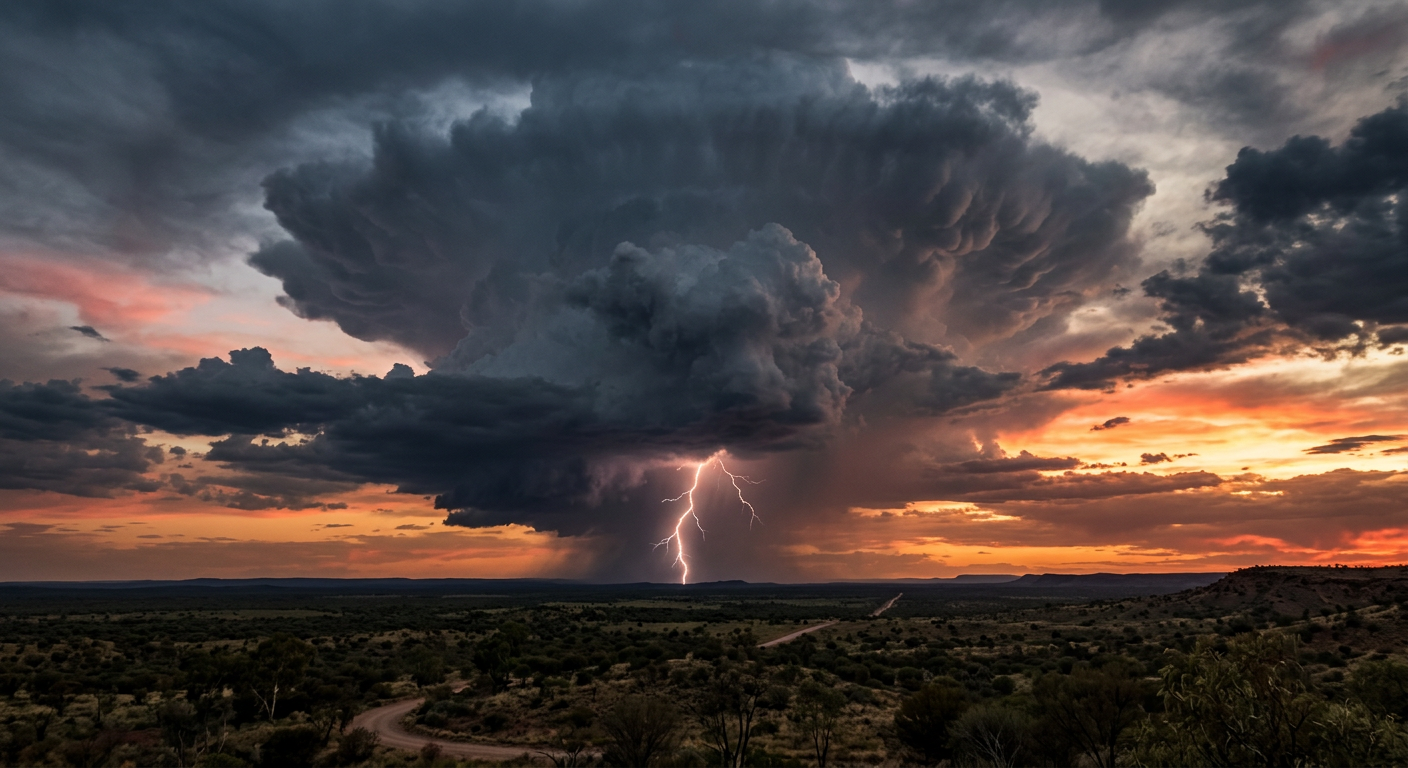
Inside mature cumulonimbus clouds, powerful convective updrafts lift water droplets and ice particles high into the sub-zero layers of the atmosphere. As these particles collide at high speeds, they exchange electrons. Lighter, positively charged ice crystals are carried upward to the top of the storm anvil, while heavier, negatively charged graupel and slush gather at the base of the cloud. This continuous charge separation creates an enormous internal electric field. When people observe the signs of a developing cumulonimbus cloud darkening the horizon, that electric field is already growing rapidly. When the field becomes strong enough, it forces a path through the air to neutralise the electrical imbalance, resulting in a strike.
The role of the return stroke
A lightning flash actually consists of multiple rapid strokes that the human eye often perceives as a single flicker. First, a faint, nearly invisible stepped leader branches downward from the cloud base, seeking the path of least resistance toward the ground. Once this leader connects with an upward-reaching positive leader from a tall object on the ground, the main return stroke surges upward along the established channel. This massive return stroke is what carries the vast bulk of the electrical current. The extreme heating required to produce thunder radiates outward precisely from this upward return stroke channel, triggering the rapid air expansion.
Types of Thunder Sounds Explained: Clap vs. Rumble
The auditory perception of thunder varies greatly depending on where you are standing relative to the lightning channel. A single lightning flash can produce a diverse range of acoustic sounds, from an ear-splitting, immediate crack to a low, sustained vibration that lasts for many seconds.
Acoustic analysis of the initial crack
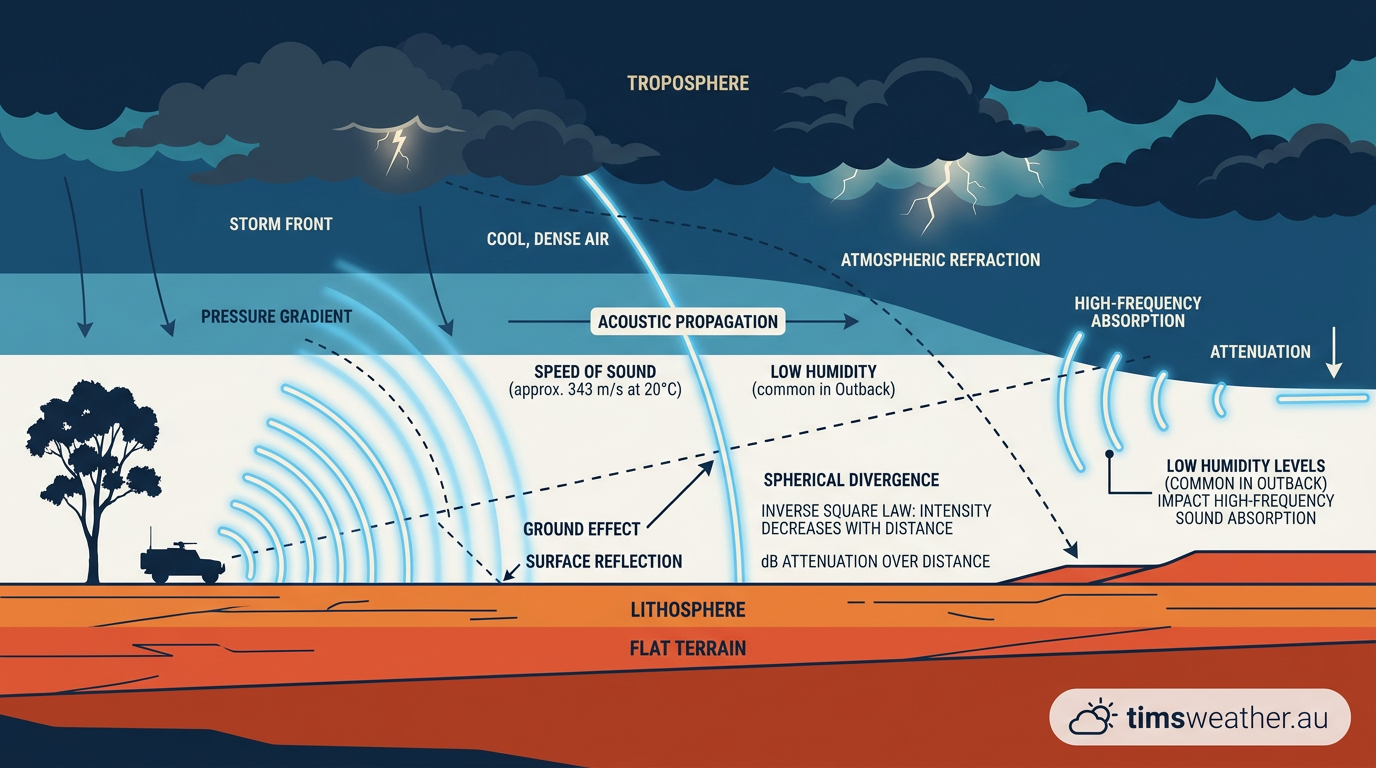
The sound character depends heavily on your distance from the strike and the structure of the lightning itself. Nearby strikes are almost always heard as a sharp, startling crack because the initial high-pressure shock wave reaches the listener directly, without losing much of its high-frequency energy. Conversely, longer, branched flashes can produce a rolling peal because sound originating from different segments of the complex lightning channel reaches the listener at varying times (www.nesdis.noaa.gov). Sound from the lowest part of the channel arrives first, while sound from higher branches arrives seconds later.
Terrain reflections and auditory perception
Sound waves behave much like ripples spreading in a pond, bouncing off obstacles they encounter along their path. Reflections from dense clouds, hilly terrain, and layers of the atmosphere stretch the initial sound out into a long, continuous rumble (www.loc.gov). Urban environments filled with tall buildings can create an echoing effect that further prolongs the noise, turning a single strike into a long sequence of crashes.
Topography impacts on sound propagation
Local geography plays a significant role in determining how we hear these storms. In flat, open areas like the Australian Outback or the Great Plains of the United States, sound waves can travel cleanly over long distances without bouncing off immediate structures, resulting in a clear, distinct boom. In contrast, during severe summer thunderstorms in South East Queensland or coastal cities globally, the sound waves interact rapidly with high-rise buildings, dense coastal forests, and mountain ranges. This complex topography causes heavy acoustic scattering. Also, during the Northern Territory monsoon season thunder activity, the exceedingly high atmospheric humidity changes the density of the air, which can muffle the higher-frequency sounds and leave behind only a deep, resonant rumble, creating a unique auditory signature for tropical storms.
Calculating Storm Distance: The Flash-to-Bang Method
Because light and sound travel through the atmosphere at vastly different speeds, observers can use basic meteorological calculations to determine exactly how far away a dangerous storm is occurring.
The speed of light versus the speed of sound
Thunder is almost always heard long after the bright flash because light travels immensely faster than sound waves (www.nesdis.noaa.gov). Light travels at roughly 300,000 kilometres per second, meaning the visual evidence of the lightning reaches our eyes instantaneously. Meanwhile, sound waves travel through standard atmospheric pressure at approximately 343 metres per second (or roughly 1,200 km/h). By counting the time delay between seeing the light and hearing the acoustic wave, observers can accurately track approaching thunderstorm signs.
Distance between lightning and thunder calculation
A highly useful field rule is the common flash-to-bang estimate. Based on standardized calculations, sound travels about 5 seconds per mile, so a 10-second delay implies the storm is roughly 2 miles, or about 3.2 kilometres, from your location (www.nesdis.noaa.gov). For a purely metric calculation, sound takes approximately three seconds to travel one full kilometre. If you count 15 seconds between the visual flash and the acoustic boom, you can confidently divide by three to determine the lightning struck roughly five kilometres away.
| Sound Type | Proximity to Strike | Acoustic Cause | Typical Duration |
|---|---|---|---|
| Sharp Crack | Less than 1 km | Direct, unmitigated shock wave from the return stroke reaching the listener instantly. | 1 to 2 seconds |
| Loud Boom | 1 to 3 km | Primary acoustic wave with minimal environmental reflection and minor frequency loss. | 2 to 4 seconds |
| Rolling Peal | 3 to 10 km | Sound arriving sequentially from different branches of a highly elongated lightning channel. | 5 to 10 seconds |
| Low Rumble | 10 to 20 km | High frequencies fully absorbed by the air; low frequencies heavily reflected off local terrain. | 10+ seconds |
Weather Safety and Severe Thunderstorms
How the fundamental physics behind these storms is critical for maintaining public safety. Even a basic single cell thunderstorm presents massive electrical hazards. When atmospheric pressure changes abruptly during storm development, the resulting lightning can be deadly to anyone caught outdoors.
The global standard '30-30 rule'
Meteorological agencies and government safety organisations globally heavily promote the '30-30 rule' to prevent tragic lightning casualties (www.nesdis.noaa.gov). If you are participating in outdoor activities, such as standing on an open field during the Australian cricket season, and the time between the lightning flash and the loud thunderclap is 30 seconds or less, the storm is already within 10 kilometres of your position. You must seek rigid, enclosed shelter immediately. Once sheltered, you should wait a full 30 minutes after the last sound of thunder is heard before heading back outside, as trailing strikes can still occur from the back of the storm system.
Lightning hazards and warnings
The danger is not limited entirely to direct electrical strikes on people or properties. Depending on the types of severe thunderstorms in Australia or other fire-prone regions, secondary hazards are common. Dry lightning and bushfire risks in the Australian bush are highly correlated, as strikes from high-based storms can easily ignite dry vegetation before any significant rain reaches the ground to suppress the fire. Also, a Severe Weather Warning will often be issued when a massive, rotating supercell thunderstorm approaches, as these vast systems produce intense, continuous electrical activity alongside destructive winds and giant hail.
Among the various types of lightning in Australia and the rest of the world, cloud-to-ground strikes remain the most dangerous. Listening closely to the acoustic signatures of the storm and accurately calculating its distance gives you the essential time needed to retreat to safety before the core of the severe weather arrives.
Frequently asked questions
Thunder forms when a lightning bolt superheats the air around it to approximately 30,000°C in a fraction of a second. This intense heat causes the air to expand explosively, creating a powerful shock wave. As this wave travels outward through the atmosphere, it transforms into the audible sound we recognise as thunder.
Source: nesdis.noaa.gov
Further reading and resources
Explore trusted articles, books, videos and other resources to go deeper on this topic.
youtube.comVideo
What Causes Thunder and Lightning? | SciShow Kids - YouTube
Video coverage on How Does Thunder Form? The Atmospheric Physics Explained from youtube.com.
lightningsafetycouncil.orgArticle
The Science of Thunderstorms and Lightning
In-depth coverage on How Does Thunder Form? The Atmospheric Physics Explained from lightningsafetycouncil.org.
en.wikipedia.orgReference
Lightning - Wikipedia
Background reference on How Does Thunder Form? The Atmospheric Physics Explained from en.wikipedia.org.
scied.ucar.eduReference
Thunder and Lightning - UCAR Center for Science Education
Background reference on How Does Thunder Form? The Atmospheric Physics Explained from scied.ucar.edu.
weather.govReference
Understanding Lightning Science - National Weather Service
Background reference on How Does Thunder Form? The Atmospheric Physics Explained from weather.gov.
britannica.comReference
What Causes Thunder & Lightning? - Britannica
Background reference on How Does Thunder Form? The Atmospheric Physics Explained from britannica.com.
Thunderstorm - Wikipedia
Background reference on How Does Thunder Form? The Atmospheric Physics Explained from en.wikipedia.org.
higherlogicdownload.s3.amazonaws.comArticle
The physics of thunderstorms
In-depth coverage on How Does Thunder Form? The Atmospheric Physics Explained from higherlogicdownload.s3.amazonaws.com.
Understanding Lightning: Thunderstorm Development
Background reference on How Does Thunder Form? The Atmospheric Physics Explained from weather.gov.
nesdis.noaa.govReference
What Causes a Thunderstorm? | NESDIS - NOAA
Background reference on How Does Thunder Form? The Atmospheric Physics Explained from nesdis.noaa.gov.
Planning weeks ahead?
Check Australia's long-range seasonal outlook for rainfall, temperature and the climate drivers (ENSO, IOD, SAM, MJO) shaping the next three months.
View Australia's Seasonal Weather Forecast