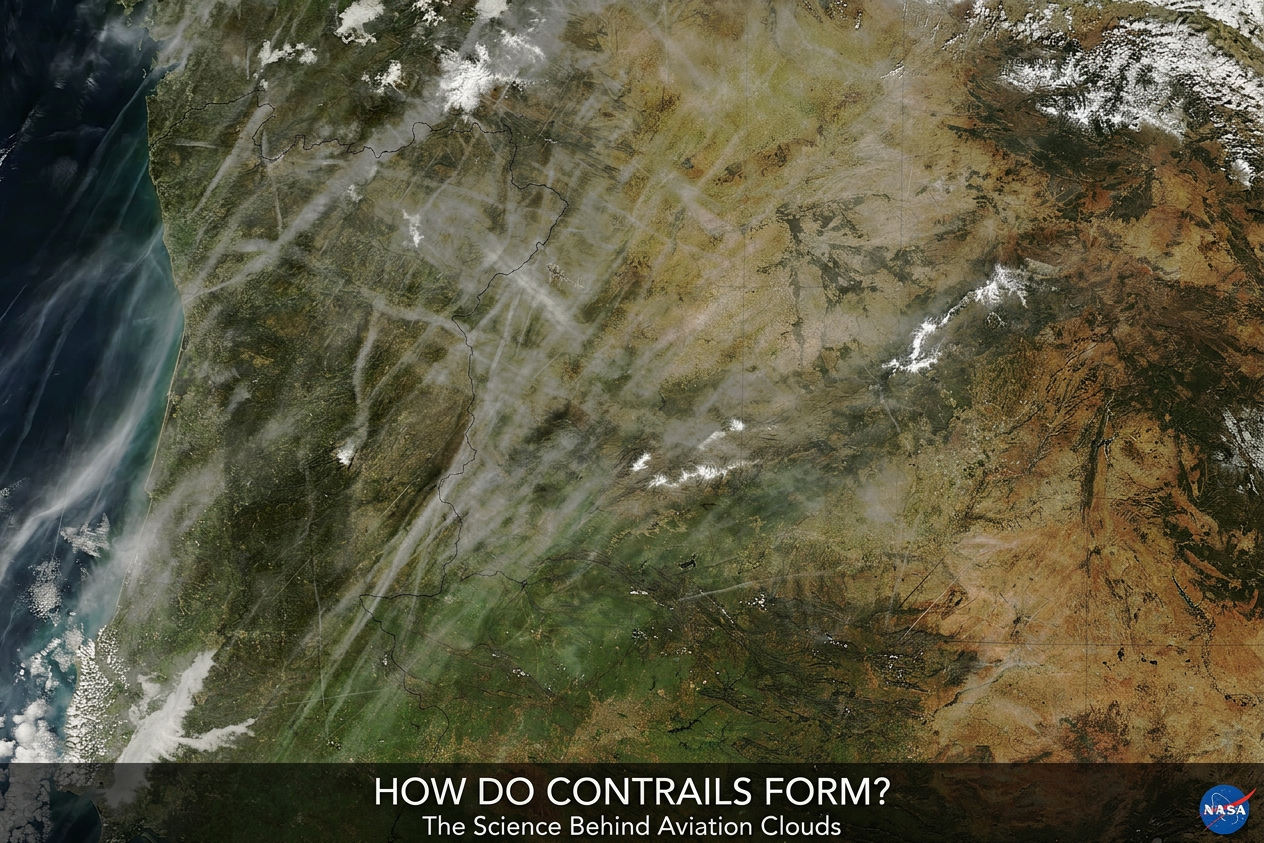
How do contrails form depends on hot, moist jet engine exhaust mixing with very cold air high in the upper troposphere. At typical cruising levels, around 10 to 11 kilometres above sea level, the air can be cold enough for water vapour to freeze onto tiny particles, forming visible ice crystals. These condensation trails persist only when relative humidity levels are high enough.
Key takeaways
- Contrails are human-made ice clouds formed from aircraft exhaust in cold upper-level air.
- The main ingredients are jet engine exhaust, atmospheric water vapour, soot particles and other hygroscopic nuclei, plus low temperatures.
- Persistent spreading contrails form when the air is supersaturated with respect to ice, so crystals grow instead of sublimating.
- Adiabatic cooling helps the exhaust cool quickly as it expands in lower-pressure air.
- Wind can spread contrails by advection, turning them into thin cirrus-like cloud that may last for hours.
How do contrails form in the upper troposphere?
Contrails, short for condensation trails, form when warm exhaust from an aircraft mixes with freezing air at cruising altitude. The Bureau of Meteorology describes the upper troposphere as a cold, dry part of the atmosphere where cloud and ice processes are common. In that setting, the jet engine exhaust adds water vapour and tiny particles that give ice crystals a place to grow.
As the exhaust leaves the engine, it expands into lower-pressure air and cools rapidly. That adiabatic cooling helps water vapour condense and freeze on soot particles and other hygroscopic nuclei, creating a visible trail. If you want a broader view of where this sits in the atmosphere, read our guide to the layers of the atmosphere.
The Schmidt-Appleman criterion explained
Meteorologists use the Schmidt-Appleman criterion to estimate when a condensation trail will form. It compares the heat and moisture in the aircraft exhaust with the temperature and moisture of the surrounding air. When the mixed plume reaches the right conditions for ice formation, a visible trail appears. The key point is simple: the exhaust must cool fast enough, and the air must be cold enough, for ice crystals to survive.
The role of high-bypass turbofan engines
Modern commercial jets, including those on busy Australian routes such as Sydney, Melbourne and Brisbane, often use high-bypass turbofan engines. These engines can still produce contrails because the exhaust contains water vapour and fine particles, even though the way the engine mixes air and fuel affects how the plume cools. A cooler and more diluted exhaust can help the trail reach saturation conditions faster in the right atmosphere.
The three stages of contrail formation
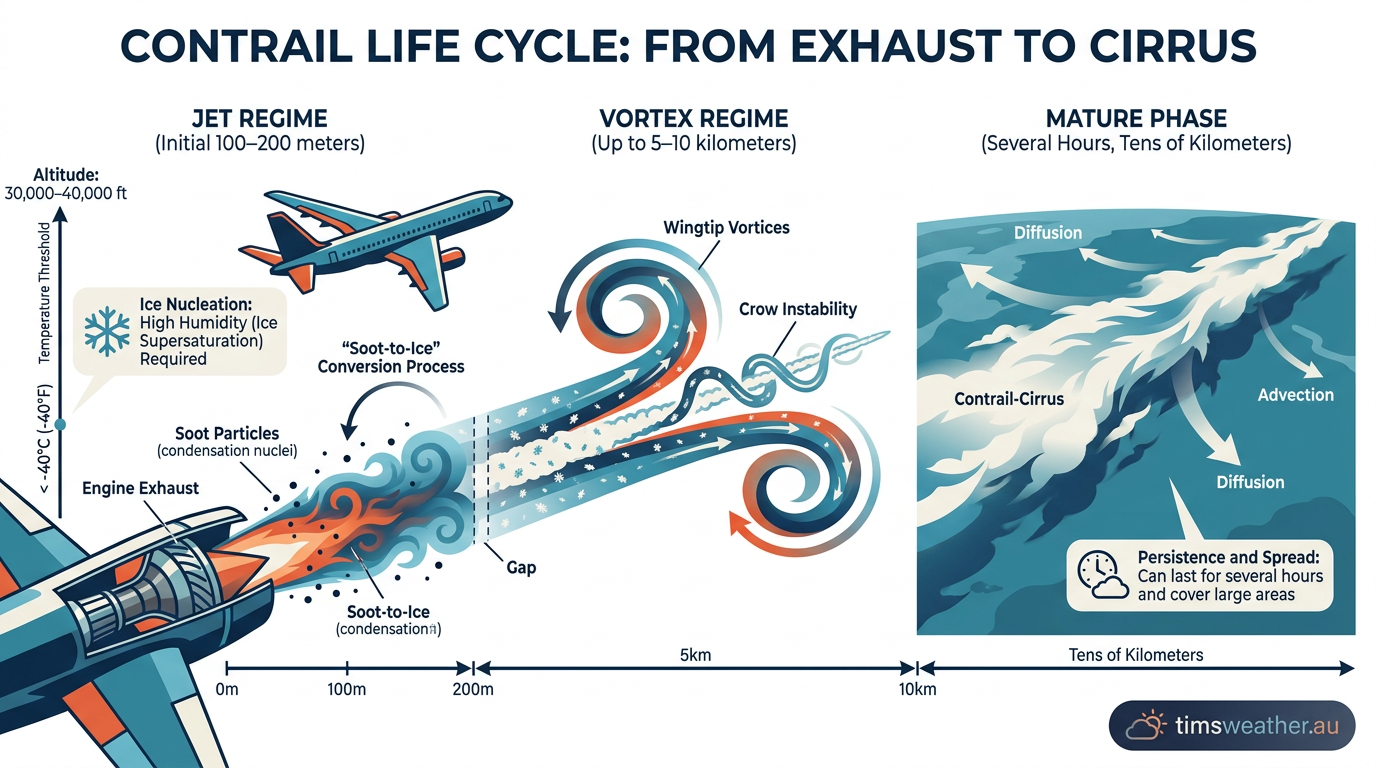
Researchers usually describe contrail formation in three stages. First comes the jet regime, when the trail forms just behind the engines. Next is the vortex regime, when wingtip vortices and other turbulence reshape the plume. Finally, the mature phase begins, when the trail is left to the winds and upper-level moisture.
Contrail types and atmospheric indicators
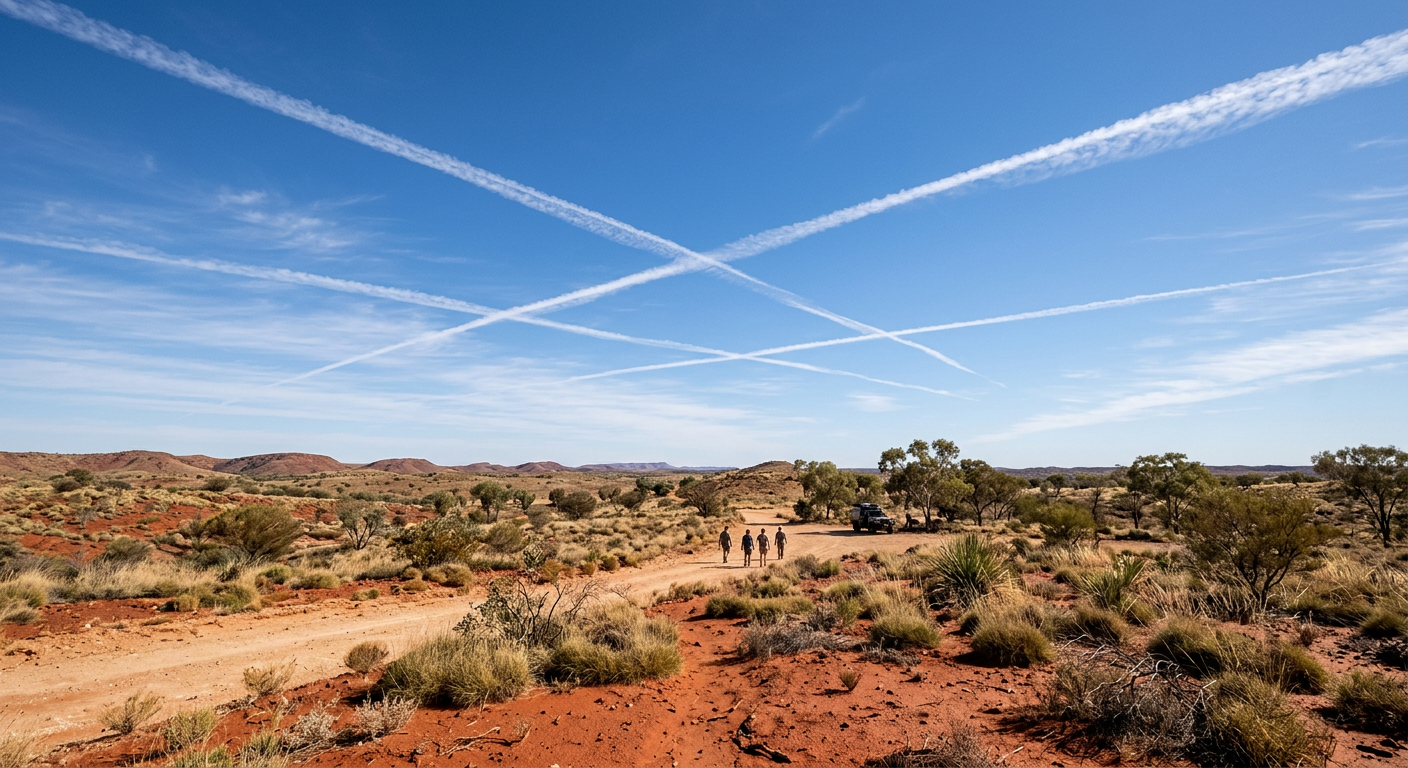
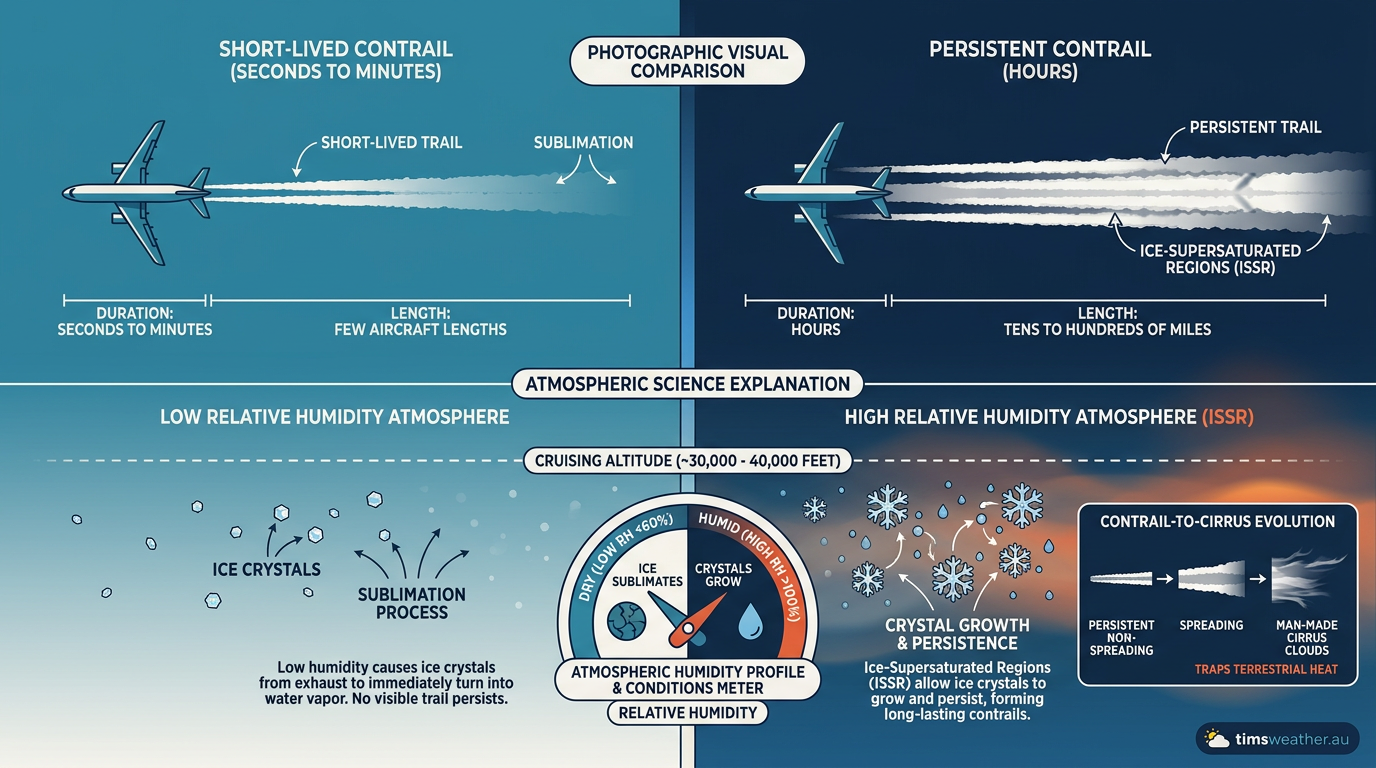
Whether a white line in the sky lasts for seconds or hours comes down to the surrounding air. Dry air favours short-lived streaks, while supersaturated air supports persistent contrails that can spread with the wind.
Why some contrails disappear quickly
In dry upper-level air, newly formed ice crystals sublimate almost immediately. Sublimation means the ice changes straight from a solid back into water vapour, without becoming liquid first. When that happens, the trail fades soon after it appears and stays narrow.
Persistent spreading contrails and cirrus homogenitus
In moist upper-level air, the ice crystals do not sublimate as quickly. Instead, they can keep growing as they draw on atmospheric water vapour in the surrounding air. Wind then carries the trail along by advection, stretching it into a wider cloud band. The World Meteorological Organization classifies these human-made clouds as Cirrus homogenitus.
What these trails can suggest about the air aloft
For people watching the sky, a long-lasting trail can be a sign that the air is cold and moist aloft. That does not mean rain is on the way on its own, but it can show that the upper troposphere contains enough moisture for ice clouds to persist. If you want to compare this with natural cloud formation, see our guide on how cirrus clouds form.
| Contrail type | Air conditions | What happens |
|---|---|---|
| Short-lived | Dry air | Ice crystals sublimate quickly and the trail fades |
| Persistent | Cold, moist air | The trail lasts longer and may spread |
| Persistent spreading | Ice-supersaturated air | The trail expands into a broader cloud |
The physics of aircraft exhaust and wingtip vortices
Engine exhaust starts the trail, while the aircraft’s airflow helps shape it in the first moments after formation. The pressure differences around a wing create turbulence that can stretch and twist the plume.
How wingtip vortices affect the trail
Wingtip vortices do not create the initial exhaust contrail, but they do reshape it. Bernoulli's principle helps explain the pressure difference across the wing, with lower pressure above the wing and higher pressure below it. That difference drives air over the wingtips and forms swirling vortices. These can split the trail into two strands that ripple and spread.
Aerodynamic contrails vs exhaust contrails
It helps to separate engine exhaust trails from aerodynamic contrails. Aerodynamic contrails can form when a sudden pressure drop around a wing or propeller cools the air enough for moisture to condense briefly. They are different from the exhaust trails most people notice behind jet aircraft. If you are interested in sudden cooling processes more generally, our article on cold fronts in Australia covers how air masses can change quickly.
Chemtrails vs contrails: what is the difference?
Contrails are a known physical result of aircraft exhaust meeting cold air. The scientific term is condensation trail, and the visible line is made mostly of ice crystals. Claims about chemtrails do not match the established physics used by the Bureau of Meteorology, Airservices Australia and international atmospheric science sources.
Why contrails matter
Most contrails fade quickly, but some persist and spread. Those longer-lasting trails can add to high cloud cover and affect how much heat the atmosphere traps. Research summarised by the National Academies and the research brief from Resources for the Future says persistent contrails contribute to warming, while a smaller share of flights create the conditions needed for them.
Frequently asked questions
Contrails form when hot, humid jet exhaust mixes with extremely cold air at high altitude. This causes water vapour to condense and freeze into tiny ice crystals. Essentially, these are man-made clouds that appear in the upper troposphere when atmospheric conditions allow the engine's moisture to crystallise.
Source: nesdis.noaa.gov
Further reading and resources
Explore trusted articles, books, videos and other resources to go deeper on this topic.
faa.govReference
Contrails | Federal Aviation Administration
Background reference on How Do Contrails Form? The Science Behind Aviation Clouds from faa.gov.
rmi.orgArticle
Aviation Contrails: What We Know — and What We Don't
In-depth coverage on How Do Contrails Form? The Science Behind Aviation Clouds from rmi.org.
youtube.comVideo
Contrails Explained
Video coverage on How Do Contrails Form? The Science Behind Aviation Clouds from youtube.com.
nasa.govReference
Airspace: Contrails
Background reference on How Do Contrails Form? The Science Behind Aviation Clouds from nasa.gov.
science.orgArticle
Aviation's dirty secret: Airplane contrails are a surprisingly potent ...
In-depth coverage on How Do Contrails Form? The Science Behind Aviation Clouds from science.org.
en.wikipedia.orgReference
Contrail
Background reference on How Do Contrails Form? The Science Behind Aviation Clouds from en.wikipedia.org.
earthdata.nasa.govReference
On the Trail of Contrails
Background reference on How Do Contrails Form? The Science Behind Aviation Clouds from earthdata.nasa.gov.
usu.eduReference
3E: The Science of Contrails | ILWA
Background reference on How Do Contrails Form? The Science Behind Aviation Clouds from usu.edu.
contrails.orgArticle
What causes contrail formation?
In-depth coverage on How Do Contrails Form? The Science Behind Aviation Clouds from contrails.org.
epa.govReference
Information on Contrails from Aircraft
Background reference on How Do Contrails Form? The Science Behind Aviation Clouds from epa.gov.
Planning weeks ahead?
Check Australia's long-range seasonal outlook for rainfall, temperature and the climate drivers (ENSO, IOD, SAM, MJO) shaping the next three months.
View Australia's Seasonal Weather Forecast