
How do mirages form? It comes down to atmospheric refraction, where light rays bend as they pass through air layers of different temperatures and densities. When a sharp thermal gradient exists, the refractive index of the air changes, causing light to curve toward the observer's eye, creating the illusion of distant objects or non-existent pools of water.
Key takeaways
Mirages are physical optical phenomena caused by atmospheric refraction curving light rays through varying air densities.
Inferior mirages occur when extreme surface heat lowers air density near the ground, bending light upwards to create the illusion of water.
Superior mirages form during a thermal inversion when cold, dense air sits beneath warmer air, lifting the apparent position of distant objects.
Because mirages involve actual bent light rather than mental hallucinations, cameras and optical sensors can record the same optical phenomenon, but the image they capture may not exactly match what the human eye perceives.
How do mirages form: the physics of light bending
To answer the question of how do mirages form, we must look to the fundamental principles of atmospheric science and thermodynamics. Electromagnetic radiation across the visible spectrum travels in perfectly straight lines when passing through a uniform medium. However, the Earth's atmosphere is rarely uniform. The density of the air constantly fluctuates based on altitude, pressure, and temperature. As light from the sun or a distant object passes through these varying atmospheric layers, its speed changes slightly, causing the light rays to bend or refract.
The role of the refractive index and Snell's Law
The core mechanism driving this optical phenomenon is defined by the refractive index of the air. The refractive index is a measure of how much light slows down as it travels through a substance compared to a vacuum. In meteorological practice, cold air is denser than warm air, meaning cold air has a higher refractive index. Academic optics texts verify the physics using Snell's Law, which dictates that as a wave crosses the boundary between two mediums with different refractive indices, its path will bend. Because the atmosphere does not have sharp boundaries but rather a continuous density gradient, the light rays curve in a smooth arc rather than bending at a sharp angle.
When meteorologists study vertical atmospheric profiles, they treat this refraction as a core observation issue. The World Meteorological Organization includes these optical effects in the WMO International Cloud Atlas, classifying them as photometeors. This puts them in the same broad category as other visual atmospheric effects, explaining phenomena like how do rainbows form when sunlight interacts with water droplets. Accurate refractivity measurements are essential for modern forecasting, as this same bending effect influences radar propagation and satellite remote sensing systems tracking storms and frontal boundaries.
What causes a mirage in the desert
The most commonly recognized visual distortion is the inferior mirage. This type of displacement happens when a shallow layer of extremely hot air develops immediately above a sun-baked surface. Desert heat and dark asphalt roads absorb intense solar radiation, rapidly transferring that heat to the air directly above them through conduction. This creates a highly unstable atmospheric profile where air density increases with height, rather than decreasing as it normally would.
Does heat cause mirages on roads?
Yes, heat radiating from dark pavement creates a severe temperature gradient in the lowest metre of the atmosphere. Light travels faster through hot air than cold air, causing photons to take curved paths towards cooler areas (www.scientificamerican.com). When you look down a long, hot highway, you are actually looking at light from the sky that has travelled downwards, entered the low-density hot air near the ground, and been bent back upwards into your eye.

Cars appear distorted and shimmering on a hot road, perfectly illustrating how atmospheric physics creates a mirage effect. By Brocken Inaglory - Own work, CC BY-SA 3.0, https://commons.wikimedia.org/w/index.php?curid=2125326
The physics behind highway mirages explained
To understand why this false puddle appears blue, we must factor in Rayleigh scattering. This is the process where gas molecules in the atmosphere scatter short-wavelength blue light in all directions, giving the sky its colour. The light rays carrying this blue scattered light travel downward towards the asphalt. As they encounter the severe temperature gradient near the surface, the steep change in the refractive index forces the light to bend in a concave upward arc. The human brain, which is wired to assume light travels in straight lines, projects this image of the blue sky onto the ground directly ahead of the observer.
For an inferior mirage to become visible, the observer must view the surface from a shallow, grazing angle. When the angle of incidence exceeds the critical angle, total internal reflection occurs, leading observers to perceive the light as coming from below ground (tsipe.com). As you approach the location of the apparent puddle, your viewing angle steepens. Once the critical angle is no longer met, the refraction is insufficient to direct the sky light into your eyes, and the false water vanishes. This intense surface heating process is the opposite of the radiational cooling required when studying how does radiation fog form on cold winter nights.
Also, these steep temperature gradients are highly unstable. Convection causes the superheated air near the surface to rise rapidly in chaotic, swirling pockets. As the light rays pass through this turbulent thermal boundary layer, their paths are constantly and rapidly altered. This is why the simulated pool of water appears to ripple or shimmer, closely mimicking the movement of real liquid.
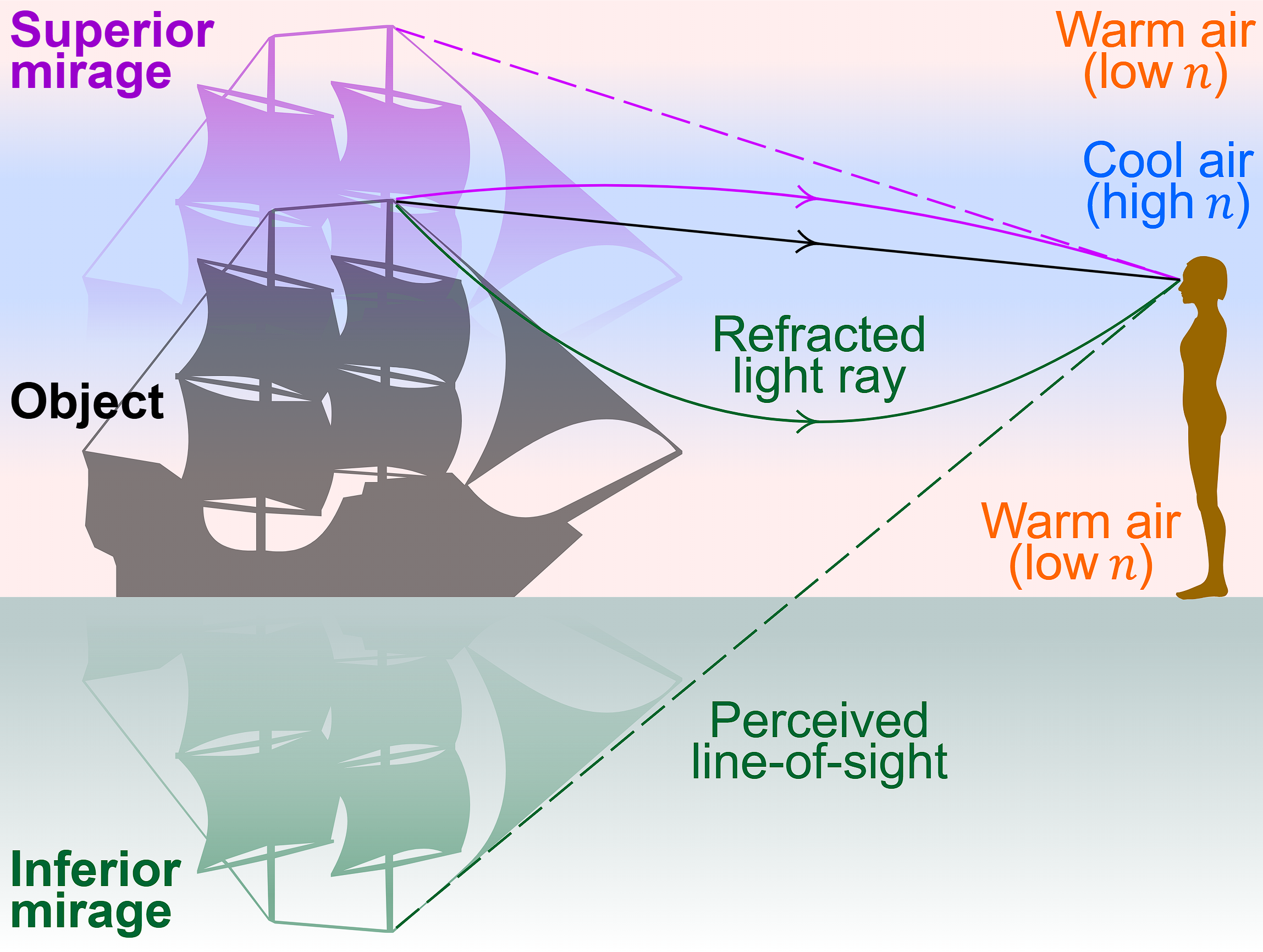
This diagram illustrates how light refraction through warm and cool air layers creates both superior and inferior mirages, explaining the atmospheric physics. By cmglee (talk · contribs), Antilived (talk · contribs), Jmarchn (talk · contribs) - Own workPirate ship.svgFemale shadow lateral.svg, CC BY-SA 4.0, https://commons.wikimedia.org/w/index.php?curid=155378786
Why thermal inversions drive superior mirages
While intense surface heat creates inferior mirages, completely different meteorological profiles generate superior mirages. A superior mirage displaces an image upward, making objects appear to float above their actual position or towering over the horizon. This requires a highly stable atmospheric condition known as a thermal inversion, where the standard temperature profile of the lower atmosphere is entirely reversed.
In a standard troposphere, air temperature drops steadily as altitude increases. During a thermal inversion, a layer of cold, dense air becomes trapped at the surface, sitting beneath a layer of warmer, less dense air aloft. Meteorological agencies routinely monitor these inversion layers using weather balloons equipped with radiosondes, tracking the exact altitude where the temperature flips. When light rays originating from an object near the surface travel upward into the warmer air, the change in density forces the light to bend downward, arching over the curvature of the Earth.
The mechanics of the Arctic mirage
Superior mirages are prevalent in polar regions or over cold ocean waters during spring and early summer. Because the cold air beneath warmer air distorts objects above the horizon, they can look stretched or floating (weather.com). For example, a ship or an iceberg physically positioned beyond the geometric horizon might become perfectly visible to an observer on the shore. The light reflecting off the ship curves downward over the ocean's surface, reaching an observer who would otherwise not be able to see it.

A superior mirage over cold water showing a ship appearing to float above the geometric horizon
The final visual outcome of an Arctic mirage depends entirely on the specific density gradient within the inversion layer. If the temperature increases gradually and evenly with height, the object simply appears elevated but structurally intact. However, if the gradient is uneven, the resulting image can be severely distorted. This can cause the object to appear stretched vertically, a phenomenon known as towering, or compressed vertically, known as stooping. These extreme temperature differences between frigid ocean currents and overlying warm air masses are the exact conditions that determine how does sea fog form in coastal maritime environments.
The Fata Morgana and historical maritime optical illusions
When atmospheric ducting becomes highly complex, with multiple alternating layers of warm and cold air, it produces the most spectacular and distorted type of superior mirage. This complex optical event is known as the Fata Morgana, named after the Arthurian sorceress Morgan le Fay because early observers believed the towering illusions were fairy castles built by magic to lure sailors to their deaths.
A Fata Morgana requires a stacked density profile that acts as a sophisticated, shifting atmospheric lens, bending light rays in multiple directions simultaneously. The science of refraction, atmospheric conditions, and different types of mirages like the Fata Morgana explains these dramatic visual shifts over open water (www.scienceofsurfing.com). A distant boat or section of coastline might appear duplicated several times over, with alternating upright and inverted images stacked vertically on top of one another. Because the atmosphere is in constant motion, these layers ripple and shift, causing the towering castles to rapidly morph, stretch, and collapse.

Comparison diagram showing the difference between superior and inferior mirages based on thermal inversions and hot surfaces
Mirage Type | Temperature Profile | Visual Displacement | Common Environment |
|---|---|---|---|
Inferior Mirage | Hot air below cooler air | Appears below actual object | Hot asphalt, desert sand |
Superior Mirage | Cold air below warmer air | Appears above actual object | Cold oceans, polar ice |
Fata Morgana | Alternating thermal layers | Stacked, rapidly changing | Straits, expansive cold water |
Historically, complex superior mirages were responsible for many famous maritime legends. The story of the Flying Dutchman, a ghost ship doomed to sail the oceans forever without making port, is widely attributed to early sailors observing a superior mirage of a real ship positioned just beyond the physical horizon. To the untrained eye of a 17th-century sailor, a ship appearing to hover upside down in the clouds was a terrifying supernatural event rather than a predictable result of physics. The atmosphere acts as a powerful invisible lens in many ways; similar refraction physics dictate why ice crystals bend light to create rings around the sun, a process you can learn about when exploring the 22-degree solar halo.
Distinguishing real water from mirage phenomena
One of the most persistent misconceptions about mirages is that they are tricks of the mind or stress-induced hallucinations brought on by dehydration in a harsh environment. The distinction between a psychological hallucination and a physical optical phenomenon is essential for educators looking for clear ways on how to explain mirages to students.
Is a mirage a real optical illusion?
Yes, a mirage is a genuine optical image, not a psychological hallucination. The light rays carrying the image of the sky or a distant ship actually arrive at the observer's location. A mirage is the result of light refraction in the atmosphere, creating the illusion by bending light rays towards the observer's eye (physicstuff.com). The optical physics are completely real; the "illusion" exists only in the brain's incorrect assumption that the incoming light travelled in a straight line from its origin. When your brain processes light entering your eye from the ground, it naturally assumes the source of that light is on the ground.
Can cameras capture a mirage?
Because a mirage is composed of real photons striking a surface, a camera lens captures the exact same optical data as the human eye. The word mirage comes from the Latin word mirari, meaning to look at, and it can be photographed like any other object (en.wikipedia.org). If you point a camera at a highway mirage, the digital sensor or film will record the refracted image of the sky appearing on the road, which may be upright or inverted depending on the temperature profile. The photographic evidence proves that the light bending is a physical event happening in the environment, entirely independent of human biology.
How these optical paths helps clarify many other atmospheric displays. The way light bends through changing densities applies equally to how high-altitude ice crystals generate Lunar and solar coronas, or why low-level moisture drops the temperature to the dew point when observing how does freezing fog form. The atmosphere continually manipulates the light passing through it, serving as a dynamic, layered lens that projects the natural world in fascinating ways.
Frequently asked questions
Mirages form when light rays bend as they pass through atmospheric layers with differing temperatures and densities. This phenomenon, known as refraction, displaces the image of an object. The common road mirage occurs when hot air near the ground bends light from the sky, creating a shimmering illusion of water.
Source: geo.libretexts.org
Further reading and resources
Explore trusted articles, books, videos and other resources to go deeper on this topic.
science.howstuffworks.comArticle
How Mirages Work
In-depth coverage on How Do Mirages Form? The Atmospheric Physics Explained from science.howstuffworks.com.
betterplaneteducation.org.ukArticle
Mirage - What is a Mirage?
In-depth coverage on How Do Mirages Form? The Atmospheric Physics Explained from betterplaneteducation.org.uk.
en.wikipedia.orgReference
Mirage
Background reference on How Do Mirages Form? The Atmospheric Physics Explained from en.wikipedia.org.
youtube.comVideo
What is a mirage? - YouTube
Video coverage on How Do Mirages Form? The Atmospheric Physics Explained from youtube.com.
scientificamerican.comArticle
What causes a mirage?
In-depth coverage on How Do Mirages Form? The Atmospheric Physics Explained from scientificamerican.com.
livescience.comArticle
How do mirages work? - Live Science
In-depth coverage on How Do Mirages Form? The Atmospheric Physics Explained from livescience.com.
Atmospheric refraction - Wikipedia
Background reference on How Do Mirages Form? The Atmospheric Physics Explained from en.wikipedia.org.
flexbooks.ck12.orgArticle
Atmospheric Refraction - Causes and Effects | CK-12 Foundation
In-depth coverage on How Do Mirages Form? The Atmospheric Physics Explained from flexbooks.ck12.org.
byjus.comArticle
Formation of Mirage
In-depth coverage on How Do Mirages Form? The Atmospheric Physics Explained from byjus.com.
hyperphysics.phy-astr.gsu.eduReference
Mirages and other atomospheric optic phenomena
Background reference on How Do Mirages Form? The Atmospheric Physics Explained from hyperphysics.phy-astr.gsu.edu.
Planning weeks ahead?
Check Australia's long-range seasonal outlook for rainfall, temperature and the climate drivers (ENSO, IOD, SAM, MJO) shaping the next three months.
View Australia's Seasonal Weather Forecast