
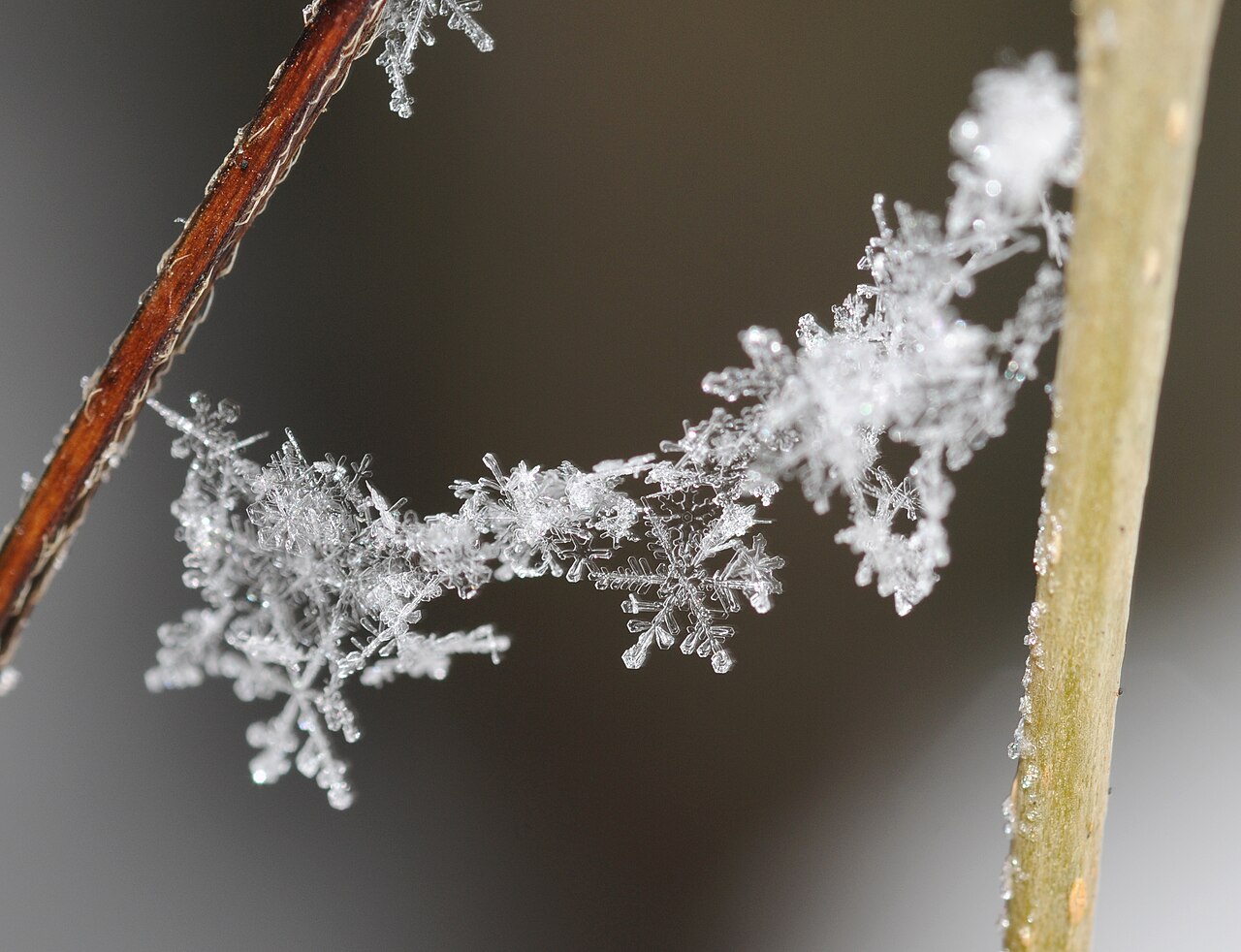
The process of how do snowflakes form begins when atmospheric water vapour freezes directly onto a microscopic dust or aerosol particle inside a cold cloud. This initial nucleation creates a tiny ice crystal that grows through deposition, developing detailed hexagonal symmetry as it falls through varying temperature and humidity layers.
Key takeaways
- Snowflakes do not start as raindrops; they grow directly from atmospheric water vapour transitioning into solid ice.
- The distinctive six-sided shape of a snow crystal is driven by the molecular arrangement of hydrogen bonds in frozen water.
- Specific combinations of cloud temperature and humidity determine whether a crystal will grow into a simple flat plate, a long column, or a branching star.
- Every snowflake takes a unique path through the atmosphere, ensuring no two detailed structures are ever exposed to the exact same environmental history.
- Australian alpine conditions frequently produce heavily aggregated wet snow because of maritime moisture and near-zero freezing levels.
How do snowflakes form: the molecular journey from nucleation to dendrite
The science of cloud microphysics shows that precipitation begins long before anything falls from the sky. For a snowflake to exist, a cloud must first possess the right ingredients. These include abundant atmospheric water vapour and temperatures that sit below the freezing point of water. However, clean water vapour in a completely pure atmosphere will not automatically freeze at 0°C. To initiate the freezing process, the vapour requires a microscopic solid foundation known as an ice nucleus.
The role of dust and aerosol particles
During the nucleation process, vapour attaches itself to tiny airborne particles. These nuclei can be specks of mineral dust lifted from arid plains, microscopic organic matter, or pollen grains caught in upward wind drafts. International meteorological agencies like the World Meteorological Organization track how global wind currents carry these aerosols across oceans. In the southern hemisphere, the high salt content in coastal air can affect ice crystal nucleation as strong weather systems sweep up from the Southern Ocean toward the Tasmanian Highlands. When the atmospheric water vapour makes contact with this suspended nucleus, it bypasses the liquid phase entirely and transforms straight into solid ice (news.wm.edu).
It is a common misconception that snow is simply rain that has frozen on the way down. The reality is quite different. Snow grows slowly in-cloud, and if cloud temperatures are below 0°C, ice crystals can form and fall as snow when the air below is also freezing or colder (www.nesdis.noaa.gov). When raindrops fall through a cold layer of air and freeze, they create sleet or ice pellets, which completely lack the complex structural geometry associated with true snow.
Deposition vs sublimation: the lifecycle of a snowball's core
Once the initial ice crystal forms, it enters a critical phase of growth. This growth relies on the phase changes of water, specifically the deposition process where a gas turns directly into a solid. Sublimation and deposition operate as opposing forces in the atmosphere. If the surrounding air is dry, sublimation strips molecules away from the ice crystal, causing it to shrink and lose its defined edges. When the air is highly saturated with moisture, deposition allows new water molecules to stack onto the growing seed, building the foundation of a mature snowflake.
The Bergeron-Findeisen process and atmospheric water vapour
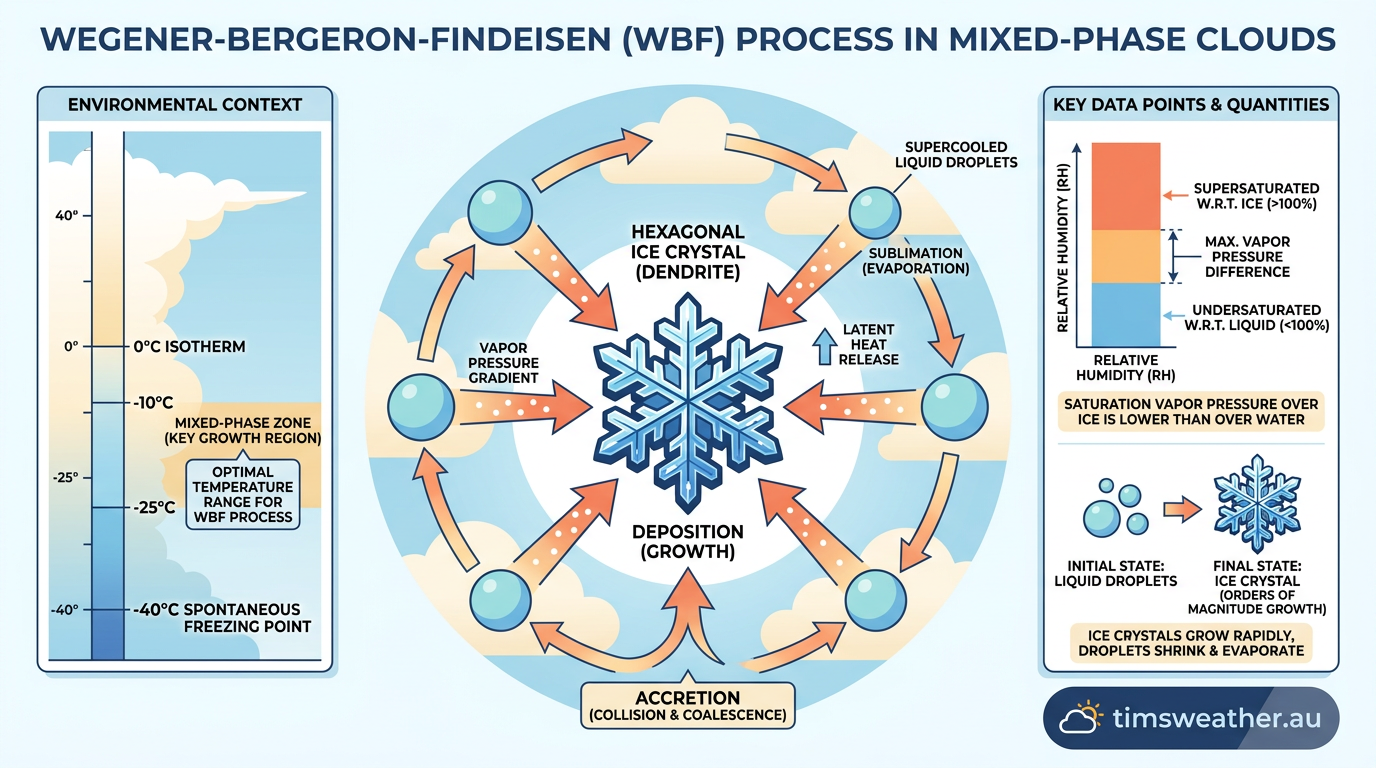
To understand how ice crystals form in clouds at a macro level, meteorologists look to the Bergeron-Findeisen process. This phenomenon occurs within mixed-phase clouds, which are common in deep winter weather systems. Inside these clouds, ice crystals and supercooled water droplets exist side by side.
Supercooled liquid water remains in a fluid state despite the ambient temperature being well below freezing. This happens because the droplets lack the necessary nucleation particles to trigger crystallisation. The classic growth mechanism in mixed-phase clouds relies on a specific thermodynamic rule. The vapour pressure over an ice surface is lower than the vapour pressure over a liquid water surface. This means that supercooled liquid droplets coexist with ice crystals, and vapour preferentially deposits on ice because ice has a lower vapour pressure than liquid water (www.nesdis.noaa.gov).
Vapour pressure deficits and cloud microphysics
As the liquid droplets slowly evaporate to balance the atmospheric pressure differences, the resulting water vapour immediately migrates toward the solid ice crystals. The ice feeds aggressively on the available moisture, growing larger and heavier. Over time, the balance inside the mixed-phase cloud shifts completely from liquid droplets to mature ice structures. Once these structures become too heavy for the internal cloud updrafts to support, gravity takes over and they begin their descent toward the surface.
Why snowflakes have a hexagonal lattice of frozen water
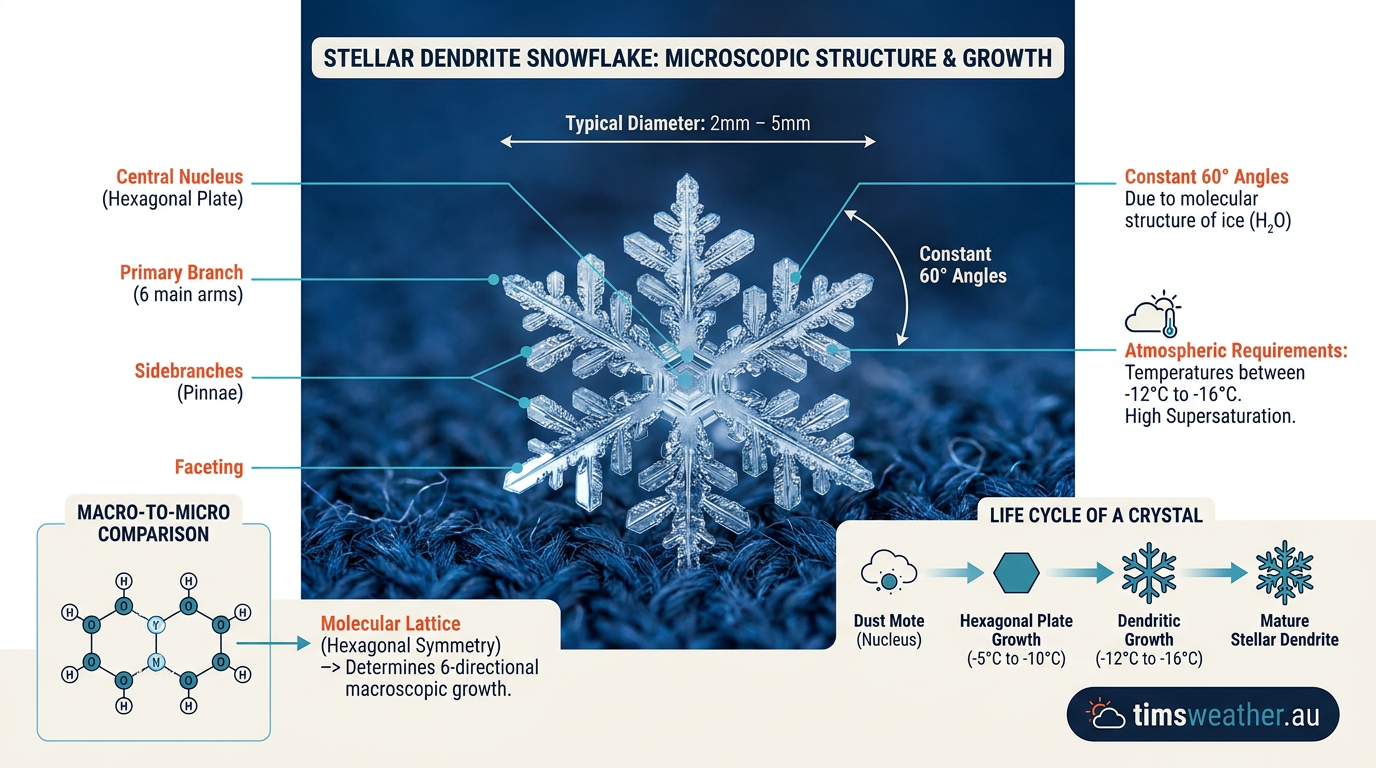
The molecular structure of a snowflake is entirely dictated by chemistry. A single water molecule consists of one oxygen atom bound to two hydrogen atoms. When water is in a liquid state, these molecules bounce around freely. As the temperature drops and the water freezes, the molecules slow down and link together through hydrogen bonding.
Hydrogen bonding in ice Ih structures
Because of the specific electrical charges on the oxygen and hydrogen atoms, they are forced to align in a pattern that maximises stability and minimises energy. This alignment creates a highly organised internal crystal lattice. Hexagonal symmetry is fundamental. The ice Ih lattice gives snow crystals sixfold symmetry, so many flakes develop six arms or facets (news.wm.edu). Snowflakes can grow sixfold-symmetric branches, but the internal chemistry prevents branches from growing at angles other than exactly 60 or 120 degrees.
The wider field of ice crystal science has spent decades mapping these precise molecular interactions. Research has shown how molecular diffusion at the edges of the crystal determines where the next water molecule will attach. The corners of the hexagon protrude slightly further into the surrounding humid air than the flat sides. Because they stick out further, these corners intercept moisture faster, prompting arms to sprout from the six points while the faces remain relatively flat.
The early photography of Wilson Bentley
Early visual proof of this rigid molecular geometry was captured by Wilson Bentley in the late nineteenth century. Using early photomicrography techniques, Bentley spent his life photographing snow crystals in freezing conditions outside his home in Vermont. Over his career, he documented over 5,000 unique patterns, providing the first widespread evidence of their complex six-sided symmetry (ssec.si.edu).
His massive catalogue of images allowed scientists to begin sorting snow shapes systematically. Bentley's observational work laid the physical foundation for what would eventually become the International Classification for Seasonal Snow on the Ground (ICSSG). Meteorologists, hydrologists, and avalanche forecasters use this precise classification system today to categorise snowpack structures and assess structural stability on mountain slopes.
How temperature gradients dictate hexagonal symmetry
While the molecular bonds enforce the six-sided rule, the actual shape the crystal takes is entirely dependent on its environment. The combination of ambient cloud temperature and supersaturation levels dictates whether the crystal will remain a simple prism or explode into a highly detailed star. This relationship was mapped comprehensively in the 1930s by Japanese physicist Ukichiro Nakaya, who created the first artificial snowflakes in a laboratory in Hokkaido.
The Nakaya Diagram in modern meteorology
The resulting Nakaya Diagram remains a cornerstone of meteorological science. Crystal habit depends strongly on temperature and supersaturation. At about -2 to -4°C and near -15°C, plate-like forms are favoured, while around -5 to -10°C and near -20°C, columnar or needle-like forms are more common, with dendrites often developing in the -12 to -16°C range under high supersaturation (earthsky.org).
| Temperature Range | Humidity Level | Resulting Crystal Shape | Common Aussie Alpine Example |
|---|---|---|---|
| 0°C to -4°C | Low to Moderate | Thin hexagonal plates | Mount Buller early winter |
| -4°C to -10°C | Moderate | Solid columns and hollow needles | Cradle Mountain blizzard |
| -10°C to -12°C | Low | Thick hexagonal plates | Thredbo summit overnight |
| -12°C to -16°C | High (Supersaturated) | Stellar dendrites (classic star shape) | Mount Kosciuszko deep freeze |
These distinct zones highlight how sensitive the formation process is. A crystal might begin growing as a flat plate at -3°C. If an atmospheric updraft pushes it higher into a colder region of -14°C with high humidity, branches will suddenly start shooting out from the corners of the plate. This alternating growth pattern creates the banding and detailed interior lines seen under a microscope.
What determines snowflake pattern complexity?
When asking why all snowflakes have different shapes, the answer lies in the turbulent journey from the cloud base to the surface. As a crystal falls, it is battered by changing wind currents, varying humidity bands, and different cloud layers. Individual flakes are rarely identical because each crystal experiences a unique history of temperature, humidity, turbulence, aggregation, riming, and partial melting as it descends (earthsky.org).
Riming and graupel formation
Two primary physical processes alter the crystal as it falls. The first is riming. If a snow crystal collides with supercooled liquid droplets on its way down, those droplets freeze instantly upon impact. This creates an opaque, frosty coating across the clean facets of the ice. If a crystal becomes heavily rimed as it passes through a wet cloud deck, it loses its delicate structure entirely and turns into a dense, white pellet called graupel.
The second process is aggregation, which occurs when multiple snow crystals collide and stick together. This is heavily dependent on surface temperatures. Key practical thresholds used in meteorology include cloud temperatures below 0°C for ice-crystal formation and surface or low-level temperatures near or below 0°C for snowfall to reach the ground without melting (www.nesdis.noaa.gov).
The role of Australian alpine conditions in crystal development
The type of snow that hits the ground in Australia often looks very different to the dry powder seen in high-altitude continental ranges in the Northern Hemisphere. This difference comes down to the temperature profile of the lower atmosphere.
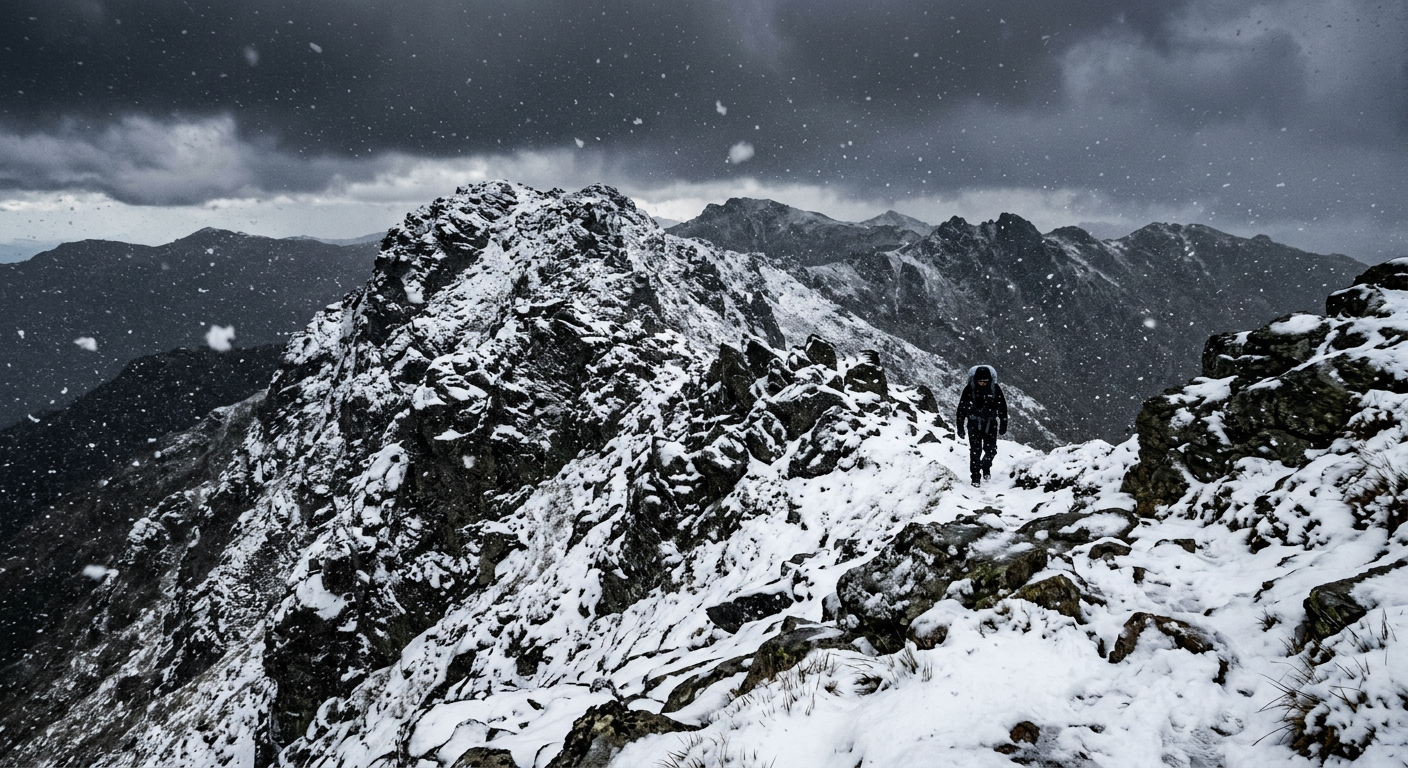
During winter, powerful cold fronts in Australia push across the Southern Ocean, gathering vast amounts of maritime moisture. The Southern Annular Mode frequently directs these westerly winds straight across the southern states. When these heavy, wet Australian air masses encounter the Great Dividing Range, the orographic lift forces the air upward into sub-zero temperatures. Bureau of Meteorology (BOM) data regularly shows that freezing levels during these storms often hover very close to the mountain peaks in the Snowy Mountains and the Australian Alps.
Because the air just above the surface is often hovering exactly around 0°C, the outer edge of the falling ice crystals begins to slightly melt. This surface water makes them incredibly sticky. As they tumble toward the Victorian Alps, they collide and bond together in massive clumps. This aggregation creates the heavy, moisture-laden wet snow that Australian skiers are familiar with. The result can range from simple plates and columns to dendrites, graupel, and heavily aggregated snowflakes, which is why "snowflake" is a general term for a range of ice-crystal forms rather than one single shape (news.wm.edu).
Faceting vs branching: the physics of the quasi-liquid layer
At the very edge of an ice crystal, where solid ice meets the open atmosphere, lies a microscopic region known as the quasi-liquid layer. Even at temperatures well below freezing, the outermost layer of water molecules behaves like a fluid. This layer is highly active and serves as the transit zone for new vapour molecules seeking a place to attach to the lattice.
Molecular diffusion rates at the crystal edge
Research led by physicist Kenneth Libbrecht at the California Institute of Technology has focused heavily on this boundary. By growing artificial snowflakes under strictly controlled laboratory conditions, meteorologists have mapped the exact physics of this quasi-liquid layer. The thickness of this layer responds dramatically to temperature changes, which directly drives the battle between faceting and branching.
Faceting is the process of building smooth, flat edges, creating simple plates and solid prisms. This happens when the quasi-liquid layer is relatively thick, allowing molecules to slide smoothly across the surface and fill in gaps. Branching occurs when the crystal grows aggressively at the corners, creating stellar dendrites.
When temperatures sit between -12 and -16°C, the quasi-liquid layer becomes exceptionally thin. This reduction forces incoming water vapour to stick exactly where it lands, which is usually on the sharpest points of the crystal. This drives explosive outward growth. It is within this narrow, bitterly cold atmospheric band that the most spectacular, complex, and highly branched star-shaped flakes are born.
Frequently asked questions
Snowflakes form when water vapour transforms directly into ice around microscopic particles like dust or pollen within cold clouds. This crystal grows as more vapour deposits onto its surface, particularly when the air is supersaturated. The process continues until the flake becomes heavy enough to fall through the atmosphere.
Source: nesdis.noaa.gov
Further reading and resources
Explore trusted articles, books, videos and other resources to go deeper on this topic.
its.caltech.eduReference
Frequently Asked Questions about Snow Crystals
Background reference on How Do Snowflakes Form? The Atmospheric Physics of Ice Crystals from its.caltech.edu.
scied.ucar.eduReference
Snowflakes - UCAR Center for Science Education
Background reference on How Do Snowflakes Form? The Atmospheric Physics of Ice Crystals from scied.ucar.edu.
washingtonpost.comArticle
How snowflakes get their intricate shapes
In-depth coverage on How Do Snowflakes Form? The Atmospheric Physics of Ice Crystals from washingtonpost.com.
physicstoday.aip.orgArticle
Snow and ice crystals
In-depth coverage on How Do Snowflakes Form? The Atmospheric Physics of Ice Crystals from physicstoday.aip.org.
earthsky.orgArticle
How snowflakes get their distinct and various shapes
In-depth coverage on How Do Snowflakes Form? The Atmospheric Physics of Ice Crystals from earthsky.org.
theconversation.comArticle
How is snow made? An atmospheric scientist describes ...
In-depth coverage on How Do Snowflakes Form? The Atmospheric Physics of Ice Crystals from theconversation.com.
youtube.comVideo
How Do Snowflakes Form?
Video coverage on How Do Snowflakes Form? The Atmospheric Physics of Ice Crystals from youtube.com.
en.wikipedia.orgReference
Snowflake
Background reference on How Do Snowflakes Form? The Atmospheric Physics of Ice Crystals from en.wikipedia.org.
nsidc.orgArticle
Snow is precipitation that forms when water vapor freezes. ...
In-depth coverage on How Do Snowflakes Form? The Atmospheric Physics of Ice Crystals from nsidc.org.
noaa.govReference
How do snowflakes form? Get the science behind snow
Background reference on How Do Snowflakes Form? The Atmospheric Physics of Ice Crystals from noaa.gov.
Planning weeks ahead?
Check Australia's long-range seasonal outlook for rainfall, temperature and the climate drivers (ENSO, IOD, SAM, MJO) shaping the next three months.
View Australia's Seasonal Weather Forecast