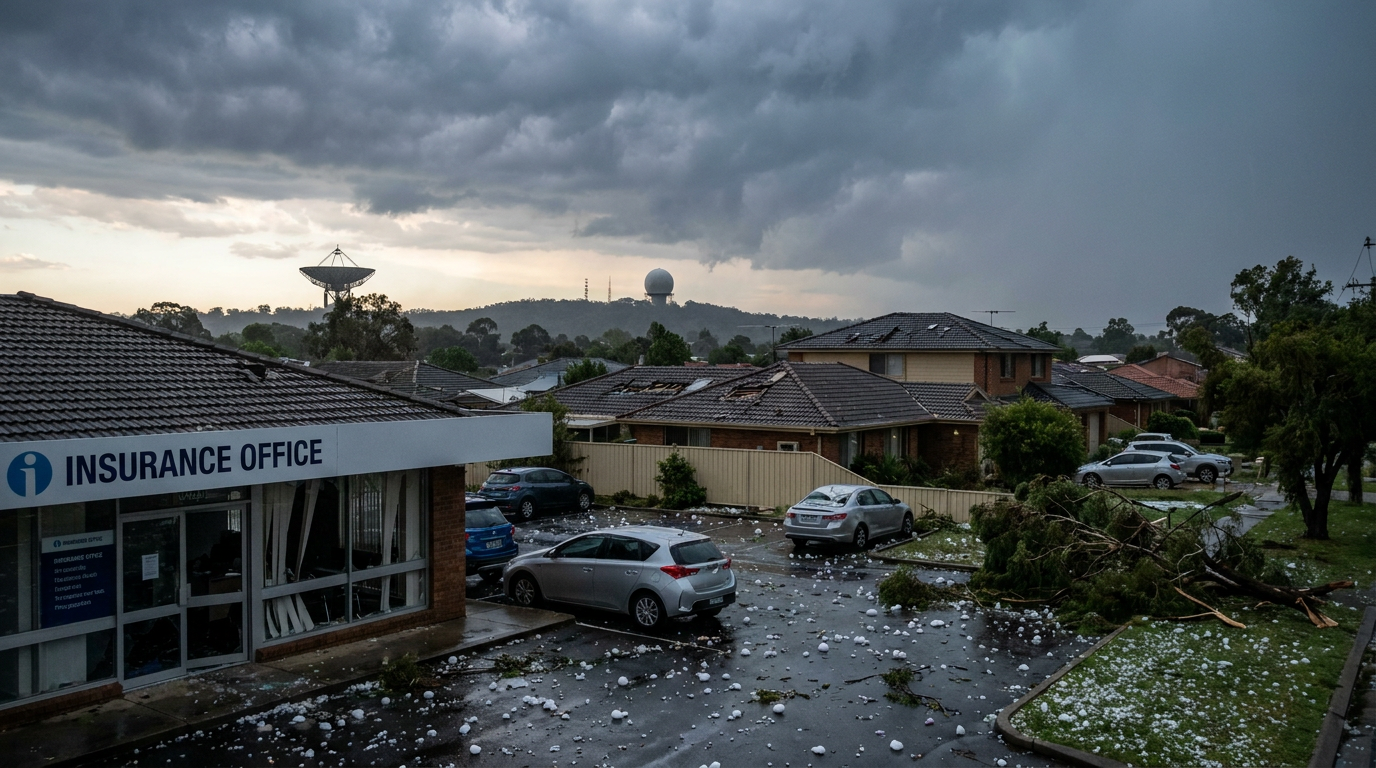
The most damaging hailstorms in Australian history are severe thunderstorms that hit built-up areas, where hail can smash roofs, cars and solar panels in minutes. The April 1999 Sydney hailstorm is widely treated as Australia’s costliest insured hail disaster, with major losses in inner and eastern Sydney and hailstones large enough to cause widespread roof damage.
Key takeaways
The 1999 Sydney hailstorm is commonly ranked as Australia’s costliest insured natural disaster, based on Australian dollar inflation-adjusted losses.
The Bureau of Meteorology (BOM) defines giant hail as hail bigger than 5 cm across.
Severe hail usually comes from supercell thunderstorms, where strong updrafts and high convective available potential energy (CAPE) help hail grow.
The Insurance Council of Australia (ICA) tracks catastrophe losses, which helps compare major hail events across decades.
If a severe thunderstorm warning is issued, move cars under cover and keep away from windows.
Most damaging hailstorms in Australian history: how the ranking works
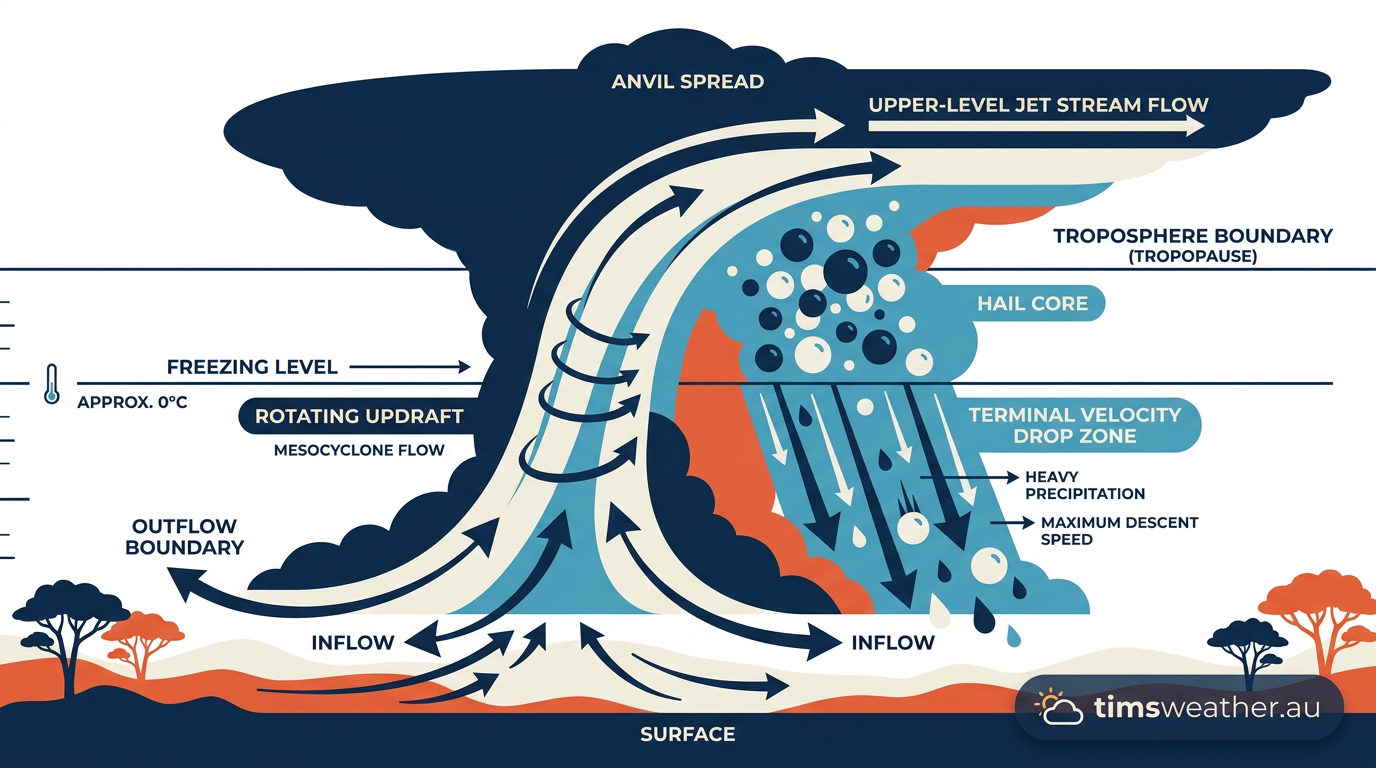
Diagram showing how giant hail forms inside an Australian supercell thunderstorm using strong vertical updrafts and supercooled water
This ranking is based on insured losses, not just hail size. That matters because a storm over central Sydney or Brisbane can cause far more damage than a bigger hail event over a sparsely populated area. The Insurance Council of Australia catastrophe list is the main reference for insured-loss comparisons, while BOM records help explain the storm setup.
When hail falls through a deep, windy thunderstorm, the supercell storm structure can keep the stones cycling through colder air. That is why a storm with strong CAPE and organised convective weather patterns can produce giant hail and heavy hailstone accumulation on roads and drains.
Most damaging hailstorms in Australian history, ranked
Exact rankings vary a little depending on whether the source uses insured loss, normalised loss, or total economic cost. Even so, the same events keep appearing near the top because they hit large urban areas and caused major insurance claims.
Struck inner, eastern and southern Sydney on the evening of 14 April 1999, with hailstones up to about 9 cm across. The Insurance Council of Australia lists roughly $1.7 billion in insured losses at the time (about $5.6 billion in today's values on ICA's normalised figures), damaging more than 20,000 homes and 40,000 vehicles. One person died from an associated lightning strike and around 50 were injured. The trigger was a slow-moving supercell that unexpectedly turned north-east into the city.
January 1985 Brisbane (The Gap) hailstorm
Hit Brisbane's western suburbs, particularly The Gap, on the afternoon of 18 January 1985 with cricket-ball-sized hail up to about 9–10 cm. Original insured losses were around $384 million (1985 dollars), which normalise to well over $2 billion in today's terms and make it one of the costliest Australian hail events on record. A severe supercell combined with strong CAPE and steep low-level shear produced widespread roof, window and vehicle damage across the western corridor.
November 2014 Brisbane hailstorm
A short, violent supercell tracked directly over the Brisbane CBD on the afternoon of 27 November 2014, with hail to about 8 cm and wind gusts above 140 km/h at the Brisbane Airport. The Insurance Council of Australia puts insured losses at roughly $1.35 billion, driven by damage to city high-rises, shopfronts and thousands of vehicles caught in peak-hour traffic. It is one of the most expensive natural disasters ever to hit Queensland's capital.
November 2020 South East Queensland events
A multi-day severe thunderstorm outbreak across late October and early November 2020 produced giant hail up to 14 cm near Springfield and Rocklea, some of the largest hailstones ever measured in Australia. The Insurance Council of Australia declared the sequence a catastrophe, with combined insured losses reported at around $1.05 billion across South East Queensland and northern NSW. Multiple supercells developed along a slow-moving trough with very high CAPE.
March 2010 Melbourne hailstorm
On the afternoon of 6 March 2010 a severe storm swept across the Melbourne metropolitan area, dropping hail up to 10 cm alongside torrential rain and flash flooding. The Insurance Council of Australia estimates insured losses of about $1.06 billion (later normalised well above that), affecting more than 100,000 homes and vehicles as well as major buildings including hospitals and the CBD rail network. The storm formed along a strong cold front interacting with a hot, moist airmass.
December 2018 Sydney and Central Coast hailstorm
Late on 20 December 2018 a supercell moved from the Southern Highlands into Sydney's northern and eastern suburbs and the Central Coast, producing hail commonly 5–8 cm across. The Insurance Council of Australia lists insured losses of around $1.25 billion, with more than 130,000 claims lodged and heavy damage to vehicles at dealerships, shopping-centre car parks and homes with skylights. It was one of the most damaging pre-Christmas storms Sydney has recorded.
January 2020 Canberra hailstorm
A short-lived but intense supercell crossed Canberra around the middle of 20 January 2020, producing hail up to about 6 cm that shattered car windscreens across the parliamentary triangle, damaged CSIRO glasshouses and injured wildlife. The Canberra event contributed a large share of the roughly $1.68 billion in insured losses from the wider January 2020 east-coast storm outbreak (which also hit Melbourne and Sydney), per the Insurance Council of Australia. The storm formed on the eastern side of an inland trough with strong deep-layer wind shear.
October 2021 Adelaide hailstorm
On 28 October 2021 a severe thunderstorm outbreak pushed across metropolitan Adelaide and parts of the Adelaide Hills, delivering hail up to about 8 cm together with damaging winds. The Insurance Council of Australia declared it an insurance catastrophe, with insured losses in the order of $780 million from vehicle, roof and solar-panel damage. Cold mid-level air over a warm, moist boundary layer created the deep instability and shear needed for organised supercells.
If you want a simple rule, it is this: the worst hailstorms are usually the ones that combine giant hail, a dense city, and a slow-moving supercell.
Why the 1999 Sydney hailstorm still stands out
The April 1999 Sydney hailstorm remains the benchmark for hail damage in Australia. The event struck inner, eastern, and southern Sydney, caused one fatality (from a lightning strike) and 50 injuries, and produced about $1.7 billion in insurance costs, with normalised losses of $4.3 billion in 2011 values according to the Insurance Council of Australia (cited by the Australian Disaster Resilience Knowledge Hub). It also affected more than 20,000 homes and 40,000 cars.
That storm mattered because it hit a densely populated city in the late afternoon, when roads, workplaces and homes were full. Hailstones reached cricket-ball size, and the damage pattern showed how quickly a single supercell can turn into a city-wide insurance event.
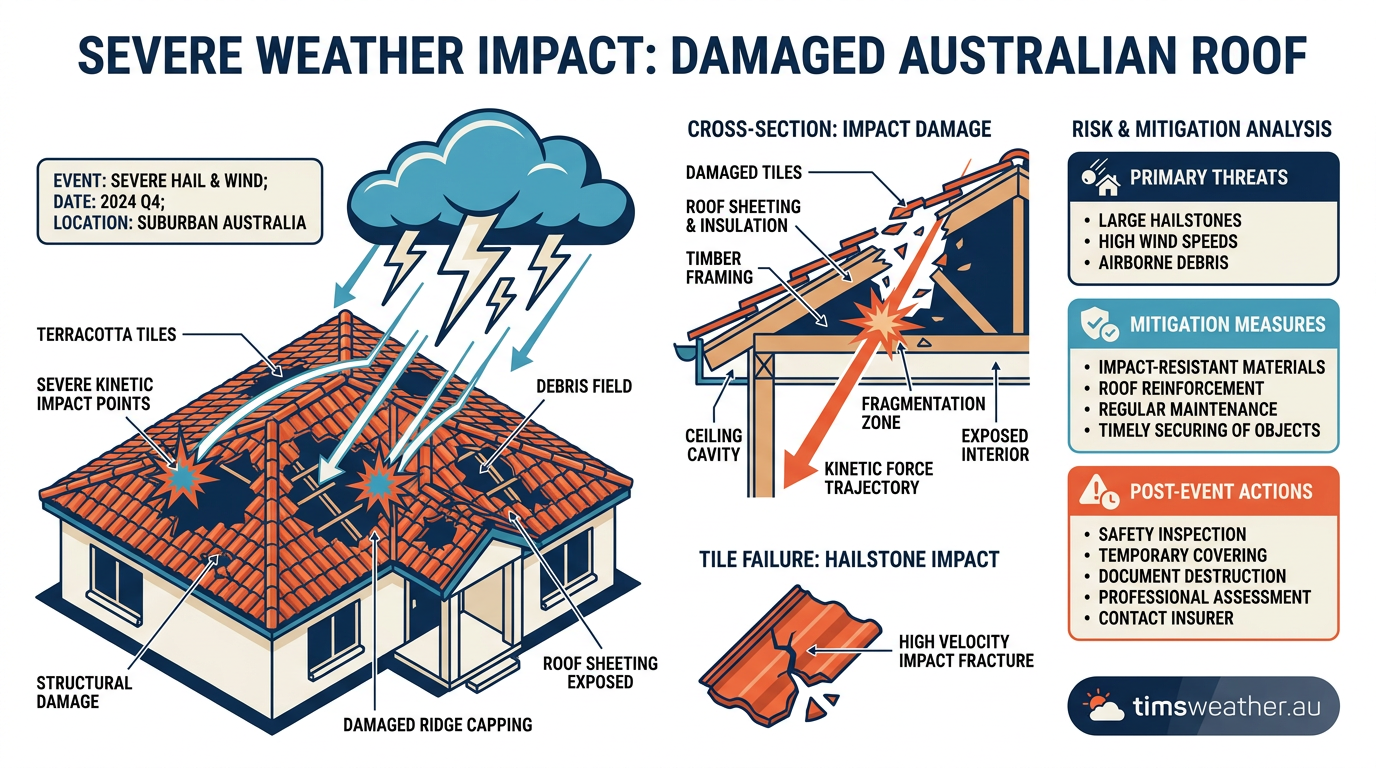
Damaged Australian roof after a severe hailstorm
Other major hail events that belong on the list
The January 1985 Brisbane (The Gap) hailstorm is another key event in Australian hail history. Major losses/damage in Brisbane and large hailstones.
The November 2014 Brisbane hailstorm and the November 2020 South East Queensland events also belong in any discussion of damaging hail in Australia. Both are tied to strong thunderstorm outbreaks over a large urban corridor, where hail, wind and flash flooding can combine to lift insured losses quickly.
Other events often discussed in the same context include the March 2010 Melbourne hailstorm, the October 2021 Adelaide hailstorm, the January 2020 Canberra hailstorm, and the December 2018 Sydney and Central Coast storm. These events show the same basic pattern: a strong storm line or supercell, large hail, and a city full of exposed cars and roofs.
How hail becomes so damaging
Hail damage depends on storm strength, storm motion and what sits under the storm. A storm with strong updrafts can keep hailstones aloft long enough for repeated ice growth. If the storm also moves slowly or sits over a city, the damage footprint becomes much larger.
That is why the biggest losses often come from storms that combine large hailstones, heavy rain, and strong wind gusts. In a city, that mix can damage roofs, break skylights, block drains and trigger local flooding at the same time.
What matters | Why it raises damage |
|---|---|
Giant hail diameter | Hail bigger than 5 cm can break glass, dent metal and crack tiles. |
Supercell storm structure | Strong, rotating storms can grow hail for longer. |
Urban exposure | More homes, cars and businesses mean higher insured losses. |
Hailstone accumulation | Deep piles of hail can block drains and add to flooding. |
Warning lead time | A clear severe thunderstorm warning gives people time to protect property. |
What the science says about future hail risk
Recent UNSW research suggests hailstorms may become more frequent and more severe in major Australian cities as temperatures rise. The study points to a greater risk of larger hailstones in cities including Sydney, Canberra, Melbourne and Perth. That does not mean every summer will be worse, but it does suggest the hail risk profile is shifting.
For readers, the practical message is simple. Watch BOM warnings, park under cover when storms approach, and keep an eye on radar if you are in a known hail corridor.
Related guides
Frequently asked questions
Assessing which hailstorms are most damaging is subjective and depends on diverse perspectives, such as insured losses versus total economic impact. Generally, the most destructive events involve giant hail hitting densely populated urban areas, leading to significant claims for damaged vehicles, smashed roofs, and solar panel destruction across suburbs.
Source: insurancecouncil.com.au
Planning weeks ahead?
Check Australia's long-range seasonal outlook for rainfall, temperature and the climate drivers (ENSO, IOD, SAM, MJO) shaping the next three months.
View Australia's Seasonal Weather Forecast